Creator-commerce platform ShopMy de facto runs an affiliate network, joining a variety of incumbents who have operated in this space for literally decades. Merchants considering running two or more affiliate programs face an obvious risk of double-paying or, if they try to de-duplicate, paying the wrong commission. I was shocked to recently discover ShopMy’s recommendation to merchants in this regard:
We recommend deduplicating ShopMy orders against your affiliate network, and canceling duplicates within the affiliate network, not ShopMy. Since ShopMy provides a more direct brand-to-creator connection, this approach helps preserve creator relationships and campaign performance.
Source as preserved by archive.org and in screenshot.
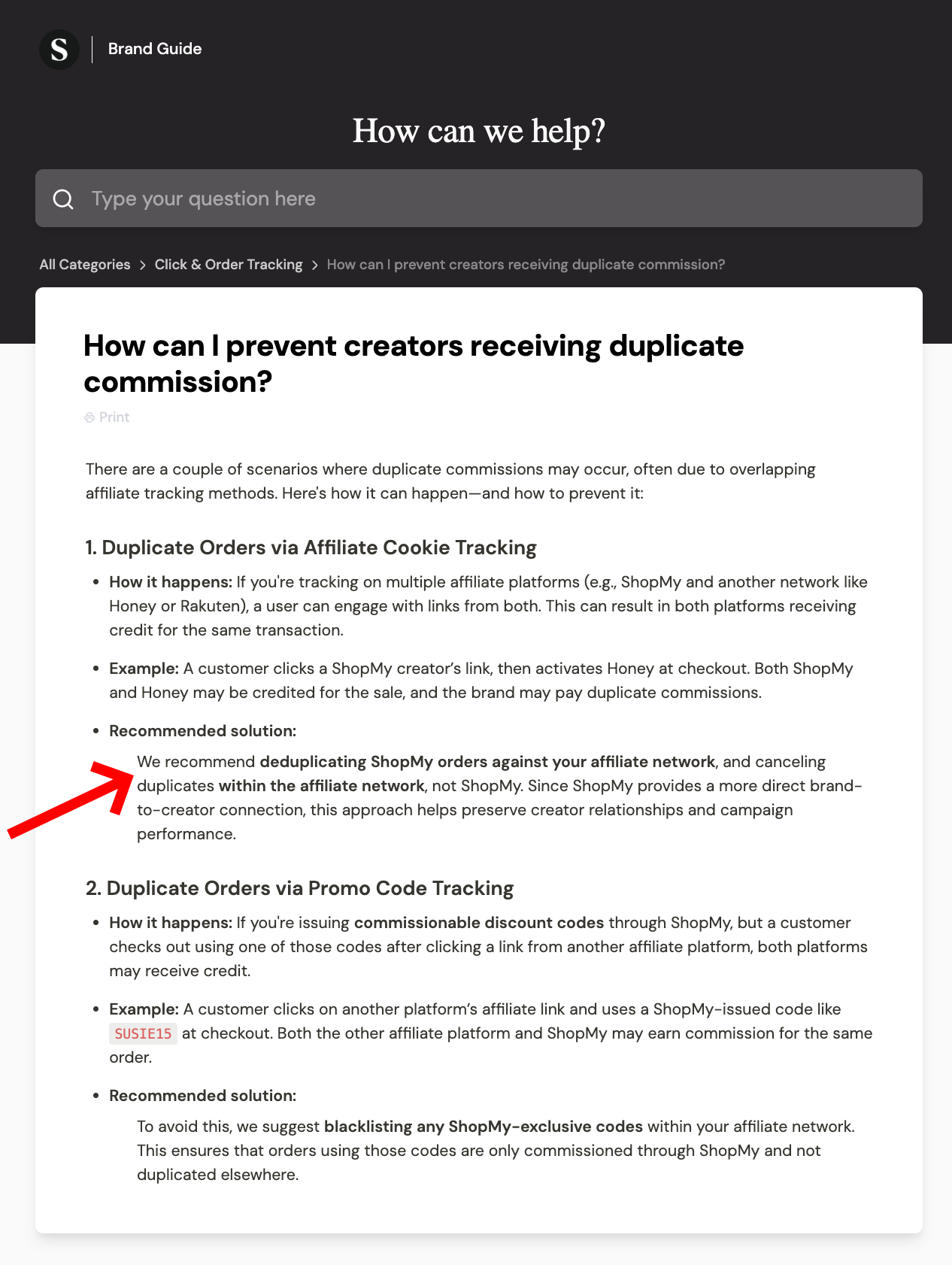
Notably, ShopMy doesn’t say its affiliate should get the commission because it was the one that closed the sale. (That line of reasoning could equally conclude that the other affiliate should get paid!) Nor does ShopMy cite any contractual basis for favoring its affiliates and penalizing those on other networks. (Nor could it. More on contract terms below.)
In encouraging merchants to open a ShopMy affiliate program alongside other affiliate programs, ShopMy creates significant complexity. In principle merchants can filter transactions to avoid paying two commissions on a single purchase, but I see little evidence of merchants actually doing so. And if merchants follow ShopMy’s recommendation to cancel non-ShopMy affiliate commissions, the non-ShopMy affiliates lose commissions for no good reason and without basis in contract.
I often feel affiliate marketing runs on equal parts trust and optimism. Commissions get lost when users don’t click (a growing risk with AI!), user devices don’t retain and provide the cookies that indicate who referred the sale (which many block in the name of privacy), or client-side software overrides a referral (as Honey did when it thought no one was looking, and Edge and Phia too). ShopMy’s guidance to merchants reveals a new impediment: Even when everything else works properly, a merchant may cancel another affiliate’s commission in order to pay a ShopMy affiliate instead.
How merchants find themselves in this mess
One might ask how a merchant could be asked to pay both ShopMy and another affiliate on a single purchase. After all, affiliate networks widely operate on a last-click basis: The last affiliate link clicked is supposed to get the entire affiliate payment, so network tracking assures that a merchant is never asked to pay more than one affiliate for a single purchase.
But network tracking logic doesn’t help when a merchant operates two or more affiliate programs. And while ShopMy calls itself a creator network, ShopMy’s “brand partner” program is, in substance, an affiliate network. When a merchant joins ShopMy as a brand partner, and also uses a traditional affiliate network, it ends up with some affiliates in each program. By default, each affiliate program will credit whichever of its affiliates had the last click. If a merchant reports each purchase to each network—the default integration on Shopify and other platforms—then multiple networks can get paid on a single purchase.
Having created multiple affiliate programs, merchants face surprisingly unpalatable options when multiple networks appear to have referred a single purchase. Let’s work through the possibilities.
Option 1: Double-pay. Easy, but expensive for merchants. Plus it distorts competition to favor small networks.
For most merchants, the default is to pay both networks. This is particularly easy because it requires no special action—just accept each network’s statements about the transactions it delivered and the amount its affiliates should be paid. If a merchant is too trusting, or just doesn’t realize the problem, double payments are the likely result.
At first glance, double payments may sound like a win—that much more money for affiliates. But for most merchants, there’s just not enough margin to pay two affiliates on a single sale—think two 15% commissions, plus two network fees, then COGS, overhead, shipping, and all the rest, collectively leaving a negative margin for the merchant. Merchants rightly grumble about high marketing costs—why the efficiencies of digital marketing don’t drop to their bottom line. Paying two affiliates on a single sale is probably both unintentional and unsustainable.
Double-paying also distorts competition. Suppose a merchant is a ShopMy brand partner, and, say, an Impact merchant. Consider what happens for a user who follows many creators, and clicks many links, before deciding to purchase. All the Impact affiliates effectively share the one Impact commission (allocating it to whichever of them is last), and all the ShopMy affiliates share one ShopMy commission (again, whichever is last). If ShopMy’s network is smaller than Impact’s—and ShopMy is much newer, so bound to start smaller—any individual affiliate will see a higher measured conversion rate from ShopMy, concluding that ShopMy just performs better. In contrast, if the merchant correctly de-duplicated the purchases, affiliates would be unlikely to see a difference in conversion rate when changing from one network to the other. Thus a merchant’s failure to de-duplicate transactions distorts competition in favor of whichever network is smaller—a weird incentive which merchants surely did not intend.
Option 2: Honor last-click. Fair in principle, but can merchants get there?
Ideally, a merchant would honor last click: sequence all affiliate clicks to find the last one before the purchase. The problem is that neither network typically knows about the clicks through another network, so each can report its last click as basis for payment. The burden is on the merchant to figure out who really deserves to be paid.
A sophisticated merchant can build or buy automation to implement a last-click rule that spans affiliate networks, reporting a sale only to the network that actually sent the last click. Large merchants often build this capability. Others buy it—historically, calling it “selective pixel firing” though these days more often “conditional triggering.” That said, automation may be out of reach for the midsized merchants most common in ShopMy. Running on Shopify, with modest technical staff, most merchants would struggle to implement a full multi-network solution.
Alternatively, merchants could filter transactions by hand, probably canceling all conversions not associated with the last click before purchase. But this requires combining data from multiple sources (purchases plus each network’s timestamped clicks). It’s painstaking and error-prone.
Option 3: Reverse payment to the non-ShopMy affiliate. Easy, but gives ShopMy an arbitrary advantage, and may violate other networks’ rules.
Finally, merchants may follow ShopMy’s recommendation to cancel payment to the non-ShopMy affiliate and pay the ShopMy affiliate. But this raises several problems. One, contracts limit the reasons why merchants can withhold commissions (details below), and this isn’t obviously compliant.
Two, there’s no business justification or logical principle for always prioritizing ShopMy affiliates. ShopMy says its affiliates should be favored because they supposedly have a “more direct brand-to-creator connection.” But both ShopMy and affiliate networks have a single intermediary between merchant and affiliate.
Three, ShopMy’s recommendation distorts competition. The more often payments through other networks are canceled, the less reliable those networks look to affiliates. Meanwhile ShopMy will have no such weakness. Notably, affiliates will not routinely learn the reason for a reversal—will not learn that commission was reversed because ShopMy so instructed.
Tabulating merchant approaches
I assembled a list of ShopMy “brand partner” merchants known to also operate programs on other affiliate networks. I’m gathering information about each merchant’s approach—which hodouble-paid, which implemented last-click logic with automation or by hand, which canceled non-ShopMy payments as ShopMy recommended. Anyone with information to share can submit through the links on my merchant list. I’ll update the list as submissions arrive, and post reflections periodically.
I found 527 ShopMy “brand partner” merchants potentially affected. ShopMy reports $200 million per month of user purchases, >$2B per year. At 15% commission, that’s >$300 million per year of commissions to ShopMy affiliates. If just 10% of sales were double-paid or paid to the wrong affiliate, this is an eight-figure issue.
My tabulation indicates problems are spread across affiliate networks. I found 173 Impact merchants potentially affected, 163 on Awin, and 101 on Rakuten. See tabulation by network.
A solution in search of a problem?
In proposing a multi-network model, ShopMy is breaking something that had been working fine, and the burden is on ShopMy to establish that its path is an improvement. If a merchant simply kept ShopMy in its existing affiliate network, as some have done but ShopMy tries to discourage, there would be no risk of double-paying and no problem of incorrect reversals.
ShopMy lists four benefits of its “brand partner” relationships with merchants, circumventing affiliate networks:
1) “higher, more competitive commission rates”
2) “additional benefits such as custom commission codes, gifted product, and flat-fee opportunities”
3) “Brand partners can fully track the impact of the creator’s content, seeing real-time performance data and the sales they drive directly through ShopMy,”
4) “occasional challenges that can arise beyond our control, such as commission changes or earning restrictions”.
Benefits 2 and 3 could equally be offered with an affiliate network performing tracking.
Perhaps an affiliate network’s fee leaves less for affiliates, meaning that skipping the network allows higher commissions (benefit 1). But skipping the network risks double commissions (not to mention the hassle of figuring out who really earned a commission, and possible expense in additional software to automate that determination), so savings are very much uncertain.
Supposed benefit 4 rings particularly hollow—it sounds more like ShopMy bemoaning merchants occasionally reversing sales, which could be improper but could also be for good cause. (What if merchants realized that the non-ShopMy affiliate was actually last, so last-click rules called for it to be paid and ShopMy not?!) ShopMy understandably wants to control its destiny and reduce dependence on factors outside its control, but merchants are equally entitled to limit their spending. Having told merchants to cancel payments through other networks, there’s considerable irony in ShopMy bemoaning cancellation of its payments.
Reviewing contracts from major affiliate networks and merchants, I found none that permit a merchant to cancel a commission so that it can pay ShopMy when the other network’s click came last. To the contrary, networks routinely limit when and why cancellations can be reversed. Impact’s Master Campaign Agreement is instructive, at section “Chargebacks” listing five specific scenarios in which commissions may be reversed—but none of them applying to merchants wishing to reverse an Impact affiliate’s earnings because ShopMy had previously referred that same affiliate.
So too for Rakuten, where affiliate network policies note that “commission determinations remain subject to validation and are final in accordance with the applicable Offer terms and the Publisher Membership Agreement”—but nothing in those documents calls for canceling Rakuten affiliate commissions based on an earlier ShopMy click.
Similarly, Awin’s advertiser terms (rule 7.6) allow merchants to cancel transactions only based on breach of T&Cs or publisher fraud. But neither scenario applies to affiliates who did everything right and whose transactions would be reversed solely because ShopMy had a prior click.
All of this is as you’d expect. Other affiliate networks want their affiliates to get paid for the valid leads they provided. Affiliate networks have every incentive not to let ShopMy instruct merchants to cancel their commissions.
Reflections
Clearly merchants should stop canceling commissions through other platforms on the misguided assumption that ShopMy always deserves payment. ShopMy should never again give merchants such an instruction, and should apologize for having given an instruction that was self-serving and unfair.
Then there’s the matter of clean-up. All commissions improperly canceled should be restored to the affiliates that fairly earned them. Affiliate networks know the timing of the last click before the purchase. If the other affiliate network’s click was later than the ShopMy click, that network’s affiliate should be paid. If payment is months overdue, I’d add interest and ideally a bonus for the hassle and delay. And ShopMy—not merchants, not networks—should cover the cost of investigation and clean-up.
A merchant might want to reclaim funds paid to ShopMy in error—all the more if ShopMy incorrectly claimed to be entitled to payment when by contract it was not. ShopMy might say it’s too late for a refund because ShopMy long ago paid its affiliates. But if ShopMy instructed a merchant to improperly withhold payment from another affiliate—it should be ShopMy, not the merchant, that bears the loss.
Instructing merchants to cancel other networks’ commissions could also inflate ShopMy’s position in the marketplace. Affiliates, merchants, investors, and the interested public all saw ShopMy’s rapid rise and sought to get on board. But some transactions attributed to ShopMy were actually generated through other channels—meaning growth was actually slower than everyone perceived.
Finally, any merchant that has been paying duplicate commissions on a single purchase should probably revisit its approach. Whatever the case for a single merchant with multiple affiliate programs, the case does not include merchants paying multiple commissions on one purchase.