Advertising Through Spyware — After Promising To Stop

On January 29, the New York Attorney General announced an important step in the fight against spyware: Holding advertisers accountable for their payments to spyware vendors. This is a principle I’ve long endorsed — beginning with my 2003 listing of Gator advertisers (then including Apple, Chrysler, and Orbitz), and continuing in my more recent articles about advertising intermediaries funding spyware and specific companies advertising through spyware.

I’m not the only one to applaud this approach. FTC Commissioner Leibowitz recently commended the NYAG’s settlement, explaining that “advertising dollars fuel the demand side of the nuisance adware problem by giving [adware vendors] the incentive to expand their installed base, with or without consumers’ consent.” In a pair of 2006 reports, the Center for Democracy and Technology also investigated spyware advertisers, attempting to expose the web of relationships that fund spyware vendors.

The NYAG’s settlement offers a major step forward in stopping spyware because it marks the first legally binding obligation that certain advertisers keep their ads (and their ad budgets) out of spyware. In Assurances of Discontinuance, Cingular (now part of AT&T), Priceline, and Travelocity each agreed to cease use of spyware. In particular, each company agreed either to stop using spyware advertising, or to use only “adware” that provides appropriate disclosures to users, prominently labels ads, and offers an easy procedure to uninstall. These requirements apply to ads purchased directly by Cingular, Priceline, and Travelocity, as well as to all marketing partners acting on their behalf.

These important promises are the first legally-binding obligations, from any Internet advertisers, to restrict use of spyware. (Compare, e.g., advertisers voluntarily announcing an intention to cease spyware advertising — admirable but not legally binding.) If followed, these promises would keep the Cingular, Priceline, and Travelocity ad budgets away from spyware vendors — reducing the economic incentive to make and distribute spyware.

But despite their duties to the NYAG, both Cingular and Travelocity have failed to sever their ties with spyware vendors. As shown in the six examples below, Cingular and Travelocity continue to receive spyware-originating traffic, including traffic from some of the web’s most notorious and most widespread spyware, in direct violation of their respective Assurances of Discontinuance. That said, Priceline seems to have succeeded in substantially reducing these relationships — suggesting that Cingular and Travelocity could do better if they put forth appropriate effort.

Example 1: Fullcontext, Yieldx (Admedian), Icon Media (Vizi) Injecting Travelocity Ad Into Google

A Travelocity Ad Injected into Google by Fullcontext A Travelocity Ad Injected into Google by Fullcontext

Travelocity
money viewers
   Icon (Vizi Media)    
money viewers
   Yieldx (Ad|Median)    
money viewers
Fullcontext

The Money Trail – How Travelocity Pays Fullcontext

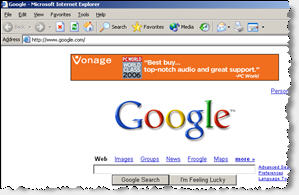
On a PC with Fullcontext spyware installed (controlling server 64.40.99.166), I requested www.google.com. In testing of February 13, I received the image shown in the thumbnail at right — with a large 728×90 pixel banner ad appearing above the Google site. Google does not sell this advertising placement to any advertiser for any price. But Fullcontext spyware placed Travelocity’s ad there nonetheless — without permission from Google, and without payment to Google.

As shown in the video I preserved, clicking the ad takes users through to the Travelocity site. The full list of URLs associated with this ad placement:

http://64.40.99.166/adrotate.php
http://ad.yieldx.com/imp?z=6&Z=728×90&s=41637&u=http%3A%2F%2Fwww.google.com…
http://ad.yieldmanager.com/imp?z=6&Z=728×90&s=41637&u=http%3A%2F%2Fwww.goog…
http://ad.yieldx.com/iframe3?jwIAAKWiAABdAwIA5soAAAAAxAEAAAAACwADBAAABgMKxQ…
http://ad.yieldmanager.com/iframe3?jwIAAKWiAABdAwIA5soAAAAAxAEAAAAACwADBAAA…
http://network.realmedia.com/RealMedia/ads/adstream_sx.ads/iconmedianetwork…
http://network.realmedia.com/RealMedia/ads/click_lx.ads/iconmedianetworks/e…
http://clk.atdmt.com/AST/go/247mancr0020000002ast/direct;at.astncr00000121;…
http://leisure.travelocity.com/RealDeals/Details/0,2941,TRAVELOCITY_CRU_354…

As shown in the URL log and packet log, Fullcontext initiated the ad placement by sending traffic to the Yieldx ad network. (Yieldx’s Whois reports an address in Hong Kong. But Yieldx is hosted at an IP block registered to Ad|Median, an ad network with headquarters near Minneapolis.) Using the Right Media Exchange marketplace (yieldmanager.com), Yieldx/Ad|Median then sold the traffic to Icon Media Networks (now Vizi Media of LA and New York), which placed the Travelocity ad. The diagram at right depicts the chain of relationships.

This placement is typical of the Fullcontext injector. I have tracked numerous Fullcontext placements, through multiple controlling servers. I retain many dozens of examples on file. See also prior examples posted to my public site: 1, 2, 3.

The Fullcontext injector falls far short of the requirements of Travelocity’s Assurance of Discontinuance. For one, users often receive Fullcontext without agreeing to install it — through exploits and in undisclosed bundles (violating Travelocity Assurance page 4, provision 11.a; PDF page 11). Furthermore, Fullcontext’s ads lack any branding indicating what adware program delivered them — violating Assurance provision 11.b, which requires such branding to appear prominently on each adware advertisement. Fullcontext’s uninstall and legacy user functions also fail to meet the requirements set out in the Assurance.

Example 2: Fullcontext and Motive Interactive Injecting Cingular Ad Into Google

A CingularAd Injected into Google by Fullcontext A Cingular Ad Injected into Google by Fullcontext

Cingular
money viewers
   Motive Interactive   
money viewers
Fullcontext

The Money Trail – How Cingular Pays Fullcontext

Through the MovieInteractive ad network, Fullcontext also injects the Cingular ad into Google. See screenshot at right, taken on February 17. On a PC with Fullcontext spyware installed (controlling server 64.40.99.166), I requested www.google.com. I received the image shown in the thumbnail at right — with a prominent Cingular banner ad appearing above Google. As in the case of Travelocity, this ad appeared without permission from Google and without payment to Google. Rather, the ad was placed into Google’s site by Fullcontext spyware.

The full list of URLs associated with this ad placement:

http://64.40.99.166/adrotate.php
http://ad.motiveinteractive.com/imp?z=6&Z=728×90&s=161838&u=http%3A%2F%2Fwww.goo…
http://ad.yieldmanager.com/imp?z=6&Z=728×90&s=161838&u=http%3A%2F%2Fwww.google.c…
http://ad.motiveinteractive.com/iframe3?jwIAAC54AgD5QwMAtVQBAAIAZAAAAP8AAAAHEQAA…
http://ad.yieldmanager.com/iframe3?jwIAAC54AgD5QwMAtVQBAAIAZAAAAP8AAAAHEQAABgTud…
http://clk.atdmt.com/goiframe/21400598/rghtccin0470000088cnt/direct;wi.728;hi.90…
http://www.cingular.com/cell-phone-service/cell-phone-details/?q_list=true&q_pho…

As shown in the URL log and packet log, Fullcontext sent traffic to Motive Interactive, a Nevada ad network. Using the Right Media Exchange marketplace (yieldmanager.com), Motive Interactive sold the traffic to Cingular. The diagram at right depicts the chain of relationships. Notice that Cingular’s relationship with Fullcontext is one level shorter than the Travelocity relationship in Example 1.

Cingular should have known that this traffic was coming from spyware, because detailed information about the ad placement was sent to Cingular’s web servers whenever a user clicked a FullContext-placed ad. The packet log shows the information sent to the Atlas servers operating on Cingular’s behalf:

http://view.atdmt.com/CNT/iview/rghtccin0470000088cnt/direct;wi.728;hi.90/01?click=http:// ad.motiveinteractive.com/click,jwIAAC54AgD5QwMAtVQBAAIAZAAAAP8AAAAHEQAABgTudAIAmUcCAPqaAAC
iJAIAAAAAAAAAAAAAAAAAAAAAAKdz10UAAAAA,,http%3A%2F%2Fwww%2Egoogle%2Ecom%2F,

The first portion of the URL specifies what ad is to be shown, while the portion following the question mark reports how traffic purportedly reached this ad. (This information structure is standard for Right Media placements.) Notice the green highlighted text — telling Atlas (and in turn Cingular) that this ad was purportedly shown at www.google.com. But Atlas and Cingular should know that the www.google.com page does not sell banner ads to any advertiser at any price. The purported placement is therefore impossible — unless the ad was actually injected into Google’s site using spyware. The presence of this Google URL in Cingular’s referer log should have raised alarms at Cingular and should have prompted further investigation.

Example 3: Deskwizz/Searchingbooth and Ad-Flow (Rydium) Injecting Travelocity Ad Into True.com

A Travelocity Ad Injected into True.com by Searchingbooth A Travelocity Ad Injected into True.com by Searchingbooth

Travelocity
money viewers
   Ad-Flow (Rydium)  
money viewers
Deskwizz/Searchingbooth

The Money Trail – How Travelocity Pays Searchingbooth

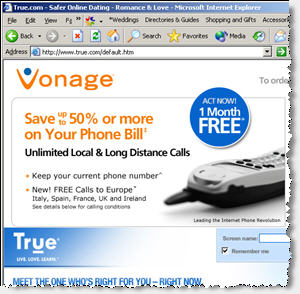
Fullcontext is just one of several active ad injectors that place ads into other companies’ sites. The screenshot at right shows a injection performed by Deskwizz/Searchingbooth. In March 9 testing, I requested True.com. Deskwizz placed a large (720×300) pixel banner into the top of the page (not shown), and another into the bottom. This latter banner, shown in the thumbnail at right, promoted Travelocity. Just as the preceding examples occurred without payment to or permission from Google, this placement occurred without payment to or permission from True.com. Rather, the ad was placed into Google’s site by Deskwizz/Searchingbooth spyware.

The full list of URLs associated with this ad placement:

http://servedby.headlinesandnews.com/media/servlet/view/banner/unique/url/strip?…
http://www.uzoogle.com/indexP.php?PID=811
http://www.uzoogle.com   [posted parameter: PID=811]
http://ad.ad-flow.com/imp?z=2&Z=300×250&s=118935&u=http%3A%2F%2Fwww.uzoogle.com%…
http://ad.yieldmanager.com/imp?z=2&Z=300×250&s=118935&u=http%3A%2F%2Fwww.uzoogle…
http://ad.doubleclick.net/adj/N447.rightmedia.com/B2130591.2;sz=300×250;click0=h…

As shown in the URL log and packet log, Deskwizz/Searchingbooth sent traffic to its Uzoogle ad loader, which forwarded the traffic onwards to Ad-Flow. (Ad-flow is the ad server of Rydium, a Toronto ad network.) The traffic then flowed through to the Right Media Exchange marketplace (yieldmanager.com), where it was sold to Travelocity. The diagram at right depicts the chain of relationships.

This placement is typical of Deskwizz/Searchingbooth. I have tracked a web of domain names operated by this group — including Calendaralerts, Droppedurl, Headlinesandnews, Z-Quest, and various others — that all receive traffic from and through similar banner injections. Z-quest.com describes itself as a “meta-search” site, while Uzoogle presents itself as offering Google-styled logos and branded search results. But in fact these sites all serve to route, frame, and redirect spyware-originating traffic, as shown above. I retain many dozens of examples on file. See also the multiple examples I have posted to my public site: 1, 2, 3, 4, 5.

Example 4: Deskwizz/Searchingbooth and Right Media Injecting Cingular Ad Into True.com

A Cingular Ad Injected into True.com by Searchingbooth A Cingular Ad Injected into True.com by Searchingbooth

Cingular
money viewers
   Yield Manager / Right Media Exchange  
money viewers
Deskwizz/Searchingbooth

The Money Trail – How Cingular Pays Searchingbooth

Deskwizz/Searchingbooth also injects Cingular ads into third parties’ sites, including into True.com. The screenshot at right shows the resulting on-screen display (as observed on March 9). The screenshot depicts a Cingular ad placed into True.com without True’s permission and without payment to True.

The full list of URLs associated with this ad placement:

http://servedby.headlinesandnews.com/media/servlet/view/banner/unique/url/strip?…
http://optimizedby.rmxads.com/st?ad_type=ad&ad_size=728×90&section=160636
http://ad.yieldmanager.com/imp?Z=728×90&s=160636&_salt=3434563176&u=http%3A%2F%2…
http://optimizedby.rmxads.com/iframe3?6B4AAHxzAgD5QwMAtVQBAAIAAAAAAP8AAAAGFAAABg…
http://ad.yieldmanager.com/iframe3?6B4AAHxzAgD5QwMAtVQBAAIAAAAAAP8AAAAGFAAABgJQF…
http://clk.atdmt.com/goiframe/22411278/rghtccin0470000088cnt/direct;wi.728;hi.90…

As shown in the URL log and packet log, Deskwizz/Searchingbooth sent traffic to the Right Media‘s Rmxads. The traffic then flowed through to the Right Media Exchange marketplace (yieldmanager.com), where it was sold to Cingular. The diagram at right depicts the chain of relationships.

Cingular should have known that this ad was appearing through spyware injections for the same reason presented in Example 2. In particular, the packet log reveals that specific information about ad context was reported to Cingular’s server whenever a user clicked an injected ad. This context information put Cingular on notice as to where its ads were appearing — including sites on which Cingular had never sought to advertise, and even including sites that do not accept advertising.

Example 5: Web Nexus, Traffic Marketplace Promoting Travelocity in Full-Screen Pop-Up Ads

Web Nexus Promotes Travelocity - Full-Screen Pop-Up Web Nexus Promotes Travelocity Using a Full-Screen Pop-Up

Travelocity
money viewers
   Traffic Marketplace   
money viewers
Web Nexus

The Money Trail – How Travelocity Pays Web Nexus

Although the four preceding examples all show banner ad injections, pop-up ads remain the most common form of spyware advertising. Spyware-delivered pop-ups continue to promote both Cingular and Travelocity. For example, Web Nexus is widely installed without consent (example) and in big bundles without the disclosures required by the Travelocity’s Assurance of Discontinuance. Yet Web Nexus continues to promote Travelocity through intrusive full-screen pop-ups, like that shown at right (taken on February 22). Indeed, this pop-up is so large and so intrusive that it even covers the Start button — preventing users from easily switching to another program or window.

The Travelocity ad at issue is also striking for its lack of branding or other attribution. A user who manages to move the pop-up upwards will find a small “Web Nexus” footer at the ad’s bottom edge. But this label initially appears substantially off-screen and hence unreadable. In contrast, Travelocity’s Assurance of Discontinuance (Travelocity section, page 4, provision 11.b; PDF page 11) requires that each adware-delivered advertisement be branded with a “prominent” name or icon. Because it appears off-screen, Web Nexus’s ad label cannot satisfy the NYAG’s prominence requirement. Furthermore, packet log analysis reveals that this placement is the foreseeable result of Web Nexus’s design decisions. Further discussion and analysis.

The full list of URLs associated with this ad placement:

http://stech.web-nexus.net/cp.php?loc=295&cid=9951709&u=ZWJheS5jb20v&en=&pt=3…
http://stech.web-nexus.net/sp.php/9157/715/295/9951709/527/
http://t.trafficmp.com/b.t/e48U/1172127347
http://cache.trafficmp.com/tmpad/content/clickhere/travelocity/0107/contextu…

As shown in the URL log and packet log, Web Nexus sent traffic to Traffic Marketplace (a New York ad network owned by California’s Vendare Media). The traffic then flowed through to Travelocity. The diagram at right depicts the relationships.

Example 6: Targetsaver, EasilyFound, LinkShare Promoting Cingular in Full-Screen Pop-Up Ads

TargetSaver Promotes Cingular Using a Full-Screen Pop-Up TargetSaver Promotes Cingular Using a Full-Screen Pop-Up

Cingular
money viewers
   LinkShare  
money viewers
   EasilyFound  
money viewers
TargetSaver

The Money Trail – How Cingular Pays TargetSaver

In testing of March 8, I searched for “get ringtones” at Google. I received the full-screen pop-up shown at right. This pop-up was served to me by TargetSaver spyware, widely installed consent (example) and with misleading and/or hidden disclosures (1, 2). These installation practices cannot meet Cingular’s duties under its Assurance of Discontinuance (Cingular section, page 4, provision 14.a; PDF page 18).

The full list of URLs associated with this ad placement:

http://a.targetsaver.com/adshow
http://www.targetsaver.com/redirect.php?…www.easilyfound.com%2Fa%2F2.php…
http://www.easilyfound.com/a/2.php?cid=1032
http://www.easilyfound.com/a/3.php?cid=1032
http://click.linksynergy.com/fs-bin/click?id=MCVDOmK0318&offerid=91613.100…
http://www.cingular.com/cell-phone-service/cell-phone-sales/free-phones.js…

As shown in the URL log and packet log, TargetSaver sent traffic to EasilyFound. EasilyFound then forwarded the traffic on to LinkShare, a New York affiliate network, which sent the traffic to Cingular.

Cingular should have known that a partnership with EasilyFound would entail Cingular ads being shown through spyware. EasilyFound describes itself as “a metacrawler search engine.” But in my extended testing, EasilyFound widely buys spyware-originating traffic and sends that traffic onwards to affiliate merchants (Cingular among others). I have previously described this general practice in multiple articles on my public web site. I have also publicly documented this very behavior by EasilyFound specifically. In May 2006 slides, I showed EasilyFound buying traffic from Targetsaver and sending that traffic onwards to LinkShare and Walmart. I even posted an annotated packet log and traffic flow diagram. My slides have been available on the web for approximately ten months. Yet, by all indications, this affiliate remains in good standing at LinkShare and continues the same practices I documented last year.

According to Whois data, EasilyFound is based in Santa Monica, California, although EasilyFound’s Contact page gives no street address.

Additional Examples on File

The preceding six examples are only a portion of my recent records of spyware-originating ads from Cingular and Travelocity. I retain additional examples on file. My additional examples include additional banner injections, additional pop-ups, additional traffic flowing through Cingular’s affiliate program (LinkShare), and traffic flowing through Travelocity’s affiliate program (Commission Junction).

In my extended testing during the past two months, I have recorded only a single example of Priceline ads shown by spyware. That placement occurred through Priceline’s affiliate program, operated by Commission Junction.

The Scope of the Problem

The Assurances of Discontinuance reflect the remarkable size of the advertising expenditures that triggered the New York Attorney General’s intervention.

  Cingular Wireless (AT&T) Priceline Travelocity
Amount spent with Direct Revenue At least $592,172 At least $481,765.05 At least $767,955.93
Duration of Direct Revenue relationship April 1, 2004 through October 11, 2005 May 1, 2004 through February 24, 2006 July 1, 2004 through April 15, 2006
Number of ads shown At least 27,623,257 At least 6,142,395 At least 2,103,341
Knowledge of Direct Revenue’s practices “Even though Cingular was aware of controversy surrounding the use of adware and was aware, or should have been aware, of Direct Revenue’s deceptive practices, including surreptitious downloads, Cingular continued to use Direct Revenue.” “Priceline knew that consumers had downloaded Direct Revenue adware without full notice and consent and continued to receive ads through that software.” “Travelocity was aware that Direct Revenue had … been the subject of consumer complaints that Direct Revenue had surreptitiously installed its software on consumers’ computers without adequate notice.”
Additional factors listed by NYAG   “Some of Priceline’s advertisements were delivered directly to consumers from web servers owned or controlled by Priceline.”  
Payment to New York $35,000 of investigatory costs and penalties $35,000 of investigatory costs and penalties $30,000 of investigatory costs and penalties

These three advertisers alone paid more than $1.8 million to Direct Revenue — approximately 2% of Direct Revenue’s 2004-2005 revenues. See detailed Direct Revenue financial records.

Bad Practices Continue at Zango, Notwithstanding Proposed FTC Settlement and Zango’s Claims with Eric Howes; updated December 8, 2006

Earlier this month, the FTC announced the proposed settlement of its investigation into Zango, makers of advertising software widely installed onto users’ computers without their consent or without their informed consent (among other bad practices).

We commend the proposed settlement’s core terms. But despite these strong provisions, bad practices continue at Zango — practices that, in our judgment, put Zango in violation of the key terms and requirements of the FTC settlement. We begin by explaining the proposed settlement’s requirements. We then present eight types of violations of the proposed settlement, with specific examples of each. We conclude with recommendations and additional analysis.

Except where otherwise indicated, this document describes only downloads we tested during November 2006 — current, recent installations and behaviors.

Zango’s Burdens Under the Proposed FTC Settlement

The FTC’s proposed settlement with Zango imposes a number of important requirements and burdens on Zango, including Zango’s installation and advertising practices. Specifically, the settlement:

  • Prohibits Zango from using “any legacy program to display any advertisement to, or otherwise communicate with, a consumer’s computer.” (settlement I)
  • Prohibits Zango from (directly or via third parties) “exploit[ing] a security vulnerability … to download or install onto any computer any software code, program, or content.” (II)
  • Prohibits from Zango installing software onto users’ computers without “express consent.” Obtaining “express consent” requires “clearly and prominently disclos[ing] the material terms of such software program or application prior to the display of, and separate from, any final End User License Agreement.” (III) Defines “prominent” disclosure to be, among other requirements, “unavoidable.” (definition 5)
  • Requires Zango to “provide a reasonable and effective means for consumers to uninstall the software or application,” e.g. through a computers’ Add/Remove utility. (VII)
  • Requires Zango to “clearly and prominently” label each advertisement it displays. (VI)

These are serious burdens and requirements that, were they zealously satisfied by Zango, would do much to protect consumers from the numerous nonconsensual and misleading Zango installations we have observed.

Zango Is Not In Compliance with the Proposed Settlement

Zango has claimed that it “has met or exceeded the key notice and consent standards detailed in the FTC consent order since at least January 1, 2006.”

Despite Zango’s claim, we continue to find ongoing installations of Zango’s software that fall far short of the proposed settlement’s burdens, requirements, and standards. The example installations that we present below establish that Zango’s current installation and advertising practices remain in violation of the terms and requirements of the proposed settlement.

  • “Material Terms” Disclosed Only in EULA
    Zango often announces “material terms” only in its End User License Agreement, not in the more prominent locations required by the proposed settlement. (Examples A, B)
  • “Material Terms” Omitted from Disclosure
    Zango often omits “material terms” from its prominent installation disclosures — failing to prominently disclose facts likely to affect consumers’ decisions to install Zango’s software. (Examples A, B, C)
  • Disclosures Not Clear & Prominent 
    Zango presents disclosures in a manner and format such that these disclosures fail to gain the required “express consent” of users because the disclosures are not “clearly and prominently” displayed. (Examples B, E, F)
  • Disclosures Presented Only After Software Download & Execution
    Zango presents disclosures only after the installation and execution of Zango’s software on the users’ computers has already occurred, contrary to the terms of the proposed settlement. (Examples C, F)
  • No Disclosure Provided Whatsoever
    Some Zango software continues to become installed with no disclosure whatsoever. (Example D)
  • Installation & Servicing of Legacy Programs
    Older versions of Zango’s software — versions with installation, uninstallation, and/or disclosure inconsistent with the proposed settlement — continue to become installed and to communicate with Zango servers. (Examples C, D, E, F)
  • Installations Promoted & Performed through Miscellaneous Other Deceptive Means & Circumstances
    Zango installs are still known to be promoted and performed in or through a variety of miscellaneous practices that can only be characterized as deceptive. (Multiple examples in section G)
  • Unlabeled Advertising
    Some Zango advertisements lack the labeling required by the proposed settlement. (Multiple examples in section H)

These improper practices remain remarkably easy to find, and we have numerous additional recent examples on file. Moreover, these problems are sufficiently serious that they cast doubt on the efficacy and viability of the FTC’s proposed settlement as well as Zango’s ability to meet the requirements of the settlement.

Example A: Zango’s Ongoing Misleading Installations On and From Its Own Servers

The proposed settlement requires “express consent” before software may be “install[ed] or “download[ed]” onto users’ PCs (III). The term “prominent” is defined to mean “clear[] and prominent[]” disclosure of “the material terms” of the program to be installed, and most of Zango’s recent installation disclosures seem to meet this standard. But we are concerned by what those disclosures say. In our view, the disclosures omit the material facts Zango is obliged to disclose.

Although the proposed settlement does not explain what constitute “material” terms, other FTC authority provides a definition. The FTC’s Policy Statement on Deception, holds that a material fact is one “likely to affect the consumer’s conduct or decision with regard to a product or service.”

From our analysis of Zango’s software, we think Zango has two material features — two features particularly likely to affect a reasonable user’s decision to install (or not install) Zango software. First, users must know that Zango will give them extra pop-up ads — not just “advertisements,” but pop-ups that appear in separate, freestanding windows. Second, users must know that Zango will transmit detailed information to its servers, including information about what web pages they view, and what they search for.

A Misleading Zango Installer Appearing Within Windows Media Player A Misleading Zango Installer Appearing Within Windows Media Player

Unfortunately, many of Zango’s installations fail to include these disclosures with the required prominence. Consider the screen shown at right. Here, Zango admits that it shows “advertisements,” but Zango fails to disclose that its ads appear in pop-ups. Zango’s use of the word “advertisements,” with nothing more, suggests that Zango’s ads appear in standard advertising formats — formats users are more inclined to tolerate, like ordinary banner ads within web pages (e.g. the ads at nytimes.com) or within other software programs (e.g. the ads in MSN Messenger). In fact Zango’s pop-up ads are quite different, in that they appear in pop-ups known to be particularly annoying and intrusive. But the word “advertisements” does nothing to alert users to this crucial fact.

Zango also fails to disclose that its servers receive detailed information about users’ online behavior. Zango tell users that ads are “based on” users’ browsing. But this disclosure is not enough, because it omits a material fact. In particular, the disclosure fails to explain that users’ behavior will be transmitted to Zango, a fact that would influence reasonable users’ decision to install Zango.

In addition, Zango’s description of its toolbar omits important, material effects of the toolbar — namely, that the toolbar will show distracting animated ads. Zango says only that the toolbar “lets [users] search the Internet from any webpage” — entirely failing to mention the toolbar’s advertising,

We’re also concerned about the format and circumstances of these installation screens. Zango’s installation request appears in a Windows Media “license acquisition” screen — a system Microsoft provides for bona fide license acquisition, not for the installation of spyware or adware. Zango’s installer appears within Windows Media Player — a context where few users will expect to be on the lookout for unwanted advertising software, particularly when users had merely sought to watch a video, not to install any software whatsoever. Furthermore, the button to proceed with installation is misleadingly labeled “Play Now” — not “I Accept,” Install,” or any other caption that might alert users to the consequences of pressing the button. The screen’s small size further adds to user confusion: At just 485 by 295 pixels, the window doesn’t have room to explain the material effects of Zango’s software, even with Zango’s extra-small font. (In Zango’s main disclosure, capital letters are just seven pixels tall.) Furthermore, a user seeking to read Zango’s EULA (as embedded in these installation screens) faces a remarkable challenge: The 3,033 word document is shown in a box just five lines tall, therefore requiring fully 53 on-screen pages to view in full. Finally, if a user ultimately presses the “Play Now ” button, then the “Open” button on the standard Open/Save box that follows, Zango installs immediately, without any further opportunity for users to learn more or to change their mind. Such a rapid installation is contrary to standard Windows convention of further disclosures within an EXE installer, providing further opportunities for users to learn more and to change their minds. Video capture of this installation sequence.

All in all, we think typical users would be confused by this screen — unable to figure out who it comes from, what it seeks to do, or what exactly will occur if they press the Play Now button. A more appropriate installation sequence would use a standard format users better understand (e.g. a web page requesting permission to install), would tell users far more about the software they’re receiving, and would label its buttons far more clearly.

These installations are under Zango’s direct control: They are loaded directly from Zango’s servers. Were Zango so inclined, it could immediately terminate this installation sequence, or it could rework these installations, without any cooperation with (or even requests to) its distributors.

Example B: Zango’s Ongoing Misleading Hotbar Installations On and From Its Own Servers

Hotbar's Initial Installation Solicitation - Silent as to Hotbar's Effects Hotbar’s Initial Installation Solicitation – Silent as to Hotbar’s Effects

Hotbar's ActiveX Installer - Without Disclosure of Material Effects Hotbar’s ActiveX Installer – Without Disclosure of Material Effects

Final Step in Hotbar Installation - No Cancel Button, No Disclosure of Material Effects Final Step in Hotbar Installation – No Cancel Button, No Disclosure of Material Effects

The “express consent” required under the proposed settlement applies not just to software branded as “Zango,” but also to all other software installed or downloaded by Zango. (See “any software” in section III.) The “express consent” requirement therefore applies to Hotbar-branded software owned by Zango as a result of Zango’s recent merger with Hotbar. But Hotbar installations fail to include unavoidable disclosures of material effects, despite the requirements in the proposed settlement.

Consider the Hotbar installation shown in this video and in the screenshots at right. The installation sequence begins with an ad offering “free new emotion icons” (first screenshot at right) — certainly no disclosure of the resulting advertising software, the kinds of ads to be shown, or the significant privacy effects. If a user clicks that ad, the user receives the second screenshot at right — a bare ActiveX screen, again lacking a substantive statement of material effects of installing. If the user presses Yes in the ActiveX screen, the user receives the third screen at right — disclosing some features of Hotbar (e.g. weather, wallpapers, screensavers), and vaguely admitting that Hotbar is “ad supported,” but saying nothing whatsoever about the specific types of ads (e.g. intrusive in-browser toolbar animations) nor the privacy consequences. Furthermore, this third screen lacks any button by which users can decline or cancel installation. (Note the absence of any “cancel” button, or even an “x” in the upper-right corner.)

This installation sequence is substantially unchanged from what Edelman reported in May 2005.

This installation lacks the unavoidable material disclosures required under the proposed settlement. We see no way to reconcile this installation sequence with the requirements of the proposed settlement.

Example C: Incomplete, Nonsensical, and Inconsistent Disclosures Shown by Aaascreensavers Installing Zango Software

Aaascreensavers' Initial Zango Prompt - Omitting Key Material Information Aaascreensavers’ Initial Zango Prompt – Omitting Key Material Information

Zango's Subsequent Screen -- with deficiencies set out in the text at left Zango’s Subsequent Screen — with deficiencies set out in the text at left

We also remain concerned about third parties installing Zango’s software without the required user consent. Zango’s past features a remarkable serious of bad-actor distributors, from exploit-based installers to botnets to faked consent. Even today, some distributors continue to install Zango without providing the required “clear and prominent” notice of “material” effects.

Consider an installation of Zango from Aaascreensavers.com. Aaascreensavers provides a generic “n-Case” installation disclosure that says nothing about the specifics of Zango’s practices — omitting even the word “advertisements,” not to mention “pop-ups” or privacy consequences. (See first screenshot at right.) Furthermore, Aaascreensavers fails to show or even reference a EULA for Zango’s software. Nonetheless, Aaascreensavers continues to place Zango software onto users’ PCs through these installers.

Particularly striking is the nonsensical screen that appears shortly after Aaascreensavers installs Zango. (See second screenshot at right.) Beneath a caption labeled “Setup,” the screen states “the content on this site is free, thanks to 180search Assistant” — although the user has just installed a program (and is not browsing a site), and the program the user (arguably) just agreed to install was called “n-Case” not “180search Assistant.” At least as paradoxically, the “Setup” screen asks users to choose between “Uninstall[ing] 180search Assistant” and “Keep[ing]” the software. Since “180search Assistant” is software reasonable users will not even know they have, this choice is particularly likely to puzzle typical users. After all, it is nonsense to speak of a user making an informed decision to “keep” software he didn’t know he had.

Crucially, both installation prompts omit the material information Zango must disclose under its settlement obligations: Neither prompt mentions that ads will be shown in pop-ups, nor do they mention the important privacy effects of installing Zango software.

Video capture of this installation sequence.

Example D: Msnemotions Installing Zango with No Disclosure At All

Msnemotions continues to install Zango software with no disclosure whatsoever. In particular, Msnemotions never shows any license agreement, nor does it mention or reference Zango in any other on-screen text, even if users fully scroll through all listings presented to them. Video proof.

This installation is a clear violation of section III of the proposed FTC settlement. That section prohibits Zango “directly, or through any person [from] install[ing] or download[ing] … any software program or application without express consent.” Here, no such consent was obtained, yet Zango software downloaded and installed anyway.

In our tests, this Zango installation did not show any ads (although it did contact a Zango server and download a 20MB file). Nonetheless, the violation of section III occurs as soon as the Zango software is downloaded onto the user’s computer, for lack of the requisite disclosure and consent.

Example E: Emomagic Installing Zango with an Off-Screen Disclosure

Emomagic First Mentions Zango Five Pages Down In Its EULA
Emomagic First Mentions Zango 5 Pages Down In Its EULA

Emomagic continues to install Zango software with a disclosure buried five pages within its lengthy (23 on-screen-page) license agreement. That is, unless a user happened to scroll to at least the fifth page of the Emomagic license, the user would not learn that installing Emomagic installs Zango too. Video proof.

This installation is a clear violation of the proposed FTC settlement, because the hidden disclosure of Zango software is not “unavoidable.” In contrast, the proposed Settlement’s provision III and definition 5 define “prominent” disclosures to be those that are unavoidable, among other requirements.

We have additional examples on file where the first mention of Zango comes as far as 64 pages into a EULA presented in a scroll box. See also example F, below, where Zango appears 44 pages into a EULA, after the GPL.

Example F: Warez P2P Speedup Pro Installing Zango with an Off-Screen Disclosure

Warez P2P First Mentions Zango at Page 44 of its EULA, Below the GPL Warez P2P First Mentions Zango at Page 44 of its EULA, Below the GPL

Warez P2P Speedup Pro continues to install Zango software with a disclosure buried 44 pages within its lengthy license agreement. Video proof. Users are unlikely to see mention of Zango in part because Zango’s first mention comes so far down within the EULA.

Users are particularly unlikely to find Zango’s EULA because the first 43 pages of the EULA scroll box show the General Public License (GPL). (Screenshot of the first page, giving no suggestion that anything but the GPL appears within the scroll box.) Sophisticated users may already be familiar with this license, which is known for the many rights it grants to users and independent developers. Recognizing this pro-consumer license, even sophisticated users are discouraged from reviewing the scroll box’s contents in full — making it all the less likely that they will find the Zango license further down.

After installation, Warez P2P Speedup Pro proceeds to the second screen shown in Example C, above. The video confirms the special deceptiveness of this screen: If a user chooses the “uninstall” button — exercising his option (however deceptively mislabeled) to refuse Zango’s software — the user then receives a further screen attempting to get the user to change his mind and accept installation after all. The substance of this screen is especially deceptive — asking the user whether he wants to “cancel,” when in fact he had never elected even to start the Zango installation sequence in the first place. Finally, if the user presses the “Exit Setup” button on that final screen, the user is told he must restart his computer — a particularly galling and unnecessary interruption.

Section G: Zango Installations Predicated on Consumer Deception or on Use of Other Vendors’ Spyware

A Zango Ad Injected into Google by FullContext A Zango Ad Injected into Google by FullContext

We have also observed Zango installs occurring subsequent to consumer deception or other vendors sending spyware-delivered traffic to Zango.

Fullcontext spyware promoting Zango. We have observed Fullcontext spyware (itself widely installed without consent) injecting Zango ads into third parties’ web sites. Through this process, Zango ads appear without the permission of the sites in which they are shown, and without payment to those sites. These ads even appear in places in which no banner ads are not available for purchase at any price. See e.g. the screenshot at right, showing a Zango banner ad injected to appear above Google’s search results.

Typosquatters promoting Zango. Separately, Websense and Chris Boyd recently documented Zango installs commencing at “Yootube”. “Yootube” is a clear typosquat on the well-known “Youtube” site — hoping to reach users who mistype the address of the more popular site. If users reach the misspelled site, they will be encouraged to install Zango. Such Zango installations are predicated on a typosquat, e.g. on users reaching a site other than what they intended — a particularly clear example of deception serving a key role in the Zango installation process.

Spyware bundlers promoting Zango. In our testing of summer and fall 2006, we repeatedly observed Zango “S3” installer programs downloaded onto users’ computers by spyware-bundlers themselves operating without user consent (e.g. DollarRevenue and TopInstalls). Users received these Zango installation prompts among an assault of literally dozens of other programs. Any consent obtained through this method is predicated on an improper, nonconsensual arrival onto users’ PCs — a circumstance in which we think users cannot grant informed consent. Furthermore. the proposed settlement requires “express consent” before “installing or downloading” (emphasis added) “any software” onto users’ PCs (section III). Zango’s S3 installer is a “software program” within the meaning of the proposed settlement, yet DollarRevenue and TopInstalls downloaded this program onto users’ computers without consent. So these downloads violate the plain language of the proposed settlement, even where users ultimately refuse to install Zango software.

Update (December 8): We have uncovered still other Zango installations predicated on deception, including on phishing at MySpace. We discuss these improper practices in our follow-up comment to the FTC. Our bottom line: These Zango installs are disturbing not because they put zango in violation of hte terms of hte proposed settlement, but precisely because they do not — because tehse isntallations, disturbing though they may be, do not clearly violate any of the settlement’s requirements. These installations raise the alarming prospect that this settlement could allow Zango to continue to pay distributors to create malicious and/or deceptive software and web pages.

Section H: Unlabeled Ads

Today CDT filed a further comment about the FTC’s proposed settlement, focusing in part on Zango’s recent display of unlabeled ads, again specifically contrary to Zango’s obligations under the proposed settlement (section VI). CDT has proof of 39 unlabeled ads — 10% of their recent partially-automated tests — in which Zango’s pop-up ads lacked the labeling required under the proposed settlement. CDT explains that the ads “provide[d] absolutely no information that would allow consumers to correlate the advertisements’ origins to Zango’s software.”

We share CDT’s concern, because we too have repeatedly seen these problems. For example, this video shows a Zango ad served on November 19, 2006 — with labeling that disappears after less than four seconds on screen (from 0:02 to 0:06 in the video). Furthermore, Edelman first reported this same problem in July 2004: That when ads include redirects (as many do), Zango’s labeling often disappears. Compliance with the proposed settlement requires that Zango’s labeling appear on each and every ad, not just on some of the ads or even on most of the ads. So, here too, Zango is in breach of the proposed settlement.

Furthermore, the proposed settlement’s labeling requirement applies to “any advertisement” Zango serves — not just to Zango’s pop-ups, but to other ads too. Zango’s toolbars show many ads, as depicted in the screenshots below. Yet these toolbars lack the labeling and hyperlinks required by the proposed settlement. These unlabeled toolbars therefore constitute an additional violation of Zango’s duties under the proposed settlement.


Zango and Zango/Hotbar Toolbars Without the Labeling Required under the Proposed Settlement

The Size of Zango’s Payment to the FTC

We are puzzled by the size of the cash payment to be made by Zango. We understand that the FTC’s authority is limited to reclaiming ill-gotten profits, not to extracting penalties. But we think Zango’s profits to date far exceed the $3 million payment specified in the proposed settlement.

Available evidence suggests Zango’s company-to-date profits are substantial, probably beyond $3 million. As a threshold matter, Zango’s business is large: Zango claims to have 20 million active users at present (albeit with some “churn” as users manage to uninstall Zango’s software). Furthermore, Zango’s revenues are large: Zango recently told a reporter of daily revenues of $100,000 (i.e. $36 million per year), a slight increase from a 2003 report of $75,000 per day. With annual revenues on the order of $20 to $40 million, and with three years of operation to date, we find it inconceivable that Zango has made only $3 million of profit.

Zango’s prior statements and other companies’ records also both indicate that Zango’s profits exceed $3 million. A 2005 Forbes article confirms high profits at Zango, reporting “double-digit percentage growth in profits” — though without stating the baseline level of profits. But financial records from competing “adware” vendor Direct Revenue indicate a remarkable 75%+ profit margin: In 2004, DR earned $30 million of pre-tax profit on $38 million of revenue. Because Zango’s business is in many respects similar to DR, Zango’s profit margin is also likely to be substantial, albeit reduced from the 2004-era “adware” peak. Even if Zango’s profit margin were an order of magnitude lower, i.e. 7%, Zango would still have earned far more than $3 million profits over the past several years.

If Zango’s profits substantially exceed $3 million, as we think they do, the settlement’s payment is only a slap on the wrist. A tougher fine — such as full disgorgement of all company-to-date profits worldwide — would better send the message that Zango’s practices are and have been unacceptable.

Zango’s Statements and the Need for Enforcement

In its November 3 press release, Zango claims its reforms are already in place. “Every consumer downloading Zango’s desktop advertising software sees a fully and conspicuously disclosed, plain-language notice and consent process,” Zango’s press release proclaims. This claim is exactly contrary to the numerous examples we present above. Zango further claims that it “has met or exceeded the key notice and consent standards detailed in the FTC consent order since at least January 1, 2006” — again contrary to our findings that nonconsensual and deceptive installations remain ongoing.

From the FTC’s press release and from recent statements of FTC commissioners and staff, it appears the FTC intends to send a tough message to makers of advertising software. We commend the FTC’s goal. The proposed settlement, if appropriately enforced, might send such a message. But we worry the FTC will send exactly the opposite message if it allows Zango to claim compliance without actually doing what the proposed settlement requires.

As a first step, we endorse CDT’s suggestion that the FTC require Zango to retract its claim of compliance with the proposed settlement. Zango’s statement is false, and the FTC should not stand by while Zango mischaracterizes its behavior vis-a-vis the proposed settlement.

More broadly, we believe intensive ongoing monitoring will be required to assure that Zango actually complies with the settlement. We have spent 3+ years following Zango’s repeated promises of “reform,” and we have first-hand experience with the wide variety of techniques Zango and its partners have used to place software onto users’ PCs. Testing these methods requires more than black-letter contracts and agreements; it requires hands-on testing of actual infected PCs and the scores of diverse infection mechanisms Zango’s partners devise. To assure that Zango actually complies with the agreement, we think the FTC will need to allocate its investigatory resources accordingly. We’ve spent approximately 10 hours on the investigations leading to the results above, and we’ve uncovered these examples as well as various others. With dozens or hundreds of hours, we think we could find many more surviving Zango installations in violation of the proposed settlement’s requirements. We think the FTC ought to find these installations, or require that Zango do so, and then ought to see that the associated files are entirely removed from the web.

***

We filed the material above as a public comment to the FTC in response to their proposed settlement with Zango.  Comment as filed (PDF page 5 and onwards).

Update (December 8): Our follow-up comment to the FTC discusses additional concerns, further ongoing bad practices at Zango, and the special difficulty of enforcement in light of practices seemingly not prohibited by the proposed settlement.

Intermix Revisited

I recently had the honor of serving as an expert witness in The People of the State of California ex. rel. Rockard J. Delgadillo, Los Angeles City Attorney v. Intermix Media, Inc., Case No. BC343196 (L.A. Superior Court), litigation brought by the City Attorney of Los Angeles (on behalf of the people of California)against Intermix. Though Intermix is better known for creating MySpace, Intermix also made spyware that, among other effects, can become installed on users’ computers without their consent.

On Monday the parties announced a settlement under which Intermix will pay total monetary relief of $300,000 (including $125,000 of penalties, $50,000 in costs of investigation, and $125,000 in a contribution of computers to local non-profits). Intermix will also assure that third parties cease continued distribution of its software, among other injunctive relief. These penalties are in addition to Intermix’s 2005 $7.5 million settlement with the New York Attorney General.

In the course of this matter, I had occasion to examine my records of past Intermix installations. For example, within my records of installations I personally observed nearly two years ago, I found video evidence of Intermix becoming installed by SecondThought. By all indications, SecondThought’s exploit-based installers placed Intermix onto users’ computers without notice or consent.

Using web pages and installer files found on Archive.org, I also demonstrated that installations on Intermix’s own web sites were remarkably deficient. For example, some Intermix installations disclosed only a portion of the Intermix programs that would become installed, systematically failing to tell users about other programs they would receive if they went forward with installation. Most Intermix installations failed to affirmatively show users their license agreements, instead requiring users to affirmatively click to access the licenses; and in some instances, even when a user did click, the license was presented without scroll bars, such that even a determined user couldn’t read the full license. Furthermore, some Intermix installations claimed a home page change would occur only if a user chose that option (“you can choose to have your default start page reset”), when in fact that change occurred no matter what, without giving users any choice.

Remarkably, I also found evidence of ongoing Intermix installations, despite Intermix’s 2005 promise to “permanently discontinue distribution of its adware, redirect and toolbar programs.” For example, in my testing of October 2006 and again just yesterday, the Battling Bones screensaver (among various others) was still available on Screensavershot.com (a third-party site). Installing Battling Bones gives users Intermix’s Incredifind too. Even worse, this installation proceeds without any disclosure to the user of the Intermix software that would be installed. (Video proof. The installer’s EULA mentions various other programs to be installed, but it never mentions Intermix or the specific Intermix programs that in fact were installed.) Furthermore, I found dozens of “.CAB” installation files still on Intermix’s own web servers — particularly hard to reconcile with Intermix’s claim of having abandoned this business nearly two years months ago. Truly shutting down the business would have entailed deleting all such files from all servers controlled by Intermix.

I continue to think there’s substantial room for litigation against US-based spyware vendors. I continue to see nonconsensual and materially deceptive installations by numerous identifiable US spyware vendors. (For example, I posted a fresh Ask.com nonconsensual toolbar installation just last month. And I see more nonconsensual installations of other US-based vendors’ programs, day in and day out.) These vendors continue to cause substantial harm to the users who receive their unwanted software.


Technology news sites and forums have been abuzz over the FTC’s proposed settlement with Zango, whose advertising software has widely been installed without consent or without informed consent. I commend the FTC’s investigation, and the injunctive terms of the settlement (i.e. what Zango has to do) are appropriately tough. Oddly, Zango claims to have “met or exceeded the key notice and consent standards … since at least January 1, 2006.” I disagree. From what I’ve seen, Zango remains out of compliance to this day. I’m putting together appropriate screenshot and video proof.

Current Ask Toolbar Practices

Last year I documented Ask toolbars installing without consent as well as installing by targeting kids. Ask staff admitted both practices are unacceptable, and Ask promised to make them stop. Unfortunately, Ask has not succeeded.

In today’s post, I report notable current Ask practices. I show Ask ads running on kids sites and in various noxious spyware, specifically contrary to Ask’s prior promises. I document yet another installation of Ask’s toolbar that occurs without user notice or consent. I point out why Ask’s toolbar is inherently objectionable — especially its rearrangement of users’ browsers and its excessive pay-per-click ads to the effective exclusion of ordinary organic links. I compare Ask’s practices with its staff’s promises and with governing law — especially “deceptive door opener” FTC precedent, prohibiting misleading initial statements even where clarified by subsequent statements.

Details:

Current Practices of IAC/Ask Toolbars

Which Anti-Spyware Programs Delete Which Cookies?

I’ve always been puzzled by the divergent attitudes of anti-spyware programs towards advertising cookies. Some anti-spyware programs take their criticism to the extreme, with terms like “spy cookies” and serious overstatements of the alleged harm from cookies. Others ignore cookies altogether. In between are some interesting alternatives — like ignoring cookies by default (but with optional detection), giving users an easy way to hide cookie detections, and flagging cookies as “low risk” detections.

I understand why some users are concerned about cookies. It’s odd and, at first, surprising that “just” visiting a web site can deposit files on a user’s hard disk. Cookies are often hard or impossible to read by hand, and ad networks’ cookies offer user no direct benefit.

Unrequested arrival, no benefit to users — sounds a lot like spyware? So say some, including the distinguished Walt Mossberg. But that’s actually not my view. Unlike the spyware I focus on, cookies don’t interrupt users with extra ads, don’t slow users’ PCs, can’t crash, and require only trivial bandwidth, memory, and CPU time.

Cookies do have some privacy consequences — especially when they integrate users’ behavior on multiple sites. But such tracking only occurs to the extent that the respective sites allow it — an important check on the scope of such practices. That’s not to say shared cookies can’t be objectionable, but to my eye these concerns are small compared with more pressing threats to online privacy (like search engine data retention). Plus, ad networks usually address privacy worries through privacy policies limiting how users’ data may be used.

All in all, I don’t think cookies raise many serious concern for typical users. Still, I know and respect others who hold contrary views. It seems reasonable people can disagree on this issue, especially on the harder cases posed by certain shared cookies.

Earlier this summer, Vinny Lingham and Clicks2Customers asked me to test the current state of cookie detections by major anti-spyware programs. They had noticed that for those anti-spyware programs that detect cookies, not all cookies are equally affected. Which cookies are most affected? By which anti-spyware programs? I ran tests to see — forming a suite of cookies, then scanning them with the leading anti-spyware programs.

Vinny is generously letting me share my results with others who are interested. The details:

Cookies Detected by Anti-Spyware Programs: The Current Status

See also Vinny’s introduction and commentary.

Services for Advertisers – Avoiding Waste and Improving Accountability

In the course of my research on spyware/adware, typosquatting, popups, and other controversial online practices, I have developed the ability to identify practices that overcharge online advertisers. I report my observations to select advertisers and top networks in order to assist them in improving the cost-effectiveness of their advertising including by flagging improper ad placements, rejecting unjustified charges, and avoiding untrustworthy partners. This page summarizes the kinds of practices I uncover and presents representative examples drawn from my publications.

For Display Advertisers and Display Networks

In work for display advertisers and display networks, I catch and report the following problems:

For Affiliate Advertisers and Affiliate Networks

In work for affiliate advertisers and affiliate networks, I catch and report the following problems:

Information and Incentives in Online Affiliate Marketing analyzes patterns in merchants’ vulnerabilities and effective defenses.

For Advertisers in Comparison Shopping Engines

In work for comparison shopping engines (CSEs) and their advertisers, I catch and report the following problems:

  • Advertisements loaded, and clicks recorded and billed for, without a user seeing the advertisement link or clicking on it. (CSE click fraud)
  • CSE advertisements presented in adware including injections, popups, sliders, and toasts.

Methods

I catch infractions using multiple “crawler” PCs which operate 24 hours per day, continuously checking for improper advertising placements. These crawlers run from multiple locations in the US, along with systems to detect behaviors targeting users outside the US. Some of my reports draw on large-scale automation developed in partnership with Wesley Brandi. I supplement automatic observations with manual testing using methods I have refined over more than a decade.

Each of my reports includes a packet log presenting the specific methods and identifiers (ad tags, affiliate IDs, etc.) associated with the infraction. Where an incident includes notable on-screen appearances (e.g. a popup), I typically include a screen-capture video or screenshot image showing occurrences as they appear to users. Each report includes a customized explanatory memorandum.

Please contact me to learn more about my reports.

Last updated: May 21, 2016

How Vonage Funds Spyware

I ought to be a Vonage enthusiast. I support Vonage’s efforts to protect network neutrality. I applaud their flexible voice over IP service and their efforts to compete with incumbent phone companies. I’m even a VoIP customer (albeit using a competitor’s service).

But instead of praising Vonage, I have to criticize them — not for their core business, nor for their customer service (which others have repeatedly criticized), but for their reckless advertising practices. Vonage spends huge amounts on advertising — more than $20 million per month. (source) Unfortunately, among this spending is widespread and substantial spyware-delivered advertising.

For years, my manual and automated testing have documented Vonage ads appearing in all the major spyware programs. Now that Vonage has completed its IPO — itself promoted as a way to raise more money to buy more advertising — this page presents twelve recent examples of Vonage ads appearing in spyware.

Spyware-Delivered Pop-Up Ads Banners Injected Into Others’ Sites Spyware Lead Acquisitions Spyware-Delivered Banner Farms
Direct Revenue

Targetsaver – covering AOL

Targetsaver – covering a sexually-explicit site

SearchingBooth

Fullcontext – ad injected into Google.com

Searchingbooth – ad injected into True.com

Searchingbooth – ad injected into eBay

DollarRevenue – replacing an ad within Boston.com

Direct Revenue – Vendare’s Myphonebillsavings

Direct Revenue – NextClick’s Phonebillsolution

Hula’s Global-Store

ExitExchange

Vonage’s Spyware-Delivered Pop-Up Ads

A Vonage Ad Shown by Direct Revenue. A Vonage Ad Shown by Direct Revenue

A Vonage Ad Shown by Targetsaver A Vonage Ad Shown by Targetsaver

Vonage
money viewers
Traffic Marketplace
money viewers
Targetsaver

The Money Trail – How Vonage Pays Targetsaver

I have repeatedly observed Vonage buying “ordinary” spyware pop-up ads from vendors like 180solutions, Direct Revenue, and eXact Advertising. See e.g. the top thumbnail at right, a March 2006 screenshot of a Vonage ad appearing through Direct Revenue. See also my March 2005 report of Vonage ads appearing through eXact Advertising. These relationships add up to big money: BusinessWeek last week reported that Vonage paid Direct Revenue $31,570 in a single month of 2005 — a remarkable $110 for each customer Direct Revenue sent to Vonage. Meanwhile, in its litigation against Intermix, the New York Attorney General specifically documented Vonage’s ads appearing in Intermix KeenValue pop-ups.

Beyond notorious spyware such as Direct Revenue and Intermix, Vonage ads also appear through less well-known spyware, including through programs that continue to be installed onto users’ computers through security exploits (without user consent). The second thumbnail at right shows a Vonage ad shown by Targetsaver (a California maker of software that becomes installed without consent, tracks users’ behavior, and shows targeted pop-up ads). Targetsaver sends traffic to Vonage in the way set out in the diagram at right: Targetsaver sends users to Traffic Marketplace which forwards users to Vonage (via aQuantive / Atlas, which serves to track most Vonage advertising purchases).

http://a.targetsaver.com/adshow
http://www.targetsaver.com/redirect.php?clientID=…&finalURL=…
http://www.targetsaver.com/js/jf1.html
http://ad.trafficmp.com/tmpad/banner/ad/tmp.asp?poID=emwG
http://t.trafficmp.com/p.t/i15275/37389831/
http://clk.atdmt.com/VON/go/trffevon0740000126von/direct/01/
http://www.vonage.com/startsavingnow

Despite the word “target” in its name, Targetsaver isn’t particularly picky about where it shows Vonage’s ads. The screenshot at right reflects a Vonage ad shown while a user tries to sign up for AOL — perhaps reasonable targeting, in that both companies provide telecommunication services. But Targetsaver also shows Vonage’s ads in unseemly locations, such as when users browse sexually-explicit sites. Screenshot.

Vonage pop-up ads also appear through various other spyware. Additional examples: Vonage shown in a SearchingBooth pop-up (via Rpowermedia and Traffic Marketplace), Vonage shown in a Dollar Revenue pop-up (via Oridian / Cydoor, Yield Manager, Falk eSolutions AG / DoubleClick, and Traffic Marketplace).

Spyware Injections of Vonage Ads – Into Others’ Sites

A Vonage Ad Injected by Fullcontext Fullcontext Injecting a Vonage Ad into Google

Vonage
money viewers
Yield Manager
money viewers
MediaPrecision
money viewers
Fullcontext

How Vonage Pays Fullcontext

As users revolt against pop-up ads, a growing trend is to inject ads into others’ sites. Users who receive injected ads may not notice they’re infected with spyware; the telltale signs are, perhaps, less obvious than extra pop-ups. And by hooking into Internet Explorer’s API, injection isn’t particularly difficult.

Of course ad injection raises serious legal concerns. A spyware vendor probably infringes a site’s copyright by inserting an ad right into that site — all the more so when such insertion occurs without a user’s consent and when such insertion lacks any labeling or disclaimer. But consider the vendors who use these methods: they already face substantial legal liability, e.g. from their nonconsensual installations of spyware onto users’ computers. Such vendors are unlikely to be deterred by possible copyright liability.

Despite the problems with spyware-injected banner ads, I have repeatedly observed Vonage ads appearing through banners injected into others’ sites using spyware, without permission from those sites. In general, the resulting Vonage banners appear in places where, but for the spyware at issue, no banner would exist. Consider e.g. the Google screenshot at right. The “real” Google site does not include a banner above the Google logo. Although the banner appears to be an integral part of Google’s site, the banner was injected into the site’s on-screen display by Fullcontext spyware; it was not placed there by Google.

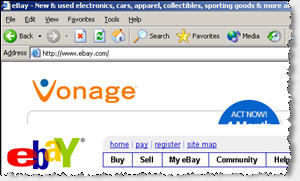
The left and center screenshots below show similar ad injections by Searchingbooth. True.com and eBay do not sell ads that appear above their respective sites. Instead, the Vonage ads at issue were injected there by Searchingbooth, yielding the on-screen appearances shown below.

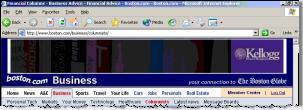
The DollarRevenue example, right screenshot below, shows a special kind of banner injection. Whereas the first three examples inject ads above a site (albeit within the site’s own window), DollarRevenue injects its ads into a site — covering a banner placed by the site (which would yield payment to the site) with a banner for DollarRevenue (which produces payments to DollarRevenue). This business model is not altogether novel; Claria (then Gator) pioneered this approach with its 2001 covering of other sites’ banners. But whereas Claria quickly abandoned this practice, in the face of IAB and other criticism, DollarRevenue continues unabated. For a particularly vivid view of DollarRevenue’s ad replacement, see the video of this ad injection. Notice the original Boston.com ad appearing for a fifth of a second at 0:00:3.65, only to be covered nearly instantly by the DollarRevenue-injected Vonage ad.

Vonage pays the respective spyware vendors through the relationships set out in the diagrams below and at right. Click an ad thumbnail for a full-size image, along with a packet log of associated network transmissions.

A Vonage Ad Injected by Searchingbooth
Searchingbooth Injecting a Vonage Ad into True.com

Vonage
money viewers
Traffic Marketplace
money viewers
Adecn
money viewers
Rpowermedia
money viewers
Searchingbooth

How Vonage Pays Searchingbooth

A Vonage Ad Injected by SearchingBooth
SearchingBooth Injecting a Vonage Ad into eBay

Vonage
money viewers
Traffic Marketplace
money viewers
Rpowermedia
money viewers
Searchingbooth

How Vonage Pays Searchingbooth

DollarRevenue Replacing a Boston.com Ad with a Vonage Ad
Initial Boston.com Ad – Visible for Only 0.2 Seconds – video

DollarRevenue Replacing a Boston.com Ad with a Vonage Ad
Replacement Vonage Ad Injected by DollarRevenue

Vonage
money viewers
24/7 RealMedia
money viewers
Yield Manager
money viewers
Oridian (Cydoor)
money viewers
DollarRevenue

How Vonage Pays DollarRevenue

The ads at issue were injected by DollarRevenue (apparently located in the Netherlands), Fullcontext (purportedly of Anguilla), Searchingbooth (from Deskwizz, giving an address in Quebec, Canada).

Vonage Lead Acquisitions via Spyware Pop-Ups

Vendare Group Using Direct Revenue to Promote Vonage Vendare Group Using Direct Revenue to Promote Vonage

Vonage
money viewers
Vendare Group / eMarketMakers
money viewers
LeadClick Media / eAdvertising
money viewers
Rextopia
money viewers
RevenueLoop
money viewers
Direct Revenue

The Money Trail – How Vonage Pays Direct Revenue

NextClick Media Using Direct Revenue to Promote Vonage NextClick Media Using Direct Revenue to Promote Vonage

As recently as March 2006, I was still observing Vonage ads shown by notorious spyware vendor Direct Revenue. (Screenshot.) But Vonage partners continue to advertise with Direct Revenue — even using Vonage-supplied site designs to do so. So Vonage’s money still reaches Direct Revenue and still helps to fund Direct Revenue.

Consider the top screenshot at right. As I browsed other telecom sites, I got a pop-up promoting Vonage. The pop-up is nearly full-screen — covering all but the title bars of the pages I had requested. The pop-up ad lacks a visible URL, but packet log analysis indicates that it was loaded from www.myphonebillsavings.com. Notably, the bottom of www.myphonebillsavings.com reads “©2001-2006, Vonage Marketing, Inc.” — reflecting that this Vonage-branded page was, by all indications, designed by Vonage itself.

To see who placed this pop-up with Direct Revenue, I again turn to packet log analysis. I observe that loading the ad entailed loading the following URLs. Click the list for the full packet log.

http://xadsj.offeroptimizer.com/imp/servlet/ImpServe?urlContext=http%3A%2F%2F…
http://login.revenueloop.com/sw/3211/CD1087/
http://rextopia.com/sw/5551/CD436/1087%3A%3A3211%3A%3A%3A%3A%3A%3A18a259ac88a…
http://www.eajmp.com/sw/7601/CD154/
http://clicks.emarketmakers.com/redir.aspx?id=671651&AFFID=CD154
http://clicks.emarketmakers.com/redir.aspx?from_pu=true&id=671651
http://clk.atdmt.com/VON/go/thvndvon0550000019von/direct/01?bannerid=671651&f…
http://www.myphonebillsavings.com/?bannerid=671651&AFFID=CD154

This analysis indicates that traffic and money flowed as listed at right. RevenueLoop (a California-based ad network), or a RevenueLoop business partner, bought traffic from Direct Revenue (controlling server offeroptimizer.com). Then RevenueLoop sent traffic to Rextopia (a New Jersey affiliate network), which redirected to Eajmp.com (LeadClick Media’s eAdvertising, of California), which redirected to eMarketMakers, which redirected to aQuantive’s Atlas and finally on to Myphonebillsavings.

The last few links of this chain reflect substantial involvement of Vendare Group. Vendare owns eMarketMakers, and Whois data indicates that Myphonebillsavings is also registered to Vendare Group. But despite receiving venture funding from Insight Venture Partners, Vendare’s ties to spyware are well-known. For example, I have widely observed — and carefully documented — Vendare’s New.net installed through security exploits without users’ consent . Furthermore, Vendare’s eMarketMakers directly funds a variety of spyware. For example, in January 2006 I documented eMarketMakers promoting NetZero using traffic purchased directly from 180solutions, and in March 2005 I documented eMarketMakers promoting Earthlink and Petchews via traffic purchased directly from eXact Advertising. Despite the direct and well-documented relationships between Vendare and spyware, Vonage nonetheless purchases advertising from Vendare and its eMarketMakers group.

Vendare’s Myphonebillsavings is just one of many Vonage partners still paying to receive traffic from Direct Revenue. Last month I also observed Phonebillsolution pop-ups appearing through Direct Revenue. Like Myphonebillsavings.com, Phonebillsolution.com’s copyright line reflects creation by Vonage. Phonebillsolutions hides its Whois data, but directly requesting the IP address of the Phonebillsolution web server yields a default page titled “NextClick Media” (a California-based ad network). The final thumbnail at right shows NextClick promoting Vonage using Direct Revenue.

Spyware-Delivered Banner Farms Promoting Vonage

A Vonage Ad Shown by Targetsaver Look2me and Hula’s Global-Store Promoting Vonage

Vonage
money viewers
ad networks (one or more)
money viewers
banner farm
money viewers
placement intermediaries (zero or more)
money viewers
spyware vendors

How Vonage Funds Spyware via Banner Farms

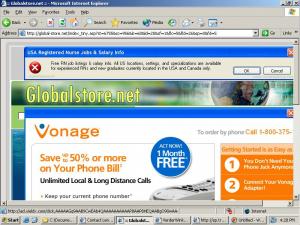
Last month I explained the problem of spyware-delivered banner farms: Web sites that buy spyware traffic (directly or indirectly), then show substantially only ads, thereby serving as ad placement intermediaries. I posted three distinct examples of Vonage appearing in spyware-delivered banner farms: Hula’s Global-Store promoting Vonage in a large window at screen center, a further Global-Store promotion of Vonage in a smaller window partially covered by another ad, and in ExitExchange.

But there are plenty of other banner farms, and in my testing most banner farms promote Vonage. For example, my June banner farm article mentions Whatsnewreport, which I have also observed promoting Vonage.

The diagram at right reflects the canonical relationships between Vonage, ad networks, banner farms, and spyware

Vonage’s Spyware Advertising in Context

Vonage isn’t the only advertiser with widespread spyware ad-buys. Other buyers of untargeted or semi-targeted ads get plenty of spyware-delivered advertising too. For example, I see Verizon ads in spyware pop-ups with remarkable frequency. In a future article, I’ll present screenshots of some other big spyware advertisers.

As best I can tell, Vonage does not specifically intend to have its ads shown in spyware. Instead, the advertising chains shown above reveal that these are generally indirect relationships, not direct spyware ad buys. (In comparison, see my September 2005 report of Expedia directly and intentionally buying spyware-delivered advertising from numerous notorious spyware vendors — a practice that, to its credit, Expedia subsequently stopped.) Yet by failing to take appropriate precautions and failing to diligently supervising its ads, Vonage makes payments to spyware vendors — funding spyware that is known to harm users’ PCs.

Vonage may seek to write off these examples as insignificant within its nine-digit advertising budget. But these spyware placements have important negative externalities: When Vonage pays spyware vendors, even indirectly, Vonage helps make spyware more profitable, and helps make the spyware problem worse. Even if Vonage is content to waste some money on buying unwanted spyware ads, it still needs to take action to avoid funding software that damages users’ PCs.

When asked about Vonage’s spyware funding, Vonage CEO Jeffrey Citron last year told the Associated Press “We do everything we can to make sure our partners adhere to our standards.” I disagree. There’s plenty more Vonage could do. For example, Vonage could refuse to work with partners like Vendare, that have known ties to spyware vendors and that even make and distribute their own spyware. Vonage could refuse to work with Traffic Marketplace and Yield Manager — partners that can’t provide reasonable assurances of keeping ads out of spyware. Vonage could specifically review all its advertising partners, and Vonage could prevent those partners from subcontracting with further unverified subpartners of their own. Vonage may consider these changes burdensome or inconvenient. But based on current practices, Vonage can’t credibly claim to be doing “everything” to stop spyware advertising. To the contrary, as the many examples above indicate, far more work is still required.

Last month Vonage won an “Effie” award for the “effectiveness” of its advertising campaign. I can’t speak to Effie’s criteria in granting this award. But advertisers might appropriately hesitate to praise an advertising strategy that, whether intentionally or recklessly, includes buying ads in spyware.

Beyond Vonage, criticism might reasonably focus on the advertising intermediaries that broker Vonage’s spyware placements. For example, Vonage receives and tracks all these spyware placements through aQuantive’s Atlas advertising. Atlas’s Acceptable Use Policy proclaims that “Atlas technology may not be used in connection with any downloadable application that is downloaded without notice and consent.” But I see no indication that Atlas actually enforces this policy: All the programs discussed above are programs I have observed installed without consent, yet these placements repeatedly flow through Atlas, as shown in each posted packet log. Other ad intermediaries lack even Atlas’s anti-spyware statement: Searching 24/7 Real Media’s site for “spyware” yields no hits, and 24/7’s lengthy and prominent code of conduct does not prohibit use of spyware.As advertising service providers, advertising specialists, publicly-traded companies, and purported ethical leaders, aQuantive, 24/7, and others could do far more to keep spyware out of their networks.

Spyware Showing Unrequested Sexually-Explicit Images

Are pop-up ads anything more than an annoyance? For advertisers they can certainly be a bad deal — particularly when spyware-delivered pop-ups cheat advertisers through PPC click fraud, PPC syndication fraud, affiliate fraud, banner farms, or other improper ways of getting paid. For users, pop-ups in overwhelming quantities may cause substantial harm — especially because pop-up-delivering spyware reduces computer speed and reliability, and because spyware transmits sensitive user information to remote servers.

But spyware-delivered pop-ups can do more than annoy. They can also offend. Consider spyware that shows sexually-explicit (most would say, pornographic) pop-ups. When such ads appear unrequested, they’re likely to be shown to users who don’t want to see sexually-explicit material. It’s a troubling practice — but all too common even among “adware” vendors that claim to have reformed. Meanwhile, some old tricks remain — like pop-ups with their “X” buttons off-screen, making the ads particularly hard to close.

ZenoTecnico and AlmondNet Showing AdultFriendFinder

The ZenoTecnico ad, edited to cover sexually-explicit areas. The ZenoTecnico ad, edited to cover sexually-explicit areas.

AdultFriendFinder
money viewers
AlmondNet / ProMarket
money viewers
ZenoTecnico

The money trail for this ad.

Let’s start with a simple example. On a test PC, I browsed the Findromance.com site. That’s definitely a dating site — but it’s not sexually explicit. Many users browse online dating service without wanting to see online porn.

In testing in May 2006, ZenoTecnico served me the pop-up shown at right (modified to cover the bare breasts exposed in the original). ZenoTecnico is notorious spyware which I have seen installed through a variety of misleading bundles and security exploits. Zeno’s web site claims an address in Panama, but I believe this address is a sham. I’m working on identifying their true location.

Packet log analysis shows that traffic flowed in the way shown in the diagram at right: From ZenoTecnico to ProMarket (part of New York-based AlmondNet) to AdultFriendFinder. See also the associated packet log.

Set against the more complex examples that follow, this Zeno-ProMarket-AdultFriendFinder is particularly notable: These three parties alone decided to show this ad, in this way, under these circumstances and with this targeting (or lack thereof), without influence by any other spyware installed on my test PC, and with a reasonably direct relationship between advertiser and spyware vendor, as shown at right. They may blame each other. But as best I can tell, they have no one but each other to blame.

Direct Revenue Showing MorpheusOfPorn

The Direct Revenue ad, edited to cover sexually-explicit areas. The Direct Revenue ad, edited to cover explicit areas.
MorpheusOfPorn
money viewers
Direct Revenue

The money trail for this ad.

It’s well-known that most spyware-infected computers contain multiple spyware programs. When multiple spyware programs interact, they are particularly likely to show sexually-explicit images without a user requesting any such materials.

The screenshot at right presents a pop-up shown to me on a massively infected test PC. The pop-up bears Direct Revenue’s branding (“The Best Offers”), and packet log analysis confirms that the ad came through the Direct Revenue pop-up system.

What caused Direct Revenue to show this ad? Mere seconds earlier, unidentified spyware on my test PC had sent traffic to ad network YieldManager, which had in turn redirected me to AdultFriendFinder. Direct Revenue saw that traffic to AdultFriendFinder and took that as a trigger to display the explicit pop-up shown at right. See the associated packet log (showing the preceding YieldManager traffic), as well as a video of the sequence (edited to cover sexually-explicit areas).

Observing my computer’s traffic to AdultFriendFinder.com, Direct Revenue’s advertising software assumed I was seeking sexually-explicit material. But where the AdultFriendFinder site itself appears unrequested, as in my example, Direct Revenue’s assumption is badly in error. To the contrary, sexually-explicit content is unlikely to be desired or appropriate when other spyware has decided to show a user AdultFriendFinder.

Even AdultFriendFinder recognized that it might not be appropriate to show a sexually-explicit image to users reaching its site in the manner captured in my testing. See a screenshot (from video at 2:46) of the landing page AdultFriendFinder showed me. As delivered to my test PC (via the undetermined spyware), AdultFriendFinder’s site included no visible sexually-explicit images. Instead, the page was a mere doorway — with a disclosure (“Warning! You are about to view…”) along with separate links for users above 18 (to enter) and below age 18 (to go elsewhere).

It is particularly notable for Direct Revenue to show unrequested sexually-explicit materials because Direct Revenue has specifically promised not to do so. In the proposed settlement of a consumer class action lawsuit against Direct Revenue, provision (m) specifically requires that Direct Revenue’s software “will not display adult content ads unless the user is viewing adult websites.” In this example, I did not request any adult web site. Neither did I actually view any adult material (prior to the material shown by Direct Revenue): The AdultFriendFinder page at issue cannot be categorized as “adult,” because it includes no sexually-explicit images. In short, on these facts, I see a strong argument that Direct Revenue violated its duties under its settlement agreement.

Deskwizz/SearchingBooth, Z-Quest, YieldManager and Zedo Showing Vitalix

The SearchingBooth ad, edited to cover sexually-explicit areas. The SearchingBooth ad, edited to cover explicit areas.

Vitalix
money viewers
Zedo
money viewers
YieldManager
money viewers
Z-Quest
money viewers
Deskwizz / SearchingBooth

The money trail for this ad.

Deskwizz/SearchingBooth shows a variety of intrusive advertisements, largely untargeted. Many of its ads are injected into others’ sites (without those sites’ consent), as in this screenshot showing a Vonage ad injected into the Vistaprint site. The SearchingBooth.com web site gives an address in Quebec. I have repeatedly observed Deskwizz/SearchingBooth installed through exploits and in large bundles (e.g. the Dollarrevenue bundle) without meaningful user consent.

The screenshot at right shows an ad served to me on a PC with SearchingBooth installed. The ad shows a total of four nude individuals, and I have edited the ad to cover sexually-explicit areas.

Packet log analysis indicates that traffic flowed in the following way: First, SearchingBooth spyware sent traffic to its SearchingBooth.com controlling server, seeking an ad to be displayed. SearchingBooth.com replied with a URL to a Z-quest.com (a Canadian company whose site describes meta-search services as well as a toolbar). Z-quest sent me on to YieldManager. YieldManager in turn sent me to Zedo (a San Francisco ad server that features Internet luminary Esther Dyson on its advisory board). Finally, Zedo opened a new window of Vitalix, which showed the sexually-explicit content at issue. These relationships are set out in the diagram at right, in the URL list below, and in the full packet log.

http://banners.searchingbooth.com/advertpro/servlet/view/dynamic/html…
http://ads.z-quest.com/MarkSect720x300.html
http://ad.yieldmanager.com/imp?z=0&s=16185&r=1&y=23&w=720&h=300
http://c5.zedo.com/jsc/c5/ff2.html?n=377;c=40;s=17;d=15;w=1;h=1
http://c4.zedo.com/ads2/d/3869/172/377/40/i4.js?z=5414
http://l5.zedo.com//log/p.html?a=146636;x=3869;g=172,0;c=377000040,37…
http://ads.vitalix.net/ads/3day/wb03/index.html?prov=seedcorn&subprov…

The longer chain of relationships in this example makes it more difficult to determine who is responsible for the unrequested display of sexually-explicit content. One might reasonably blame Deskwizz/SearchingBooth, whose nonconsensually-installed spyware was the root cause of any ad being shown at all. But also responsible is Zedo, which had the last clear chance to prevent the display of this ad, and which showed these sexually-explicit images without obtaining a correct and reliable verification that such a display was appropriate. Meanwhile, ad placement system YieldManager was squarely in the middle of the chain, and YM’s detailed Media Guard blog suggests they’ve thought at length about the special problems of sexually-explicit ads. Yet they too failed to prevent this sexually-explicit ad from appearing unrequested.

Typical users are likely to find this sexually-explicit ad particularly intrusive and particularly hard to remove because the ad’s “X” button appears off-screen. Notice the absence of a title bar, “X” button, or minimize button in the screenshot at right. Sophisticated users may know they can press Alt-F4 to close the ad. But novices don’t. Reviewing the packet log, it appears that Zedo is responsible for this partially-off-screen window placement: The ad is placed in the specified location by JavaScript code served from the Zedo server, which instructs as follows:

zzWindow.moveTo(Math.ceil((screen.availWidth – 380) / 2), Math.ceil((screen.availHeight – 680) / 2));

This code moves the ad window to a vertical location given by the screen’s available height (in pixels) minus 680 (the intended height of the ad at issue), divided by two. If the user’s screen is more than 680 pixels tall, this code has the effect of centering the window vertically on the user’s screen. But if the user’s screen is less than 680 pixels tall, e.g. a 800×600 pixel screen common on many older laptops and some older desktops, then this code predictably and inevitably has the effect of placing the “X” button off-screen. Zedo and its advertiser should have checked the user’s actual screen-height (e.g. via the code “if screen.availHeight>680”), to make sure they were not positioning the pop-up with its “X” off-screen.

Look2me/Ad-w-a-r-e, FirstAdSolution, YieldManager, Falk AG/DoubleClick, eXact Advertising, MyGeek Showing Naughtyplay

The SearchingBooth ad, edited to cover sexually-explicit areas. The SearchingBooth ad, edited to cover explicit areas.

Naughtyplay
money viewers
MyGeek
money viewers
Instant Navigation / eXact Advertising
money viewers
Falk AG / DoubleClick
money viewers
YieldManager
money viewers
FirstAdSolution / Oridian
money viewers
Look2me / Ad-w-a-r-e / Intern-etadvertising

The money trail for this ad.

From Minnesota-based NicTech Networks, Look2me/Ad-w-a-r-e spyware is widely installed through security exploits and misleading bundles. Its revenue sources are equally broad. I’ve seen Look2me/Ad-w-a-r-e getting paid by performing click fraud against Yahoo advertisers, and by seizing unearned commission through merchants’ affiliate programs. But Look2me/Ad-w-a-r-e also shows ordinary banner ads and pop-up ads, including untargeted run-of-network ads through sites such as its buyer-shabit.com banner loading page (among many others).

The screenshot at right shows an ad served to me on a PC with Look2me/Ad-w-a-r-e installed. The ad is exceptionally explicit: Its large images show four women completely nude and one partially disrobed, in addition to two protruding male members from men not otherwise pictured. Smaller images show at least sixteen women and ten male members (although not a single male face). In total, the ad pictures at least thirty-three individuals in an overwhelming array of sexual positions. The ad arrived on my screen as a full-screen pop-up, but with its upper-right “X” button entirely off-screen, just as shown in the screenshot and thumbnail.

Packet log analysis indicates that traffic flowed in the following way: First, Look2me sought an ad from its controlling server, Ad-w-a-r-e.com. Ad-w-a-r-e specified an ad at intern-etadvertising.com, a standard Look2me loading page which shows untargeted (run-of-network) ads. Intern-etadvertising specified that the ad was to come from Firstadsolution.com (Oridian Online Media Solutions of Israel), which in turn sent me to YieldManager, which specified that the ad was actually at Falkag.net. Falk AG (recently acquired by DoubleClick) in turn sent me on to Instantnavigation.com (whose Contact Us page indicates that it is part of Brainfox.com, recently acquired by eXact Advertising). Instantnavigation sent me to the 207.97.227.29 server (eXact Advertising), which redirected me to MyGeek, which finally passed me to Naughtyplay, the explicit web site shown in the pop-up.

These relationships are set out in the diagram at right, in the URL list below, and in the full packet log.

http://www.ad-w-a-r-e.com/cgi-bin/UMonitorV2
http://www.intern-etadvertising.com/muon.html
http://ad.firstadsolution.com/imp?z=0&s=3926&u=http%3A%2F%2Fwww.inter…
http://ad.yieldmanager.com/imp?z=0&s=3926&u=http%3A%2F%2Fwww.intern-e…
http://a.as-us.falkag.net/dat/cjf/00/14/73/07.js
http://a.as-us.falkag.net/dat/dlv/aslframe.html?dat=147307&kid=130138…
http://www.instantnavigation.com/search.php?cat=dvd&partner=ap_tk
http://207.97.227.29/clk/?313b313134373035373939352e34327e61705f746b3…
http://xmlsearch.mygeek.com/presults.jsp?partnerid=110126&vendorI…
http://www.naughtyplay.com/pornstars/heatherhunter/index.html

By all indications, the 207.97.227.29 server performed click fraud against MyGeek. The structure and obfuscation of the HTML on that server indicate a special desire to avoid being caught, as does eXact’s unilateral insertion of purported search keywords (“heather hunter”) not specified earlier in the traffic. I have observed nearby server addresses with the same URL syntax serving in a click fraud chain against Yahoo Overture. Furthermore, I understand that the xmlsearch.mygeek.com server runs a pay-per-click advertising system, distinct from MyGeek’s separate “cost per view” system for which advertisers may be charged without a click occurring. Traffic to and through that server, without a bona fide user click, seems to constitute click fraud.

This chain of relationships is notable for its extreme length — five intermediaries between spyware vendor and advertiser. These many relationships provide numerous opportunities for ad context to be lost — for ad networks to fail to tell each other that a sexually-explicit ad is not appropriate here.

Policy Recommendations; The Problem In Context

The four examples shown above are just a tiny portion of the problem of sexually-explicit images shown to users who didn’t request such materials. I have numerous additional examples on file. In one example on file, spyware on my test PC identifies the name of a fashion designer on a well-known retailer’s site, then uses that word as a trigger for an ad, ultimately showing an ad that is sexually-explicit. In another example, spyware on my test PC observes me browsing the children’s section of an online shoe store, a page mentioning “girls” in its title. The spyware then serves me a full-screen sexually-explicit pop-up. Notably, the pop-up was obtained via click fraud against a major pay-per-click search engine.

In my view, unrequested displays of sexually-explicit content largely arise out of the unaccountability pervasive in the spyware space. In each of the examples above, I anticipate that the parties involved will blame each other. Ad networks may claim that other ad networks told them (through tags, attributes, or contracts) that traffic was suitable for sexually-explicit ad display. Spyware vendors will blame other spyware for having suggested that users wanted such content. In all likelihood, no party will take responsibility for the bad outcomes that resulted.

In other contexts, online service providers face serious penalties for showing unrequested sexually-explicit images. Section 521 of the PROTECT Act creates criminal liability (up to two years imprisonment) for “us[ing] a misleading domain name … with the intent to deceive a person into viewing material constituting obscenity”, and additional liability for deceiving minors into viewing material that is harmful to minors. This law responded to the problem of typosquatters and other bulk domain registrants showing adult materials — such that users would stumble onto sexually-explicit images unrequested. But no such law protects users from unrequested pornography shown by spyware.

Even without legislative intervention, well-intentioned ad networks have tools at their disposal to prevent the unrequested display of sexually-explicit materials. One natural approach is to make all ads and landing pages non-explicit. Then a mistaken ad display does not show sexually-explicit materials (although it might still link to such materials). Ad networks could also redouble their supervision of their partners — checking the specific circumstances in which explicit ads may be shown, and confirming that these circumstances leave no doubt that a user actually wanted to receive explicit content. Tough ad networks could create financial incentives that penalize their partners for any errors uncovered — warnings, fines, and contract termination. Finally, ad networks could improve their public statements of applicable policies and procedures, making it easier for consumers to report unwanted images — including helping consumers learn where and how to submit such reports. Ad networks that find these steps too difficult or too costly could simply leave the business of serving or placing sexually-explicit advertisements.

Semi-explicit sites raise particular problems for spyware targeting. In my Direct Revenue example (above) and in various other examples I have on file, AdultFriendFinder buys spyware-delivered traffic and shows ads that, while suggestive, are not sexually-explicit. But then other spyware observes this AdultFriendFinder traffic, using this traffic as a catalyst to show ads that are explicit. Spyware vendors need to recognize that while some AdultFriendFinder ads are explicit (e.g. my first example above), others are not. With AdultFriendFinder’s mix of ads, and with typical spyware-infected PCs running multiple spyware programs, a visit to AdultFriendFinder cannot be interpreted as a proper trigger to show sexually-explicit images. Same for any other sites that buy run-of-network (or other spyware-delivered) advertising, or that otherwise straddle the border between explicit and non-explicit materials.

Yesterday the Direct Marketing Association released best practices for online advertising networks and affiliate marketing.The DMA calls for obtaining assurances of compliance with applicable law, performing due diligence on prospective partners, and monitoring compliance. It’s easy to criticize these approaches as obvious or overdue. But if the ad networks above were using the DMA’s recommended methods, these problems would be substantially less widespread. Meanwhile, I continue to think the DMA’s final recommendation — “develop a system to routinely monitor your ad placements” — remains essential yet under-appreciated. Tough enforcement and real penalties could stop thesepractices: Spyware purveyorswouldn’t run these (or any other) ads if they weren’t getting paid for it.

Direct Revenue’s Dirty Documents

On Tuesday, the New York Attorney General filed suit against notorious spyware vendor Direct Revenue. In a detailed complaint, the NYAG alleged Direct Revenue surreptitiously installed spyware onto users’ computers and made its spyware exceptionally difficult to remove. The suit includes claims under New York’s General Business Law (prohibiting false advertising and deceptive business practices), New York’s Penal Law (prohibiting computer tampering), and New York’s common law prohibitions against trespass.

The NYAG’s complaint was accompanied by more than a thousand pages of exhibits and appendices. Some of these documents present the results of NYAG’s testing — narratives of misleading and nonconsensual installation, not unlike my own installation tests. But the NYAG also produced a treasure trove of documents: Internal Direct Revenue documents, records, and emails that present their strategy, intentions, and plans in great detail.

I have obtained these additional documents and posted them to a new page:

People of the State of New York v. Direct Revenue, LLC – Documents and Analysis

Some documents and findings of particular interest:

  • Revenues reported at $6.9 million in 2003, $39 million in 2004, $33 million in January-October 2005. 2004 expenses total only $13 million, for a profit margin of 66%.
  • Payments to Direct Revenue’s senior staff, totaling more than $27 million.
  • A list of distributors of Direct Revenue’s spyware, with the number of installations attributable to each.
  • Admission that Direct Revenue for a time sold a “majority” of its advertising through ad networks Traffic Marketplace and ValueClick.
  • Admission that Direct Revenue’s ads appear so frequently that they constitute “user abuse.” But reducing ad frequency lowers company revenues, so frequency stays high.
  • Admission that Direct Revenue previously tracked and transmited users’ GET and POST data — names, addresses, emails — and even sent this data to third parties Hitwise and Compete.com. Itemizes the specific personal information collected from online forms: first name, last name, e-mail address, street address, and zip code. Hitwise reports successfully analyzing and matching users’ IDs, genders, and phone numbers.
  • Instructs making Direct Revenue harder to remove, by deleting its entry from Control Panel’s Add/Remove Programs, because too many users were relying on that method to remove Direct Revenue.
  • Report of April-June 2005 payments from Yahoo, totaling more than $600,000 in those three months alone.
  • Installation by Direct Revenue of Ebates’ Moe Money Maker onto users’ computers.
  • Listing of Direct Revenue’s many names and shell companies, all used to confuse and deceive the public.
  • Complaints from Direct Revenue partners, such as Kazaa (which called Direct Revenue’s ads “purposefully confusing to the user”) and Integrated Search (which wanted Direct Revenue to include an uninstaller in Control Panel, as previously promised)
  • Threatening the Center for Democracy and Technology. Demanding revisions from CNET. Hiring an investigator to track anti-spyware researcher Webhelper, and planning tactics to intimidate him.
  • Claims I am “losing credibility in the industry” and calls me a “fanatic.”
  • Endorses NYAG’s suit against Intermix as an “important opportunity to draw a bright line between purveyors of spyware and legitimate behavioral marketing companies like Direct Revenue.”
  • Scores of complaints from users (1, 2, 3 , 4, 5, 6, 7, 8, 9) Direct Revenue staff call one complaining user an “idiot.”
  • Complaints from Direct Revenue’s investors get special handling. One investor worries that another member of his investment firm, former Secretary of the Treasury Bob Rubin, may learn of Direct Revenue’s practices.
  • Reports daily revenue per user at approximately $0.015 (one and one half cents per user per day). (Compare that revenue with the harm caused to users — the amount a typical user would be willing to pay not to have Direct Revenue installed.)

See also others’ analysis of the documents.

I still have a few more documents to post, and I’ll be uploading them later today.